e has told the story hundreds of times, but it never seems to fade. If anything, it only becomes more vivid. "Oh, gosh," exclaims Stanley Praimnath, his voice cracking with an "ooooooh!" as if bearing a weight. "It's like reliving that day."
Nearly 3,000 people died in the terrorist attacks on New York City and Washington DC on September 11 2001. But Praimnath and another office worker, Brian Clark, were two of only four individuals known to have survived from above the impact zone in either tower of the World Trade Center. The two strangers met in the smoke and fire of the 81st floor of the south tower, and walked down 1,620 steps into the rest of their lives.
Their split-second decisions that day made all the difference. Over the next 25 years, both men moved from middle age into old age and retirement. Both enjoyed family weddings and watched children and grandchildren grow. Both saw US presidents come and go as old wars ended and new wars began. They remained friends through it all.
They also told their story – countless times – in churches, schools, TV studios and elsewhere. "It could be 800, 1,200, a number like that," Clark estimates.
Praimnath, in a separate interview, muses: "People refer to me as 'the 9/11 guy'. It doesn't feel repetitive. It is like unloading baggage from my shoulder, like washing my soul with tears. It is comforting to know that people out there still want to hear."
A cry for help
Clark is now 79, living in retirement in northern New Jersey with his wife; he has 11 grandchildren and two great-grandchildren. Praimnath, a decade younger, lives in Valley Stream, Long Island; he is a pastor, grandfather and empty-nester who speaks of his survival not as luck, but as an act of God's grace.
Their recollections of 9/11 are still as clear as the cloudless sky over Manhattan on that September morning. Clark, a Canadian who was executive vice-president at the financial brokerage firm Euro Brokers, arrived at his office on the 84th floor around 7.15am. Down on the 81st floor, the Guyanese-born Praimnath had settled into his desk at Fuji Bank, where he worked as a loan officer.
At 8.46am, the peace was shattered by a deafening double boom as the hijacked American Airlines Flight 11 slammed into the north tower. Clark recalls: "The lights above me flickered and I spun around in my chair and my peripheral vision caught flames against the window. It was surreal. Two or three seconds later, the flames dissipated and the airspace was filled with singed paper."
Having volunteered as a floor fire warden after the 1993 World Trade Center truck bombing, Clark sprang into action. He retrieved an official torch marked "WTC fire safety team" from an overhead cabinet and began shepherding staff toward the building's central corridor.
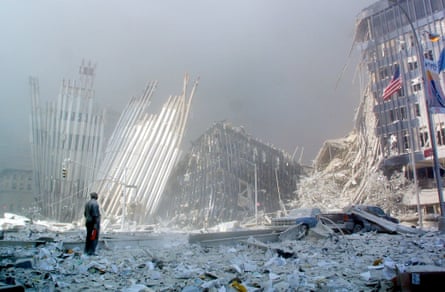
Co-workers crowded against the north-facing windows, gazing up nine stories at the raging "ring of fire" consuming their twin building. Thinking the emergency was confined next door, Clark phoned his wife at home and his father in Toronto, reassuring them that he was safe.
Three floors below, Praimnath was on the telephone with a colleague in Chicago who had witnessed the north tower explosion on television and begged him to evacuate. He was looking towards the Statue of Liberty when he spotted another plane – so close that he could make out the "U" on the tail of United Airlines Flight 175.
"On a given day, it was normal for a plane to zoom by a half a mile to a mile away," he recalls. "But this plane is coming towards me. I made eye contact. I dropped the phone and screamed and said, 'Lord, I can't do this. You take over'. I don't know why I said that – but thank God I said that."
Praimnath dived under his desk in the foetal position, weeping and praying as the Boeing 767 bore down on his window. "With the most thunderous sound, the plane came and crashed into the building," he says.
The aircraft struck diagonally at 9.03am, cutting through the 77th to 85th floors. The impact flattened entire walls, severed electrical wiring and sent a shock wave of jet fuel and debris through Fuji Bank's offices.
Praimnath says: "That big orange glow that you see there – I'm stuck in the middle of it. Upon impact, it looks like a demolition crew came with a big giant wrecking ball and ripped the entire office. Every wall is flattened. I remember a large chunk of the plane was broken off and stuck in the office doorway.
"I remember flames all around me, as if somebody took a giant bag of cement, threw it in the air and I can't breathe. The floor above me collapsed and it's hovering over the desk and I'm like, 'Oh, my God, I'm going to die. It's gonna totally collapse, crush me to death, or I'm gonna get sucked out by the air pressure.' You can hear the sound."
At the memory, he sets his teeth and blows down the phone to recreate the terrifying whoosh.
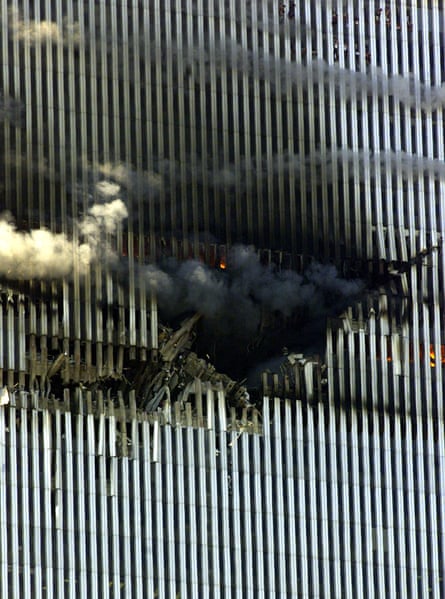
Three floors higher, Clark was standing on the west side of the 84th floor when the aircraft sliced into the building's eastern trading floor. "Our room exploded," he says. "Everything came out of the ceiling – air conditioning ducts, lighting, the whole works. For five seconds the building swayed to the west and then it swayed back to vertical. For those 10 seconds I was quite terrified, thinking the building was going to roll over. But it didn't."
When the tower steadied, Clark gathered a group of six or seven colleagues and led them toward the central core. The impact had demolished stairwells B and C, but stairwell A, tucked furthest away on the north-west side, somehow remained open.
The group began descending stairwell A. On the 81st floor landing, they were halted by a man and woman coming up the stairs. "She was insistent we not go down," Clark says. "'No, no, no. You can't go down,' she said and, because she stopped us, it allowed me to hear a call for help from within the 81st floor, a muffled cry: 'Help, I'm buried. I can't breathe.'"
Brothers for life
Clark squeezed through an opening where the door frame had been ripped from the drywall and stepped into the dark 81st floor, guided by Praimnath's desperate shouts.
Inside the office, Praimnath prayed for rescue. "I can still remember the flames encroaching and I'm screaming, 'Lord, send somebody, I don't want to die.' I'm crawling away from the flames, dodging all the cables that were hanging in the ceiling, short-circuiting because the sprinkler system came on," he recalls.
"I'm like, 'Oh my God, I'm gonna die.' Somebody had a flashlight on the other end of the floor. The person's saying, 'I'll wait for you', but I couldn't hear because I got temporarily deaf when the plane hit the building. As I'm crawling away, the flames are coming closer, licking up the office space.
"I got to the wall. The person's saying, 'Bang on the wall, I know where you are'. I hit the wall and the person says, 'Climb over there.' It had a hollow ceiling, a 10-foot sheetrock wall, a drywall. I remember that so vividly."
Clark's torchlight had picked out a hand protruding from a hole in the 10-foot sheetrock wall. He grasped Praimnath's hands and hauled him over the partition. The desk beneath Clark gave way, and both men crashed to the floor in a heap.
Clark recalls: "We fell and he gave me a big kiss. I said, 'What's going on, what are you doing?' I stuck out my hand and said, 'I'm Brian Clark.' He says, 'I'm Stanley Praimnath; we'll be brothers for life.' I said, 'Well, I don't have any siblings.'"
Clark noticed that Praimnath had a puncture wound on his palm, while his own hand was cut and bleeding from moving debris. Clark recalls his instinctive gesture of solidarity: "I smooshed our hands together and said, 'In fact, we'll be blood brothers for life. Come on, buddy. Let's go home.'"
When they returned to the stairwell, Clark made the critical decision to ignore the warning of the woman on the landing. Pointing his torch down the staircase, he saw no flames. Clark and Praimnath turned downward. Most of the colleagues who had been with Clark, however, chose to head upward, believing safety lay on the roof. They died in the collapse. At Euro Brokers, 61 of Clark's colleagues perished.
Lives intertwined
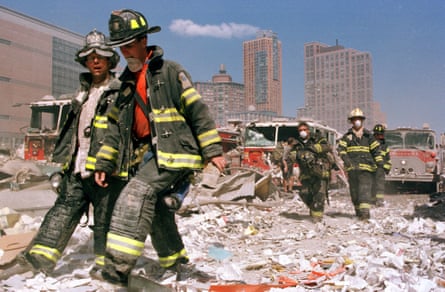
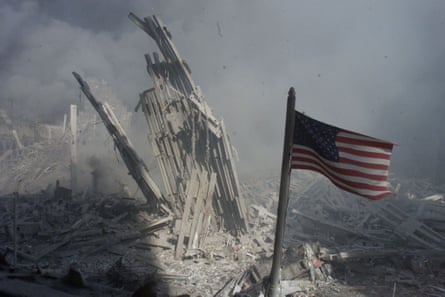
When Clark and Praimnath finally emerged on to the street, police and emergency workers yelled at them to run. Minutes later, the south tower collapsed in a cascade of steel and concrete, sending a rolling cloud of debris surging through lower Manhattan. The two men dived inside 42 Broadway to escape the choking dust.
In the chaos, Praimnath reached into his pocket and handed Clark a business card from a small home business he and his wife operated. Separated in the confusion, Clark used the number on that card to reach Praimnath late that evening, confirming that both had made it home.
While Clark suffered remarkably little long-term psychological distress – describing his lack of post-traumatic stress as an unearned "gift" – Praimnath's return to the living was fraught.
Arriving home on Long Island on the evening of 9/11, Praimnath says he suffered profound memory loss. "I wanted to know what this strange woman was doing in our house with two children, not going home. I refused to go to bed because this strange woman was in that room."
His wife, Jennifer, quietly cared for him without judgment. "She would hobble me into the bathroom, fill the tub with warm water and Epsom salts, and tell me to soak," he says. "Then she would put me on the couch. Every day, she would leave an apple, a sandwich, a bottle of water and a notepad. I don't know how long I was in that state. All I know is that one day, I got up, looked at her, recognised her and snapped out of it."
When Praimnath returned to work in October at a temporary office in Jersey City, he still could not navigate on his own. "I had to draw out my commute on a map and color-code it," he recalls. "When I got to work, people would say, 'Stan, can you please sign this?' I didn't have a clue what I was signing. But they were kind, patient managers. Gradually, the pieces came back."
In the quarter-century since that Tuesday morning, the lives of Clark and Praimnath have remained intertwined. They shared family milestones, celebrated at each other's daughters' weddings and phoned one another regularly.
When Clark's eldest daughter married, Praimnath and his wife were seated at the head table. Praimnath says: "Brian introduced me to all his friends and family as his blood brother. You could see people looking around, thinking, 'Something doesn't quite fit the picture!' But Brian didn't care. That's who he is. He is the big brother I never had."
For Praimnath, surviving 9/11 opened a deep spiritual vocation. In 2006, he became a pastor, joining the staff of the church where his father-in-law was senior minister. Over the past two decades, he has travelled to churches, military bases and schools worldwide, delivering his testimony as a sermon on redemption.
"On 9/11, I was crying out to the Lord under that desk, 'Lord, let me live to walk my daughters down the aisle,' and God answered. I walked Stephanie and Caitlin down the aisle. I've lived to see my grandchildren, Hannah and Ezra. They don't call me Papa – they call me 'Papaya'. Stephanie even bought me a shirt that says 'Papaya'."
Yet Praimnath's resilience has been tested repeatedly. In 1993, he narrowly escaped the first truck bombing at the World Trade Center. He was diagnosed with leukaemia and a severe bout of Covid-19 scarred his lungs with bilateral pneumonia. Then, after a trip to Europe with his wife, doctors discovered that his four coronary arteries were severely blocked, requiring emergency quadruple bypass surgery.
"My question has always been: how many times do you try to kill one man?" asks Praimnath, who retired from the Sumitomo Mitsui Banking Corporation two years ago. "I'm living by grace. I still travel. I still do exactly what I used to do before."
Blood brothers
He and Clark know they have more years behind them than lie ahead. On the 25th anniversary, Clark will attend a memorial service at his local town square in New Jersey, beginning at 8.45am, before spending the day quietly with his wife. Praimnath will be at a church in Virginia, telling his story once again, with gratitude.
Both men find themselves speaking to a generation for whom 9/11 is not a living memory, but history. Clark, who retired in 2006, says: "I don't have to teach history anymore – the textbooks have that covered. What textbooks don't have is the emotional reality, the optimism that life carries on despite terrible evil. But whenever I speak at schools, 98% of the time, the very first question the kids ask is: 'Are you still in touch with Stanley?'"
Praimnath experiences the exact same phenomenon. Just recently, he addressed 700 students over Zoom at a Christian school in Tampa, Florida. "These children weren't even alive when the towers fell," Praimnath says. "Yet when you describe the roar of the jet engine and the wing slicing through the office, you can hear the audible gasp in the auditorium. It becomes real to them."
The blood brothers look out at the contemporary US with a mixture of sorrow and perplexity. Clark has become an outspoken pacifist, dismayed by the decades of overseas conflict that followed the attacks.
He says: "With 25 years of time to think about it, I realise more and more the utter futility of war. I think of Germany, Italy, and Japan being our greatest allies today. What on earth are we doing to ourselves? Dropping bombs on residential areas in Ukraine, Russia, Gaza – what a senseless waste of energy and human life."
Clark's aversion to vengeance ran so deep that he was repulsed by the street celebrations following the killing of al-Qaida leader Osama bin Laden in 2011. "I was disgusted when people were driving around in pickup trucks chanting 'USA!' and cheering for another human being's death. Capture him, interrogate him, lock him away – fine. But taking lives and celebrating it? No. That is not who we should be."
Praimnath recalls the profound but fleeting sense of unity that blossomed after 9/11. "After that infamous day, the entire nation rallied around each other," he reflects. "All the churches were packed. A month later, everything went back to normal.
"But I still believe we are a resilient people. We may have our political differences but at the end of the day we know that, when tragedy strikes, the labels fall away. On the 81st floor, there were no Republicans or Democrats, no Black or white. We were just brothers trying to find the way out."