In 2017, two aspiring YouTubers going by the name Topjaw published a video posing the London foodie's most important question: what to eat in Chinatown? They enlisted the help of longtime Instagrammer Kar-Shing Tong (better known by his username @ks_ate_here), who took them on a lovingly curated loop of the neighbourhood. Cantonese siu mei duck at Four Seasons, Chongqing-style handmade noodles at the now defunct Little Wooden Hut, and Barshu on Frith Street, where they decadently cracked a whole crab for the camera. Any of the 100,000-odd viewers who watched it at the time would be well served by its responsible (if unspectacular) recommendations. But in retrospect, the video may be of more interest to historians. In its unassuming and rapidly cut seven minutes, you can almost see the tectonic plates of the food world begin to shift.
Tong is the elder statesman: the @ks_ate_here account began in the social media dark ages, first on Twitter then on an Instagram that was dominated by static photography. He's in his element in the video, dutifully explaining the history and technique behind the dishes. He is relaxed and affable in front of the camera, but in his own work he doesn't show his face often – it just wasn't the style. Topjaw is something different. Nine years ago, it was still embryonic: host Jesse Burgess sweating profusely at any hint of chilli, cameraman Will Warr unable to use chopsticks. But the formula was there. The constant checking in to see if what they're eating truly is "the best". Even doubled over from the heat of a spicy fish soup, Burgess's eyes always find the camera. He holds out food for inspection and addresses the imagined viewer. The audience is out there. "KS has 40,000 Instagram followers! 40,000!" Burgess says, pointing at Tong with aspirational glee.
Now, Topjaw – buoyed partly by their own charms and partly by the tech industry's hard turn to short-form video – has 1.7 million followers across the major platforms. But it's not a singular phenomenon. The algorithm now serves up an influencer for every genre of restaurant, from halal to fine dining. The most popular account in the UK – with 2.4 million followers on Instagram and 1.2 million on TikTok – is Eating With Tod, featuring the preternaturally excitable Toby Inskip, who rubs his hands together and hangs his mouth open in gluttonous ecstasy behind gargantuan mounds of roasted and fried meats. Rollin Lee goes deep on Korean food and culture. The landscape skews depressingly male among the largest accounts, but Lylaa Ali Shaikh of @SaltandShaikh promises a guide to the "ethnic hot girl spots in London", while Kate Ovens mixes restaurant reviews with the occasional – stunningly impressive – competitive eating challenge.
The rise of these influencers, in the half-decade since the pandemic, initially caught the restaurant world off-guard. Asma Khan told me that her Soho restaurant, Darjeeling Express, was busy for four months after appearing in a Topjaw video. Man Hon Luk, of Hon's BBQ, said that, in one day, 200 people came to his pop-up in Hackney after he was featured on Inskip's "Best BBQ" series. The rise of the food influencers has also disrupted the food media world, equalling or supplanting traditional media critics as the dominant force in restaurant coverage. As Hannah Twiggs, the food and drink editor of the Independent told me, one reel by Inskip alone could reach a larger audience than the circulation of the entire print media in the UK.
Over the past few months I've spoken to more than 50 influencers, chefs, restaurateurs, PR professionals and other industry players to find out where influencers came from, how they gained this position in the restaurant world and how the business of influencing works day-to-day. I've learned that while some restaurateurs and PRs claim influencers are a plague of locusts with ring lights, many more see them as a form of cheap advertising. The most striking thing I learned was that very few influencers have been able to translate their viewers into steady paychecks. They battle to be invited to exclusive launches, while also trying to hawk themselves to brands for potentially lucrative partnership deals. It is also clear that there is a secretive trade involving some influencers taking under-the-table payments from restaurants in return for positive coverage, blurring the line between entertainment and advertising, and certainly violating the UK's advertising standards rules. While influencers' audiences are continuing to grow, their relentless positivity and seemingly total lack of critical faculty has led to a viewer backlash that one influencer described to me as a "crisis of authenticity".
Through means both shady and legitimate, the influencer is the current kingmaker of the food scene in the British capital. This is the story of how it happened, how long it can last and who, at the end of the day, is paying for all this content.
Every technological leap in the history of the internet has brought about a new way to talk about food, and expanded the audience for content. But it wasn't until the late era of restaurant blogs, in the second half of the 2000s, that the industry began to reckon with the growing power of the social internet and tried to turn it to its advantage. The blog names were punny (Oliver Thring's Thring for Your Supper launched in 2008) or twee (Chris Pople's Cheese and Biscuits, launched in 2007), and they generally did what the traditional food media already did – reviewed restaurants, shared recipes, photographed meals – only in a more spirited, anarchic and amateur way.
In 2009, the restaurant writer Tim Hayward (then a contributor to the Guardian) and the PR firm owner Sarah Canet held a summit for bloggers and restaurant PRs at the five-star The Rubens at the Palace, across from Buckingham Palace. The point, according to attenders, was to come to an understanding. Many PRs found bloggers amateurish and impudent, too ready to generate notoriety for themselves by slagging off their client restaurants. The bloggers, in general, felt they were treated like childish blaggers or free advertising billboards. Linda Williams, a blogger who attended the event, said that the PR industry seemed to think bloggers would be more pliable than "real" journalists, while bloggers "wanted to preserve their own voice, not be told what they have to say".
Another development was about to change the lay of the land. In 2010, Instagram launched; by the end of 2014 it had more than 300 million users. Meticulously posed shots of food were an early hit on the platform. Tong and an anonymous account who goes by Clerkenwell Boy (real name Tim) were early stalwarts of the scene. Tong recalls being given the moniker "the food porn king" – a reference to his penchant for closeups of the goods – while Clerkenwell Boy was the master of the "table lay" or "flat lay", the shot-from-above foodscapes that were the dominant visual form in the latter half of the decade. Helen Graves, who was a food blogger at the time, recalls people standing up on chairs in restaurants and cafes to get the bird's-eye view needed to shoot the perfect lay. Chefs were aghast.
In 2014, Instagram co-founder and then-CEO Kevin Systrom invited Clerkenwell Boy out for lunch to talk about food content on the platform. One of the obvious hitches was that there was no money in it. Influencers like Clerkenwell Boy and Tong had amassed followings in the tens of thousands, but Instagram did not pay creators for views, and "branded content" was still in its infancy. However, the PR industry already knew that whatever the platform, internet stars could be a valuable conduit to the public – and they wanted a good relationship with Instagrammers. What emerged was a chummy quid pro quo.
"From 2015 the free meal exchange really starts," said Tong, referring to the general agreement that Instagrammers would trade coverage for free meals. This represented a great deal for the industry, given that an outright marketing campaign could cost thousands of pounds. Soon every savvy PR was cultivating a stable of Instagrammers to send to restaurants. "The return on investment is incredible, right? We were going in for a freebie meal, maybe worth a hundred quid, and [the restaurant gets] instant coverage – thousands, tens of thousands of followers, see it," Tong said.
Naturally, this helped set the dominant tone of restaurant coverage as positive. Many bloggers thought of themselves as amateur critics, but the Instagrammers were something different. As Henry Taylor of Kitchen Communications put it, influencers stepped into the gap left by "the decline of general restaurant coverage" – not reviews, but positive features covering new openings, high-personality chefs and emerging trends in the food world. But there are plenty in the industry who took a more jaundiced view, seeing influencers as little more than an extension of an advertising budget. One PR, who works for a large restaurant group in London, told me: "It's never been the case that I say, if I invite someone, they have to give positive coverage – it's not spelled out like that. But it is kind of how it works." Anyone who persistently posted negative coverage would see their gratis meals drying up quickly. "There's no such thing as a free lunch," the PR said.
Another prominent PR told me that pre-pandemic, they often used influencers as a plan B if the usual routes to coverage weren't working. "We were really snooty about bloggers and Instagrammers," they told me. "We treated them like shit, really. Then the followings started going way up and we realised it was time to take them seriously."
This is the landscape in which the modern food influencer emerged. If the development of social media had felt just about linear enough to comprehend during the 2010s, by the 2020s it was something else entirely. Instagram introduced the algorithmic timeline in 2016, and each subsequent year intensified the amount of unsolicited content it forced through users' feeds. Under pressure from TikTok, the entire social media industry moved aggressively into short-form video content. Meta has the most transparent numbers here: it launched Reels in 2020, and by 2022 Reels' ad revenue was about $2bn. By last year, Mark Zuckerberg said it was set to make $50bn, and Meta released viewership stats showing that about 50% of all time on Instagram is spent on Reels. It is this shift that created the modern food influencer: at the outset of 2023, Topjaw had a modest Instagram follower count in the mid-tens of thousands, while Eating With Tod's Instagram count was about 150,000.
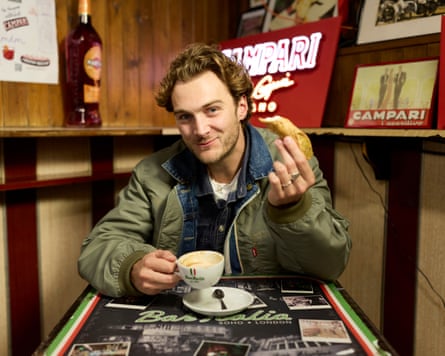
The most significant change was the new power and opacity of the algorithm. Many influencers described trying to intuit the behaviour favoured by the algorithm – voiceovers, text across the frame, holding the camera up and away from the body for an opening shot, quick cuts between courses, ultra-closeups of food, lists – fast enough to reap the rewards, and these quickly became part of the influencer vernacular. Shaikh described posting a 10-second clip of her eating desserts with a soundtrack of an already viral song, and waking up to millions of views – a result she found baffling. Topjaw noted that their most successful posts – the series that blew their channel up in 2024 – were not their thoughtful long-form restaurant mini-docs, but the fast-cut reels in which they interviewed chefs and celebrities about their favourite places to eat in London. As Burgess pointed out to me, in the 250 episodes of this mini-series aired to date, no food is even shown.
The influencers who built huge followings before the pandemic have been left behind by the algorithm. "You look at those old guys who were like kings then, but they don't get any views now, there's no engagement," James Dimitri, who has 300,000 Instagram followers, told me. What is immediately obvious is that while the first wave of food influencers rarely appeared in their posts, the new scene is all about the personalities. What people – or the algorithm – really want is not pictures of food, but to see their favourite influencer eating or talking about food. A former advertising executive at a big four firm told me that brands, too, were increasingly asking for "face only" content, meaning they would only work with influencers who appear personally on camera.
It is easy to track a more performative, almost cartoonish style emerging and intensifying. Among the most successful of these figures is south London influencer Jon the Food Don, who has more than half a million followers on TikTok and mainly reviews chicken shops. Jon's patented bit is leaping up and running from the restaurant in excitement when he eats a particularly good dish, camera bouncing like the chaotic backstage handycam footage of a WWE production. Like many of the new wave of influencers, he is playing a character; he called it "a more animated version of my younger self" when I spoke to him. But his approach is, he said, a combination of his interpretation of the desires of the audience and algorithm, and also a reaction to what he found to be a stultifying landscape, where most influencers looked and sounded the same and rarely offered their own opinion.
In May, I attended several restaurant openings to get a feel for influencers in the wild. The most illuminating was a party for the 280-seat second London location of the Latin-American restaurant Tigermilk. There was a fountain and a mariachi band. There were 18 influencers present, but as one of the attenders put it, they were "baby influencers" – all had under 50,000 followers. Here were the next generation of hopefuls, buzzing with excitement over a glitzy PR invite and a free meal. A young man named Ryan Ewhare – who was seated in a corner table with a phone rig, shooting front-facing content – told me he had studied the greats, especially Inskip, to learn about timing and angles. He has only 2,000 followers so far, but he has a natural charisma and posts at least once a day. He already has an agent. A woman named Crystal Wong, closer to my own age of 40, has the unbeatable gimmick of bringing her family to restaurants. They milled about together, cross-posting to each other's accounts, searching for the most glamorous light, the best wall-hanging plants, and avoiding the band. They were having fun.
Over the next few days I saw their content roll in on my feed: instant coverage and hundreds of thousands of views. What looks spontaneous to the viewer is in fact an out-of-the-box advertising solution that has become the industry standard. Some restaurateurs, such as Robin Gill of Darby's, told me they reach out directly to influencers and work with ones they like. But most restaurants simply pay for a standard PR service for their establishment, which runs to about £3,000 to £6,000 a month for a medium-sized restaurant and climbs well above £10,000 a month for larger or more prominent restaurants and specialised campaigns. The PRs consult their Rolodex and send some influencers through to their clients. Influencers mostly don't want the responsibility of critics, and so have welcomed collaboration and access. Burgess told me that while "a critic can slip in and have a meal, we have a crew of three, cameras, lights. We want to show people the kitchen, meet the chef. We can't do that tear the food apart."
And while the press often paints a picture of hordes of disruptive influencers springing up from nowhere, what's most striking is how seamlessly influencers are integrated into the industry. Longtime London restaurateur Jeremy King caused a frenzy this year when, according to news reports, he threatened to ban influencers from his recently opened restaurant, The Park, after it was "overrun" with influencers behaving badly – reportedly doing photoshoots on the stairways with full camera rigs and setting up makeup stations in the bathroom. The coverage seemed baffled as to where these people had come from. King called it "an influenza-like outbreak". What was elided was that The Park had previously invited several influencers to shoot content and eat free meals – this had been arranged by their PR agency, Tonic PR & Communications. Jeremy King Restaurants noted to me that the proposed ban on influencers was around uninvited fashion influencers behaving badly, not food influencers. It said: "We did engage on a few occasions with a limited number of respected, specialist food and restaurant content creators who were invited by our social media agency. Unlike the uninvited, fashion-oriented self-promoters, they were professional, worked discreetly, within our guidelines and to a brief to create food content for social media." The problem is not influencers per se, it seems, but influencers working outside the well-established system.
As influencers have become powers in their own right, many have started to ask the same question: how do I get paid? The harsh reality of the influencer world is that a very small proportion of them make any money. This seems surprising at first. There's no shortage of internet celebrities who have spun views into riches. But the economics of restaurant influencing is particularly dismal. Tong has a day job, as does Dimitri. In fact, it seems like nearly all the influencers that come across my feed have either day jobs or side-businesses that support their influencing (a significant number of these day jobs are in finance or consulting).
The UK Committee of Advertising Practice, and its sister company, the Advertising Standards Authority, both of which regulate advertising, including by influencers, are relatively permissive. When I spoke to the director of data science, Adam Davison, and senior compliance executive Ed Senior, they explained that as long as a post is tagged somewhere as an ad, and a viewer could reasonably find that disclosure, influencers are generally in the clear. Practices such as taking free meals are not necessarily contraventions either, as it must be proved that any gifts exerted "control" over the content. "For instance, an agreement for content on a certain date could be called control, or if you stipulate that it has to be positive," Davison said. Given the nature of the obvious but unspoken exchange between influencers and PRs, it isn't very hard to stay technically within bounds.
The other major avenue for influencers is brand partnerships – in which the influencer makes videos endorsing a product or services – either on the brand's account or their own. Topjaw, for instance, is partnered with Deliveroo, while Inskip endorses McDonald's. Shaikh said that tourist boards were very interested in bringing influencers out, and that they fit with a general food and restaurant aesthetic. She's made videos for Visit Jamaica, and recently made one for the Channel Isle of Guernsey ("Guernsey has no right being this good!"). Two other influencers who have made videos for tourist boards said that their remuneration started at about £10,000 – on top of a multi-day trip and accommodation – and required them to produce between three and six pieces of short-form content.
Ads for products, especially from major corporations, can be extremely lucrative. But everyone I spoke to cautioned that these big paydays were few and far between. As one PR told me, only a small proportion of influencers are able to command four-figure – let alone five-figure – payouts. It seems that every other popular genre of influencer has access to more lucrative deals than those that cover restaurants. According to correspondence I saw, representatives for the recipe and travel influencer Notorious Foodie – who is London-based and has 12 million followers across TikTok and Instagram – asked for more than £40,000 for a collaboration with a venue, including a personal appearance and co-produced content. (A representative for Notorious Foodie told me the rate I saw "is not at all accurate" and "incorrect".)
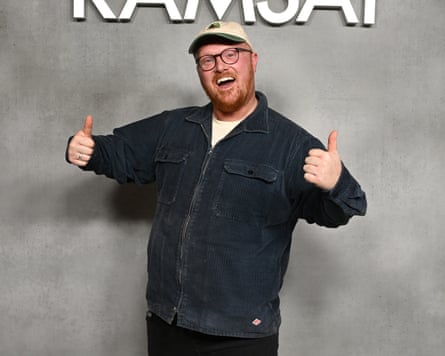
Studies have shown that this type of disclosed paid-for content isn't always well liked by audiences (and even, in some cases, lessened engagement on subsequent posts). This puts the influencer in a tough spot. While they clearly generate revenue for the PRs and restaurants for whom they make adulatory videos, the vast majority of that work is paid in nothing more than free meals. It is perhaps not a surprise, then, that some are accused of taking under-the-table payments to endorse restaurants. As the biggest influencer in the country, Inskip in particular has become a lightning rod for industry and audience criticism. It has not escaped notice that, between all the mountains of food he has posted himself eating – about three times a week for the past five years – Inskip seems to like everything. (Here are some comments that appeared beneath his videos – all sic: "Everywhere is your favorite!"; "Every place you go is the best.. !!!!The best this, the best that…!!!!"; "Is this a legit opinion or did you get paid as an advert?")
From what I understand, the arrangement between Inskip and restaurants varies from post to post. Several restaurateurs that I trust told me that Inskip neither charged them nor raised the question of payment. Farbez Uddin, owner of the Bun & Sum brand, told me that because he knew Inskip personally, Inskip charged him only £500 in 2022 to post about his restaurant and then made subsequent videos for free. Another restaurateur confirmed that he paid Inskip about £1,500 for a video in 2024. I also spoke to two highly placed staff members at a well-regarded restaurant group in London who provided details of a transaction between the group and Inskip from across the past 18 months (they gave this information anonymously as my naming them could result in professional repercussions). They said the group contacted Inskip to see if he would cover their establishment. Inskip brought up the topic of payment, which the group negotiated in the range of about £6,000 for more than one post. It was understood that the restaurant group would see the posts beforehand and make amends if needed. This wasn't necessary because, of course, Inskip loved the food. None of the posts were tagged as an ad. (I reached out to Inskip several times for comment about this, and asked whether he takes payments without tagging the content as an ad. He offered no response and did not pick up my calls.)
The social media giants, too, will fall out of love with influencers if it benefits them. The former advertising executive I spoke to told me that the algorithm itself is getting less predictable. Whereas five years ago, elite advertisers (and globally famous influencers) were regularly briefed by Meta and Google about how the algorithm worked, this is happening less and less. Now, no one has any real idea where it is going next. Even the titans of the field don't think they're immune. Burgess told me that it was simply a fact that the algorithm changes all the time, and it will change again. "I could wake up tomorrow, and this is all gone," he said. It wasn't clear if he was describing a dream or a nightmare.
On the restaurant side, the money may also be drying up. Both Uddin and the restaurateur who says he paid Inskip in 2024 said they no longer pay for influencer visits because their value has become diluted. The problem is that there are more influencers than ever, all presenting in a similar style, all going to the same restaurants. Jon said that the proliferation of amateurs – who are happy with any payment at all – sets the prices lower for those who work making content full-time. "In the UK now, everyone and their dog is a content creator. And a lot of people are horrendously undercharging," he said. (Jon has done paid ads for specific restaurant deals, and a series for an AI assistant, Dola.) Almost every influencer I spoke to said it was more competitive now than a year ago, and even big brands were paying less than they used to. People mostly assured me that relations within the community were still cordial, although I learned that Topjaw demanded exclusivity for videos shot at London restaurants Legado, Vincenzo's Pizza and Crisp – meaning that they would be allowed to film and post before any other influencers were let in. In a statement, Burgess said: "[In those cases] we asked for a period of grace time in order to make our efforts worthwhile – you know the investment each of our videos costs us – and not be one of a long stream of content going out. However, this system we trialled felt more hassle than it was worth and so have not continued to do it."
This demand for exclusivity, itself a trick taken from newspapers, points towards a new problem, which is that traditional and social media have become virtually indistinguishable from each other. On one hand, while influencers have broken free of the elitism of traditional food media, they have also recapitulated its chummy relationship with industry. On the other, restaurant writers have become much more like influencers. Several former and current editors of newspaper food sections told me that as budgets shrink, they have become increasingly reliant on industry freebies for their non-review coverage. And even the firewall around critical reviews never being based on free meals has weakened. Twiggs said that, without an expense account, the Independent sometimes publishes reviews based on comped meals – a practice that I have heard dates back to at least 2019. (She added that she always makes it clear to the PR that the review will be honest.) In general, says the critic Jimi Famurewa, "hardly anyone is totally pure when it comes to modern food media's freebie economy".
"This whole thing of never giving a critical opinion, just presenting a big pile of food, everything's great! That style is becoming passé. That's doing the audience a disservice. And you can see it. People are super angry," Jon told me. The only way back – the only way to win real trust, he said – was to rediscover the ideal of being a critic: expert (even if simply in the field of chicken shops), opinionated and accountable to no one but the viewer.
"People are sick and tired of lying," says Gerry del Guercio of Bite Twice, a food review account he runs with Paul Delany. "People aren't stupid, they go out and eat stuff. They know everything's not good." On a recent trip with them to Tooting Market, I watched them try the south London outpost of Boom Bap Burger Restaurant & Bar, passing a single iPhone between themselves to shoot the segment – one take, two or three minutes total. Each bit into the "2 Pac Smash" burger, grimaced, and laid into it. "Underwhelming … thin" (Delany). "Dry… the burger meat got absolutely CRUCIFIED on that grill" (del Guercio). The review went up a few weeks later. It's not exactly AA Gill on L'Ami Louis, but it works.
The two had a Damascene conversion early in their career – a run-in with Max Lewis, the chef behind Lenny's Apizza in north London, who accused them of being pizza philistines with no sense of taste. "He basically said to us, if you like everything, you like nothing. And we were like, damn, he's right," says del Guercio. They began to review more widely and honestly, and found not only success but a sense of freedom from working outside the system. Their account isn't totally cut off from sources of payment. They have done a food market collaboration and travelled to the World Cup in North America to make videos sponsored by Wise Multi-Currency Card.
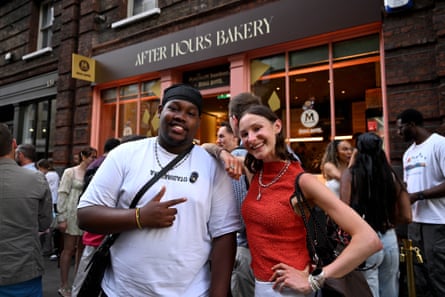
There are other similar bright spots. Sama Ansari Pour does videos about travelling the world within London, projecting a narrative of cultural abundance within a single city. There is still a place for service journalism – such as Dimitri's documentation of London cafes and chippies – that other influencers aren't likely to touch. It may seem prosaic, but there is no press release describing the quality of a family-run caff in London's zone 3. Dimitri's list of 125 London Greasy Spoons, released last year, is a work that required real research and expertise. Meanwhile, new influencers are rapidly rising through the algorithm. This year, 22-year-old Moses Combe shot to fame with his genuinely insightful Endz Department for Research videos, which poke fun at influencers hopping around pricey bakeries in his local area. By May, Meta had tapped him to promote Meta Ray-Bans on billboards in London.
Influencers are inescapable now, but history suggests something else will surpass them soon, unless they change. Thinking back to the baby influencers I met at Tigermilk, I'm reminded that I still find many influencers charming. Charming, but often too narrow. In person they were bright and fun, but as I watched the dozens of videos that emerged from the launch party, I couldn't help but notice that their content had been flattened into the same marketing copy ("London's hottest new restaurant", "your new favourite spot before everyone finds out about it"), praising the ceviche and "perfect" lamb tacos, both of which I recalled as dull, verging on wet. Something vital wasn't coming through. I hope some of them can break out of a system that has them tied to the advertising machine, effusively praising mediocre food for an increasingly distrustful audience, before it is too late.
A longer version of this article first appeared in , a magazine about modern food and culture