eff Lee became interested in beekeeping in his late 50s after his wife, Amanda, took part in a "beard of bees" event at Science World's "science of fear" exhibition in Vancouver, Canada, where they lived. She stepped into a Perspex booth, a caged queen bee was placed beneath her chin and thousands of bees climbed her neck – hence the "beard". She was so calm that the stallholder was impressed. "You should keep bees," he said.
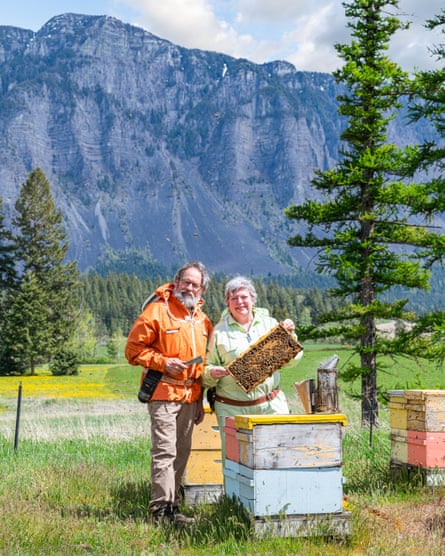
Lee had a small collection of books on the insects – "the idea of homesteading and having something of an independent life, rather than a rat-race life, always appealed to me" – and the pair enrolled on a beekeeping course. Before long, they had put two hives in their back yard. Fast-forward to 60 and he and Amanda had moved 300 miles east to rural British Columbia to buy a bee farm. For Lee's part, however, he didn't just acquire a business. The bees taught him a completely different way to live.
Lee had been working as a journalist since he was 21. In his job as an investigative reporter at the Vancouver Sun, he "operated at an incredibly high tempo". He would arrive at the office at 8am on Monday, "crash and bang", working to daily deadlines. "My middle child" – he has three, from his first marriage – "once said: 'Dad, you have undiagnosed ADHD.'" He doesn't know if that's right, but "I live fairly intensely", he says.
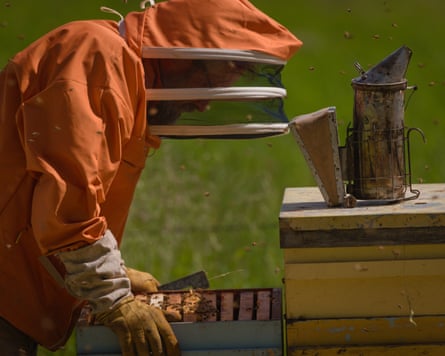
When they bought their first hives, he would head out to the back yard after work to play with the bees, as he puts it. "And the bees would sting the shit out of me. I got my ass handed to me, because every time I opened up the hive, I'd be banging around just like I did as a journalist, working fast, getting it done," he says. "I learned you have to slow down. Work with the bees. Listen to the bees. By the end of the weekend, I was much calmer. My writing was better. I was a better human being."
In the early days, he was just "dabbling" in bees as a hobby, but when the Sun's parent company was taken over, cuts followed and he began to rethink his life. "I always loved journalism, but I found that I was marking time. Marking time is a very bad way to live," he says. It took about six months to request redundancy.
Lee had happened upon his first career by chance. His parents were academics and the family travelled from California to London, Guatemala, New Mexico and Vancouver. "I was the antithesis of what my parents expected," he says. He failed his first year at the University of British Columbia and took a gap year. By then, he was deemed to have "aged out" of family trips, so when his parents went on sabbatical to Japan, he had to fend for himself.
He found work at a lumber mill in Boston Bar in the Fraser Canyon, British Columbia. Not paying attention one day, he got his arm stuck in a conveyor turnbuckle. He was off work for six months, after which he switched to bar work. All sort of folks came in. He liked hearing their stories and offered his services as a freelance writer to the Hope Standard newspaper.
After a few months, the editor offered him a full-time position with the words: "'Listen, sonny, it's the who, what, where, when, why. And don't forget that it is 'rink' and not 'team' in curling.' I fell in love with the craft," Lee says.
He is 69 now and it's a decade since he took redundancy. "I could have travelled around the world and done other things. What I did is I started an entirely new direction of life, of work," he says. "And I don't see any slowdown."
After buying the farm, Lee and Amanda lost nearly all their bees in the first two years, "then slowly rebuilt". Now, they have 800 hives and have won awards at two major US honey shows. "Yes, it's a second career, but it's also an attitudinal change in life," Lee says. "It's about enjoying my life and you know what? I could not have done that without the bees.
"I don't think the word 'retirement' is something that I can believe in. I think that you live a good life and you do what you love and you enjoy it. And when it is done, it's done."
Tell us: has your life taken a new direction after the age of 60?