Colombian police have stormed a supermarket in one of the country's most popular tourist cities, ending a daylong siege in which all the hostages were freed and one man police described as a hostage-taker was killed.
Abelardo de la Espriella, the far-right president, travelled to the Caribbean port city of Cartagena to follow the final hours of negotiations and the tactical assault, in which special forces officers broke through blocked entrances and detonated stun grenades.
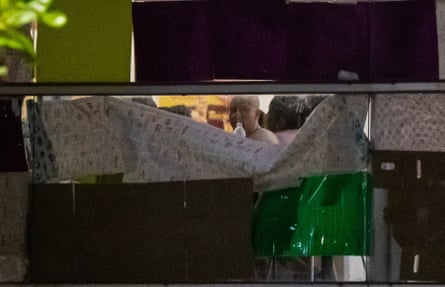
When masked and armed assailants stormed the supermarket at about 8am on Tuesday local time, customers and employees were taken hostage – the president initially said there were 30 hostages, but after the final count, police put the number at about 70.
Many of them could be seen through windows with their hands and feet tied. Ten had already been released over the course of the day.
When, after 17 hours in captivity, the final people were freed at about 1.30am on Wednesday, four of the hostage-takers were arrested.
One man was killed, whom De la Espriella and police described as one of the criminals who had allegedly resisted.
"One of the criminals was killed. They were given the opportunity to surrender and release the hostages; they rejected that opportunity and we acted forcefully," said De la Espriella in a video posted outside the supermarket – about 6 miles from the old city and its 500-year-old fortress walls, which are visited by thousands of tourists every year.
Local media identified the dead man as Haider Muñetón Zapata, 51, whose wife had spent the day searching for him as one of the hostages. She gave an interview to Blu Radio on Tuesday, saying they lived near the supermarket and that he had gone there to buy buñuelos, a type of fried dough ball, before picking her up to take her to work, but had stopped responding to her WhatsApp messages at 8.12am.
Zapata reportedly had no criminal record. Cartagena's mayor, Dumek Turbay, told local media that when special forces stormed the supermarket, Zapata had allegedly resisted and attacked one of the officers, prompting police to shoot him dead.
In a video released shortly after the operation, De la Espriella described the police action as "extraordinary", speaking with a gun tucked into his waistband, as he has done on several other public occasions as part of his populist tough-on-crime rhetoric.
The president arrived in Cartagena late on Tuesday afternoon from Villavicencio, about 684 miles inland, where he had been dealing with the aftermath of another attack on Monday night, when a car bomb was detonated outside the headquarters of the Meta departmental government.
More than 20 people were injured, and the president attributed the attack to a dissident faction of the Revolutionary Armed Forces of Colombia (Farc).
De la Espriella, however, denied that the supermarket hostage-taking had been carried out by a "terrorist group", as he describes the groups involved in Colombia's decades-long armed conflict, saying instead that those responsible were common criminals.
The president said they had tried to rob an armoured cash-in-transit vehicle but, after being spotted by private security – who then alerted police – they took refuge in the supermarket.
As the lengthy negotiations continued into the night, police used water cannon to disperse dozens of onlookers who had gathered outside the supermarket.
Cartagena's mayor said that when police stormed the supermarket, some of the hostage-takers tried to blend in with the hostages by removing their hoods and changing out of their black clothes into civilian clothing.
According to Turbay, police then had to screen the hostages before eventually identifying the four who were arrested.
Supermarket employee Héctor Puello, who was taken hostage, told Caracol Radio that he had started his shift in the store's bakery about two and a half hours before the gunmen arrived.
"First of all, I felt like I had come back to life because those armed men were mistreating us," he said.
Another employee, Dayro Rafael Velázquez Castrillo, said that when he realised what was happening, he hid inside a cold-storage room with four other employees. "After four hours, we couldn't stand the cold any longer and came out," he said, at which point they were captured and taken hostage.
Commenting on the rescue operation, De la Espriella said his government was acting out of "the need to defend our people and go after all the criminals with an iron fist".
The daylong hostage siege took place on a symbolic day for security in Colombia: the 10th anniversary of the country's landmark peace accord with Farc guerrillas.
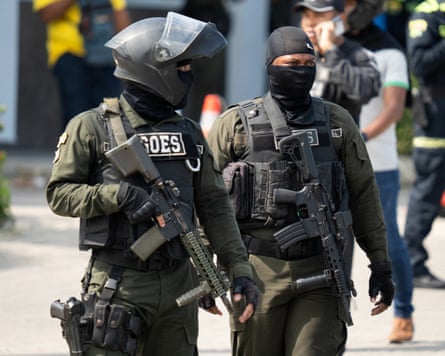
In office for just over three months, the president – previously a lawyer and businessman – is a fierce critic of the peace deal and has focused his government on returning to a strategy of full-on confrontation with criminal groups, breaking completely with the "total peace" plan of his predecessor, the leftist Gustavo Petro.
Although some indicators show slight improvements in areas such as homicides and kidnappings, recent days have been marked by a strong response from criminal groups: in addition to the car bombing, another guerrilla group carried out the first-ever drone attack on a departmental capital on Monday.
On Tuesday night, five departments were left without electricity, and De la Espriella said criminals used explosives to bring down power pylons.
"These criminal acts constitute the response of terrorist groups to the forceful offensive being carried out by the national government to restore order and security across the country," he said.