The academy cited the author's "bold and inventive oeuvre that, in playful dialogue with the classical tradition, has created new forms for contemporary literature".
The Nobel prize, regarded as the most prestigious award in global literature, is awarded for a lifetime's body of work. The winner receives 12 million Swedish kronor (£900,000.
Ingrid Carlberg, the permanent secretary of the Swedish Academy, said she told Carson of the news on the phone shortly before the news broke. "She had time to tell me that she is, for the moment, in Iceland, where she is listening to the wind," Carlberg said. "She was taken by surprise but very happy. I could hear that in her voice."
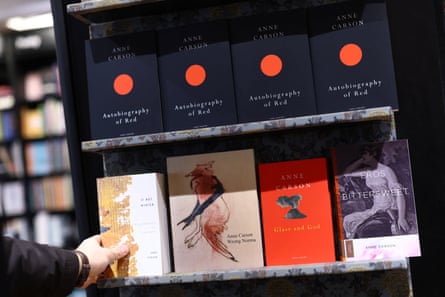
Born in Toronto in 1950, Carson is known for work that moves freely between poetry, prose and translation, drawing heavily on the literature and mythology of the ancient Greek world. She has been a professor of classics at various institutions including Princeton, New York University and McGill University in Montreal. Her win makes her the 19th woman out of 123 literature laureates.
Carson's first book, Eros the Bittersweet, was published in 1986, and combined literary criticism with an exploration of desire and the ancient Greek tradition.
Her best-known work is Autobiography of Red, a 1998 novel in verse inspired by the fragments of the ancient Greek poet Stesichorus. It reimagines the myth of Geryon, the red-winged monster killed by Herakles, as the story of a modern teenage boy navigating heartbreak and desire.
In 2001, she became the first woman to win the TS Eliot prize for her collection The Beauty of the Husband. She has also been awarded Guggenheim and MacArthur fellowships.
Her work has attracted praise from fellow writers, including Susan Sontag, who once said: "She is one of the few writers writing in English that I would read anything she wrote. If there's a magazine that has something of hers in it, I buy it automatically."
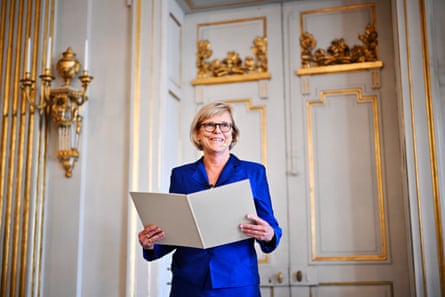
Anders Olsson, the chair of the Swedish Academy's Nobel Committee for Literature, praised Carson for work that had "broken away from lyrical poetry bound to the narrative self and inspired new forms of contemporary literature". He said: "This method of writing leads to playful and ironic works that move not only between classical and modern poetry but also between different genres and artforms."
Carson's books have ranged widely in form. Men in the Off Hours combined verse essays, poems, epitaphs and prose about artists and historical figures, and won the inaugural Griffin poetry prize in 2001. Decreation, another eclectic work, brought together poetry, essays and an opera. Nox, published in 2010, is particularly characteristic of Carson's avant-garde approach to literature – the book takes the form of an accordion-fold box containing a reproduction of a notebook Carson made after the death of her brother. Her later works include Red Doc> and Float.
In a Guardian review of Red Doc>, Sarah Crown wrote: "To engage so fluidly, so originally and compellingly, with a story first told more than 3,000 years ago, is astonishing: her ambition is one thing; the fact that it is so completely achieved is, frankly, something else."
Much of Carson's work has emerged from her fascination with language itself. The Swedish Academy noted that "almost all her literary production has centred upon the intersection between the philologist's obsession with words and the poet's desire for new meaning", adding that Carson had identified the etymology of words as "the starting point for all her work".
Asked why she continually moved between forms, Carson said in an interview: "Boredom I guess. There is a restlessness. There are a lot of forms to try."
She has acknowledged the difficulties that come with her experimental style. "[My work] does fall apart a lot," she said in a 2018 interview. "It gets just too weird for anyone to care about reading, or else it gets diluted into a sort of parody of itself."
Carson has generally kept her personal life out of interviews. However, in an August 2024 article for the London Review of Books, she disclosed that she had been diagnosed with Parkinson's disease.
The Nobel prize in literature has been awarded on 118 previous occasions since 1901. Recent laureates include Annie Ernaux, Bob Dylan, Abdulrazak Gurnah, Louise Glück, Peter Handke and Olga Tokarczuk. Last year's recipient was the Hungarian author László Krasznahorkai, known for his dystopic and avant-garde writing.
Carson, 76, will formally receive the medal and diploma in a ceremony in Stockholm in December.