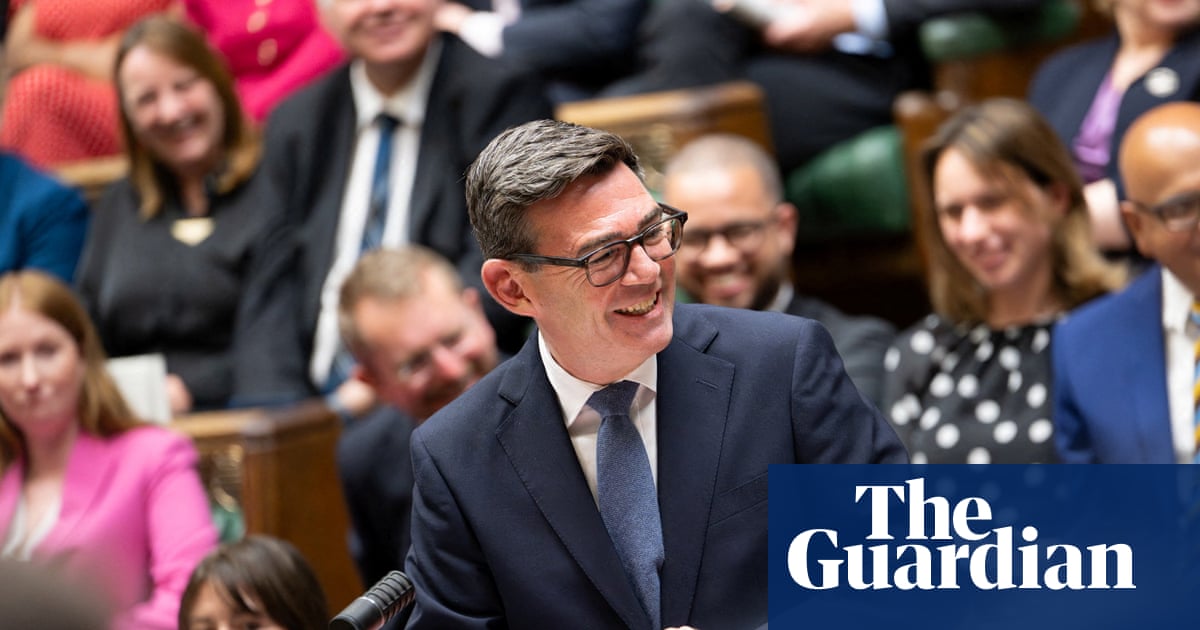
The coming months will show whether Andy Burnham fits Kemi Badenoch's charge of a leader too obsessed with being liked to make hard choices. One thing, however, does seem clear from his first outing at prime minister's questions: he likes saying yes.
The very first question came from a political opponent – Ann Davies of Plaid Cymru – but Burnham replied as if she was a valued constituent, saying he understood her worries about the prison early release scheme and hoped she could be reassured.
By the session's close, Burnham had responded patiently to MPs from virtually all benches of the Commons, even Reform UK, and committed to a series of in-person meetings, some for himself, others for colleagues.
Bonhomie is a necessarily limited political resource, even for new prime ministers who have promised to, as Burnham put it, focus on "problem solving rather than point scoring".
And thus it was that by Badenoch's third question, Burnham was blaming the economic legacy of previous Conservative governments. By the fourth, he was bringing up Liz Truss's mini-budget, a near-weekly feature of Keir Starmer's PMQs repertoire.
In fairness, the latter was something of a political open goal given Badenoch's decision to, in a weekend reshuffle of her shadow cabinet, give the top Treasury post to Andrew Griffith, who worked closely on and then stoutly defended Truss's 2022 fiscal debacle.
What did these 45 minutes of studied empathy, mixed in with a few above-the-knee tackles, tell us? As is generally the case with the PMQs, not much in the way of definitive lessons, but it gave several interesting pointers.
PMQs is a hard skill to learn, even for someone like Burnham who spent more than a decade in frontbench posts during his last period in parliament, and he is unlikely to sound as tentative again. Equally, facing a brand new opponent, Badenoch was obliged to test out a few areas of attack, seeing which might stick.
The bulk of these were based on a pre-existing Badenoch narrative that Burnham is perfectly nice, but a people-pleaser, a "spendthrift prime minister who wants to say yes to everyone", as she put it on Wednesday.
Burnham did push back at times, insisting his early-weeks giveaways were fully costed and stressing the importance of fiscal discipline. But more often he simply ignored the attacks, setting out a pledge – dismissed by Badenoch as mere "vibes" – to restore the nation's "sense of positivity, a sense of possibility".
When it comes to assessing PMQs performances, there are two linked caveats, the first of which is that this is primarily a terrain for the pros and the geeks. Few beyond MPs, the media and political fans notice the weekly spectacle beyond a 20-second clip that might crop up in their social media feed.
The follow-on is that even doing well at PMQs brings limited benefits, beyond cheering up the faithful. Badenoch was regularly praised for making life uncomfortable for Starmer, but her party is still polling below the level of its disastrous 2024 election defeat. A phenomenon that has echoes of William Hague, a Tory leader who loved the Commons but was not loved by voters.
Nonetheless, Burnham and his MPs will do well to study Badenoch's PMQs attacks. Vibes will only get him so far, and with the fiscal clouds darkening, he will need to not only disappoint some people, but do so obviously.
For Badenoch, her first PMQs against Burnham will have told her nothing new, just reinforced some lessons which are not wholly comfortable.
To begin with, despite his long absence from parliament, Burnham showed he could hold his own, both at PMQs and at Tuesday's marathon debut, where he answered 125 questions over three hours.
Badenoch should also be mindful of the universal political rule first set out by the pollster and focus group expert Luke Tryl: all things being equal, voters prefer politicians who look as if they actually enjoy the job over those who make it feel like a chore.
Yes, he was nervous, at times hesitant. But Burnham clearly relished being at the despatch box, the centre of attention and scrutiny, something Starmer managed rarely, if ever. These are different times.