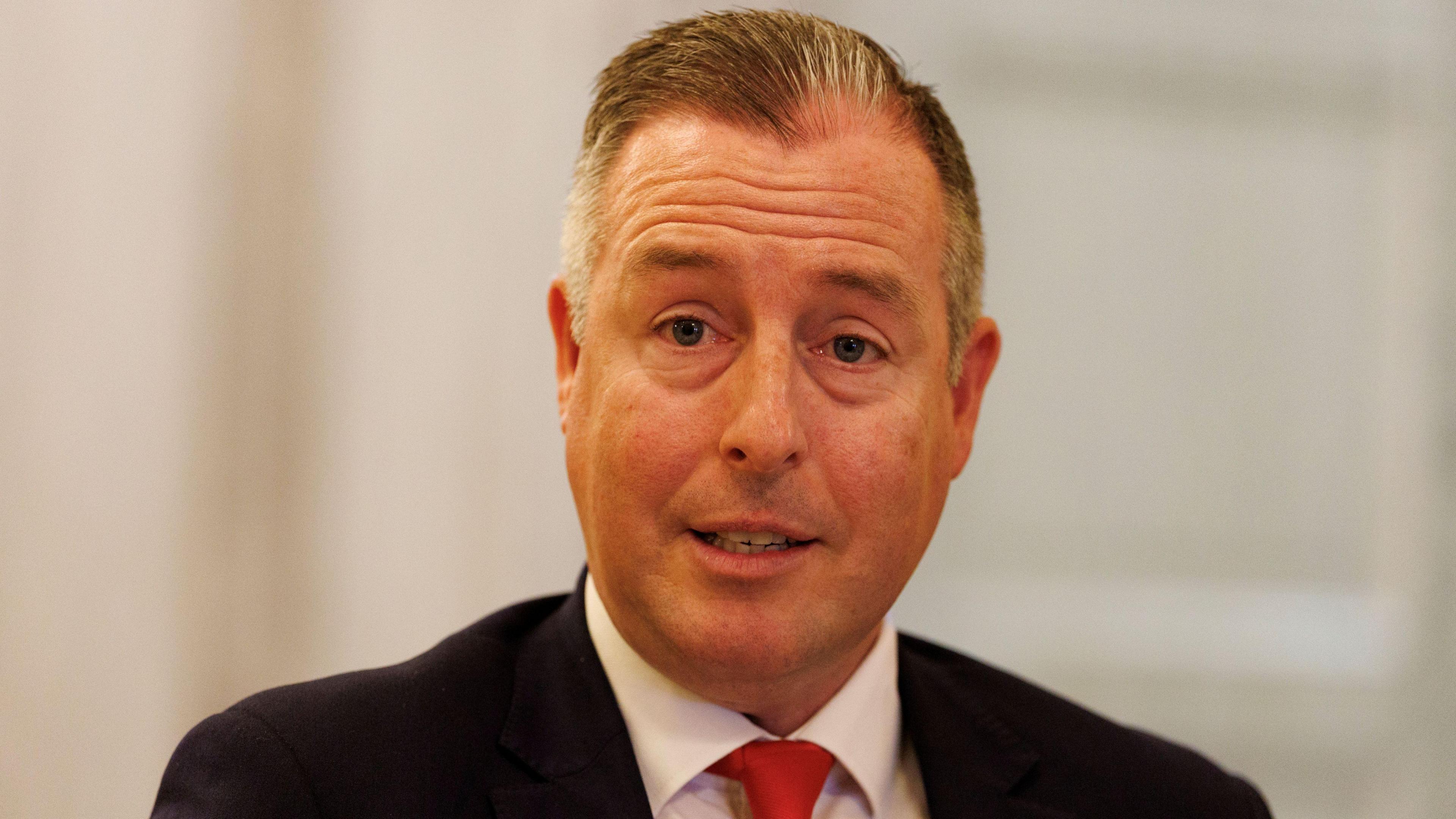
Most children with a parent on benefits will not be eligible for priority nursery places from next year under changes to the rules announced by Education Minister Paul Givan.
The minister said he believed the rules - known as Socially Disadvantaged Circumstances (SDC) criterion - were not "lawful" and were "discriminating against hard-working families".
He added that the move would "level the playing field" for pre-school admissions.
However, critics have said the rules made sure vulnerable children got "a foot up the ladder", while political representatives from Sinn Féin, Alliance and the SDLP questioned the plans at Stormont on Monday.
The Education Authority (EA) said it "arrangements to implement the change will begin immediately".
Givan announced his department was to repeal the SDC criterion and was launching a consultation to gather views on whether new legislation was also needed.
What has Paul Given announced around pre-school places?
The SDC criterion, first introduced in 1998, provides the basis for underprivileged families to get priority pre-school placements.
The criterion allows the children of parents in receipt of benefits - specifically Income Support, income-based Jobseeker's Allowance, Employment and Support Allowance and Universal Credit - to get priority for a pre-school place.
Speaking in the assembly on Monday, Givan said the context of pre-school places is "very different" compared to when the SDC criterion were introduced.
He said welfare reforms meant that the officials had "read in" new welfare payments, such as Universal Credit, a payment he described as "significantly wider" than those named in the SDC legislation.
He added: "The current practice is also no longer legally defensible."
Givan said that only benefits specifically named in the legislation - Income Support and Jobseeker's Allowance - would be applied as SDC criteria from September 2027.
He added that as those benefits "have been phased out or superseded" he expected a "negligible number of applications" under SDC criterion next year.
He told BBC Radio Ulster's Nolan Show on Tuesday morning that limiting the number of benefit claims that qualify a child for a priority placement will "level the playing field in preschool admissions for hard working families".
"They're not middle-class. They're working-class people who are struggling, and their children have been disadvantaged," he said.
How have people responded?
Some assembly members criticised the move when unveiled by Givan in the Stormont chamber on Monday, with one - Sinn Féin's Danny Baker - at one point describing him as "a disgrace".
In questioning the move, SDLP's Cara Hunter asked why he was removing the only statutory protection for children living "in absolute poverty", while Alliance's Nick Mathison said it was "something that could further disadvantage the children who are at the highest risk of educational disadvantage".
In response, Givan said it was about not taking a blanket approach, adding that "those struggling to make end meets" should not be disadvantaged because they work.
Dr Ciara Fitzpatrick, a lecturer at Ulster University, said SDC had been used to create an early education selection system that gave "our most vulnerable children" a "foot up on the ladder".
Fitzpatrick said research showed children from working class backgrounds tended to be "educationally further ahead" than their peers from socially disadvantaged backgrounds, and argued the education minister's plans would widen this disparity.
"Pre-school education is not about childcare, it's about early education.
"The evidence suggests that those children from socially deprived backgrounds have less communication skills, less school-readiness, less social skills.
"It means that early education is so important for them.
"It's going to stick by them as they go through school."
She also questioned how the move would affect how many hours a child would get a pre-school.
Currently, there is no standardised set hours for pre-school children across Northern Ireland, with some getting 12.5 hours of pre-school and others getting 22.5.
"Those less affluent children are prioritised for 22.5 hours because that is going to ensure they are not on the backfoot as they enter into primary school."
On Monday, the education minister said those getting 22.5 hours of pre-school had grown significantly during his time, from 40% of pupils two years ago to 65% now.
He added that the executive has committed to delivering standardised full-time pre-school hours but that the Department of Finance need to make the money available to do so.
Meanwhile, speaking to The Nolan Show, Fitzpatrick said she understood "working-class parents have frustrations but that's not on the back of these three and four-year-old children."
She said it is a "crude measure that is going to impact our most vulnerable children".
'I think it should just be equal'

At a mother-and-toddler group in north Belfast, some parents welcomed the move saying it would be positive for working parents.
Carolyn, who has a six-year-old and three-year-old, told BBC News NI she works full-time and spends up to £600 a month on childcare.
"I do think it's a bit more positive because you feel like you're kind of being penalised for working," she said, while at the group at Woodvale Community Centre.
"If I didn't work then my child would have got that place and they're able to go out and thrive in an educational environment with less time between my house and the nanny's.
"I do feel it's a real positive that everyone's going to be on equal footing because as much as it's not classed as a childcare going to a preschool place, it still helps the working parents."
Ashton, who has two-year-old twin daughters, said she worked two days a week and is on benefits. However, she was unsuccessful in an application to get her daughters a two-year place.
"I still think that it should just be equal, for people that are on benefits and people that are in work, they shouldn't be treated any differently."