Civil society organisations wrote to Cop31's joint presidents, Chris Bowen and Murat Kurum, overnight to tell them they had hours left to avoid making it "one of the most disappointing Cops the UNFCCC has ever had".
"The Global South is being abandoned," they told the presidencies. "Developed countries have blocked progress across the negotiations and arrived with no new finance commitments."
The draft cover text "is a gift to the fossil fuel industry", they went on. "The major cause of the climate crisis – coal, oil and gas – fails to rate a mention."
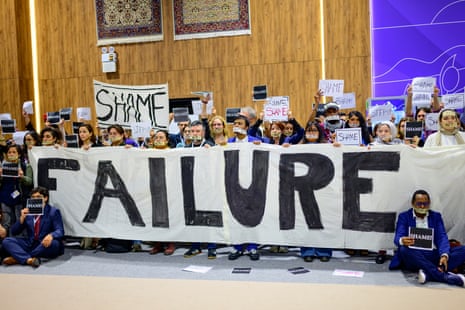
In sum: "It has all the hallmarks of a deal to let carbon capture through in exchange for an electrification target that does not even require renewables-based electricity or ensures access for the people who need it most. None of this is defensible."
The letter is co-signed by 100 different environmental organisations, from the Africa Just Transition Network to Zero Waste Alliance Ireland, and including 350.org, Climate Action Network, Greenpeace International and WWF.
They called on the presidencies to remove targets for carbon capture, restore pledges to uphold the rights of indigenous peoples and include measures to make rich countries accountable for public climate finance. They called for the summit to explicitly welcome the advisory opinion by the International Court of Justice that states have a duty to protect the climate.
And they demanded that a link was drawn between the summit's goal on electrification and the generation of energy from renewable sources and the transition away from fossil fuels.
"Without this link, the target risks supporting additional electricity demand while leaving fossil fuel dependence intact," the letter said.
"In addition, we ask you to take forward the Cop30 roadmap on transitioning away from fossil fuels, with the Cop30 and Cop32 Presidencies, through to the second Global Stocktake external to the consensus process, as a Presidency-led dialogue.
"Otherwise Ethiopia will unfairly be left to carry the burden of your failure into Cop32."
Although not quite deserted, the halls of the Cop31 conference centre are considerably less peopled today. A few people wander back and forth with their backpacks on. Young Turkish support staff walk around in groups.
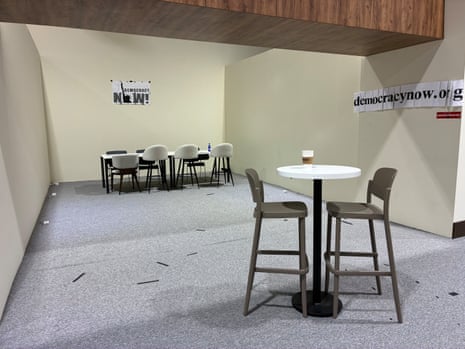
It's possible to find a seat at the tables next to the food stalls. Those, however, are closed, so there is nothing to actually rest on the table except for your laptop.
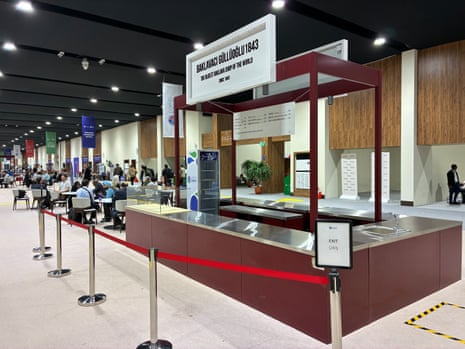
A profusion of fairly bold flies in some parts of the conference centre seem fitting for what is apparently becoming a "Zombie Cop".
At 12pm (9am GMT) expectation for the drop of a new draft text has come and gone. That potentially puts the expected 4pm closing plenary under threat. Negotiators will be very tired. Rumour has it that the presidency was carrying out bilaterals with parties until 5am.
Hello, this is Natalie Hanman, the Guardian's head of environment, taking over the blog from my colleague Bibi while we wait for more updates from the summit …
Civil society is a little thin on the ground in the halls of the Cop31 conference today after 17 campaigners were refused entry.
Everyone attending on a badge linked to Latin American climate organisation Colectivo VientoSur was told they could not attend the UN summit after one staged an unauthorised protest in last night's plenary.
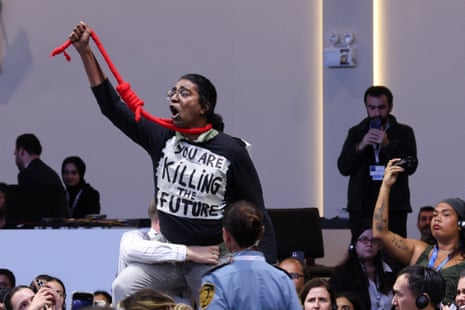
In the middle of comments by Murat Kurum, Turkey's Cop president, Amalen Sathananthar, a member of the Artivist Network, stood on a table holding a noose of red rope around his neck and wearing a T-shirt with the message "You are killing the future" painted on it.
"You are killing the future," he shouted. "Why don't you just kill me now. The climate crisis is killing us, and you do nothing. You don't remove fossil fuels, you are killing 1.5C.
"Today is my birthday, the same year I was born, you signed the UNFCCC treaty. Thirty four years later, nothing. The world is collapsing and you keep stalling. You do nothing because you are greedy and cruel old people.
"We inherit the future, not you! Do something! Make a radical change now! If not, take this, hang me now!
"The Global South can't wait. Save the planet or kill me now. We will all die if you don't make change."
The protest has caused some problems for civil society organisations as many members who filled important roles, including coordinators, policy people and communication people, had also attended on Colectivo VientoSur badges.
While authorised protests are allowed inside the blue zone of Cop climate summits, they are tightly circumscribed and must take place at prescribed locations, for limited amounts of time.
I have been talking to a few people here who are close to the negotiations and the Australian presidency about what we might expect today, and the order we might expect it in.
And this is caveated by the truth that big things can shift quickly at Cops.
But I understand a new draft text is unlikely to be released until this afternoon, Antalya time, and then there will be a period of time (this is necessarily vague) for negotiators to analyse it, and then for UN lawyers to check it, before the closing plenary meeting is re-opened.
My sense is that the Australians would prefer that the agreement is pretty much complete before the plenary starts.
This is a long way of saying that a late finish this evening is a possibility.
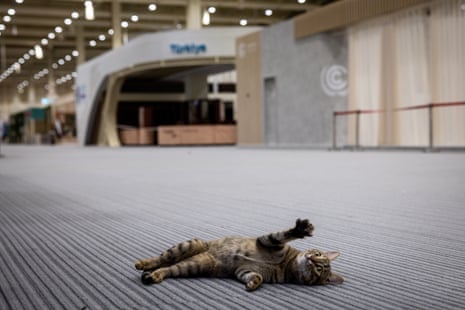
The conference centre is a lot emptier, my colleagues report. However the UN photographer roaming the corridors has spotted a very cuddly visitor making the most of all the space.
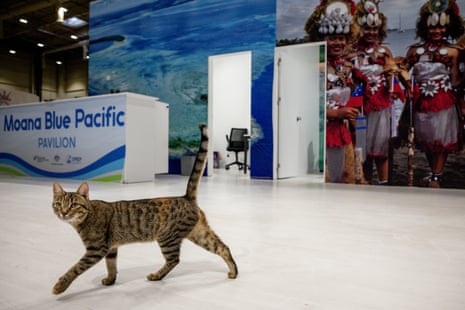
He (or she) checked out the Moana pavilion too.
We are expecting a third version of the cover decision today, which is likely to be a key outcome of this year's Cop. The Guardian's environment editor Fiona Harvey has dissected the most recent draft to help you know what to look out for when the next one drops.
Civil society organisations wrote to Cop31's joint presidents, Chris Bowen and Murat Kurum, overnight to tell them they had hours left to avoid making it "one of the most disappointing Cops the UNFCCC has ever had".
"The Global South is being abandoned," they told the presidencies. "Developed countries have blocked progress across the negotiations and arrived with no new finance commitments."
The draft cover text "is a gift to the fossil fuel industry", they went on. "The major cause of the climate crisis – coal, oil and gas – fails to rate a mention."
In sum: "It has all the hallmarks of a deal to let carbon capture through in exchange for an electrification target that does not even require renewables-based electricity or ensures access for the people who need it most. None of this is defensible."
The letter is co-signed by 100 different environmental organisations, from the Africa Just Transition Network to Zero Waste Alliance Ireland, and including 350.org, Climate Action Network, Greenpeace International and WWF.
They called on the presidencies to remove targets for carbon capture, restore pledges to uphold the rights of indigenous peoples and include measures to make rich countries accountable for public climate finance. They called for the summit to explicitly welcome the advisory opinion by the International Court of Justice that states have a duty to protect the climate.
And they demanded that a link was drawn between the summit's goal on electrification and the generation of energy from renewable sources and the transition away from fossil fuels.
"Without this link, the target risks supporting additional electricity demand while leaving fossil fuel dependence intact," the letter said.
"In addition, we ask you to take forward the Cop30 roadmap on transitioning away from fossil fuels, with the Cop30 and Cop32 Presidencies, through to the second Global Stocktake external to the consensus process, as a Presidency-led dialogue.
"Otherwise Ethiopia will unfairly be left to carry the burden of your failure into Cop32."
A quick summary of where we are as the summit heads into overtime:
Now we are waiting for the latest draft texts to arrive to see if any progress has been made.
As the talks continue into overtime, my colleague has written this useful explainer on what is required for a final decision to go through.
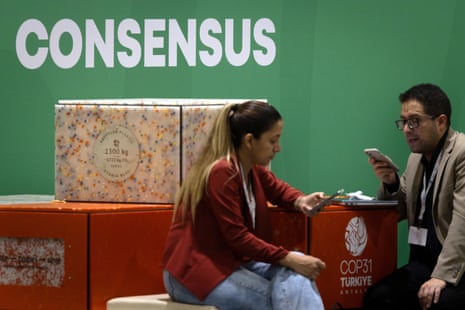
When a final decision is made from Cop31, it will require "consensus" to be gavelled through and become official. But the meaning of consensus within the UN Framework Convention on Climate Change is not always well understood.
Consensus means that the result has been thrashed out by all parties and that the strong feeling in the room is that it should be accepted. Consensus does not mean unanimity. Not every country has to agree for a Cop decision to be passed.
"No country has a veto," one Cop veteran said. "It's wrong to think that one country can hold up everything."
This is important: at many Cops, there have been last-minute objections by a small number of countries, which have been overridden. For instance, at the Paris summit in 2015, a handful of countries including Nicaragua, Cuba, Bolivia and Venezuela were unhappy with the deal, but it was gavelled through. India raised objections in the final plenary of Cop29 in Baku in 2024, but the final deal was done.
The convention of consensus reflects an early Cop in the 1990s when Saudi Arabia and its allies in the Arab Group strongly objected to an outcome that the rest of the world favoured. They were named in the subsequent outcome of the Cop as having objected, and the countries then realised that they preferred not to be singled out as standing against progress on the climate crisis.
Although consensus can be difficult to achieve, and some complain that the result is heavily compromised, it also gives a greater authority to the outcome than any majority decision could do. The universality of Cops is one of their key advantages – if some countries were to break away, it would diminish the authority of Cops, and make it more difficult to forge a unified global approach to a global crisis. As another Cop veteran put it: "All countries feel the impacts of the climate crisis. We are all in this together."
Good morning. Cop31 officially ended yesterday and we are now into overtime. Last night delegates were told to go home and come back in the morning. New draft texts were expected at 0900am local time – but that time has come and gone, and there is nothing to be seen.
I'm Bibi van der Zee, helming the liveblog this morning, and we'll be following developments this morning as they happen.