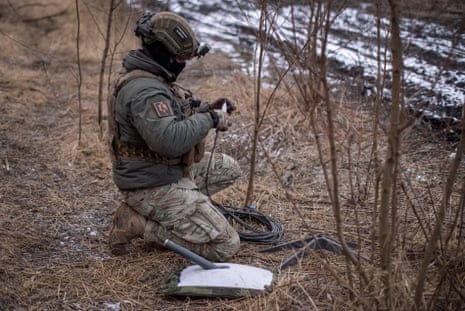
Billionaire tech mogul Elon Musk has suggested that the US government could be behind the decision to restrict the speed of SpaceX's satellite-technology used by Ukraine's military.
In a post of X, he appeared to suggest the Trump administration was behind the move, which Ukraine says restricts its ability to use key defensive weapons.
Musk said:
"Starshield systems are owned and controlled by the US government. Any limits on speed or usage are decided by the US military and ultimately POTUS.
Starlink is a commercial service owned and controlled by SpaceX. Usage of Starlink is limited to civilian or defensive activities and cannot be used for offensive military action, as doing so would be inappropriate for a commercial company."
In further posts overnight, reacting to Zelenskyy's comments on his relationship with Donald Trump,
In a TV interview with Piers Morgan, Zelenskyy said he felt "betrayed" by Trump's decisions and worried about "losing a strong partner," playing a critical role across Ukraine's defence.
For what it's worth, Trump denied that his administration had cut intelligence sharing on Tuesday, but Zelenskyy said in an interview with US broadcaster NPR, aired on Wednesday, that military advisers had received threats from the US that intelligence sharing could be limited in the future.
The issue is likely to come up again today and tomorrow as EU leaders meet in Brussels for key political talks on the future.
With today's discussions focused on the bloc's internal matters, including the EU's next budget, Ukraine is expected to come up on Friday when Zelenskyy joins other leaders in Brussels. But the ongoing crisis in Ukraine's relations with the US risks overshadowing the entire meeting.
I will bring you all the updates throughout the day.
It's , it's here, and this is .
Good morning.
EU's foreign policy chief Kaja Kallas acknowledged that the EU and the US had "definitely different approach to this war," as she said Europeans believe "we should squeeze Russia, not Ukraine, to surrender and end this war."
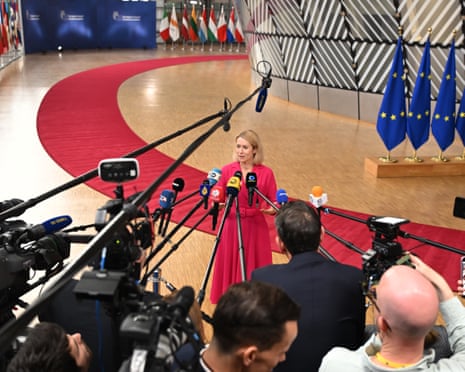
Responding to the US diesel deal with Russia, she said:
"The majority of Russia's funding for the war comes from oil revenues. Clearly, Ukraine wants this war to stop, and that's why … cutting off the funding for the war is the way to do it.
We see that we should squeeze … Russia, not Ukraine, to surrender to end this war."
She added that the EU has adopted a new round of sanction listings earlier this week, as "this is the only way to put pressure on Russia."
She also said that it's important to send a clear message to Russia that "all these things they are interested in – [unfreezing] frozen assets, lifting the sanctions – are actually up to Europeans to decide."
"And these things are not given for free for them," she said.
Germany's Friedrich Merz also focused on the budget talks, saying they remain "very, very difficult" and expecting them to run well into December.
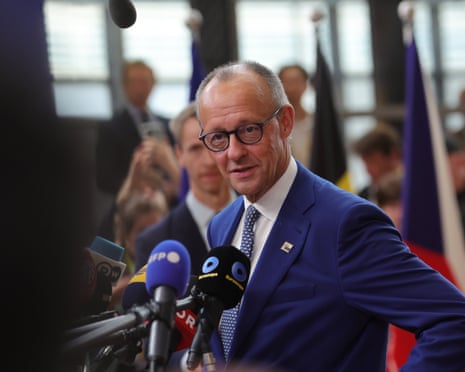
On Ukraine, he warned that "we are witnessing an increasingly ruthless wave of attacks by Russia," and said that "we must do everything possible to support Ukraine not just through the winter, but into next year as well."
"It remains my firm conviction that we are not merely defending Ukraine's territorial integrity; we are defending the political order of Europe, which is being subjected to intense pressure by Russia in every respect."
Hungary's Péter Magyar focused on other issues in his doorstep statement, particularly on migration and the next EU budget.
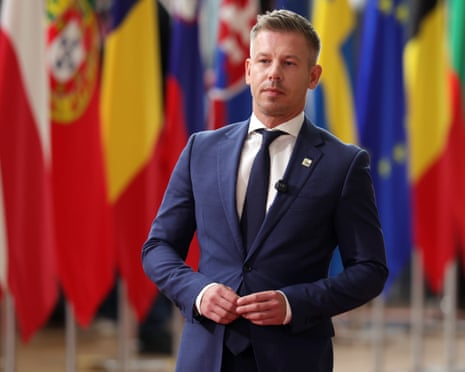
But he welcomed the much-awaited law reform in Ukraine that could resolve a longstanding dispute over the rights of the Hungarian minority in western Ukraine, which until now threatened to bloc Kyiv's accession path.
Magyar will hold a one-on-one with Ukraine's Zelenskyy tomorrow, his first since ousting and coming into power earlier this year.
Ireland's Micheál Martin urged Europe to "re-engage" with the US and figure out the best way forward, despite tensions over Ukraine.
"We have had moments in the past when there were challenges and difficulties in respect of this, and it was retrieved by good outreach and engagement from Europe with the US, and I have no doubt that will continue."
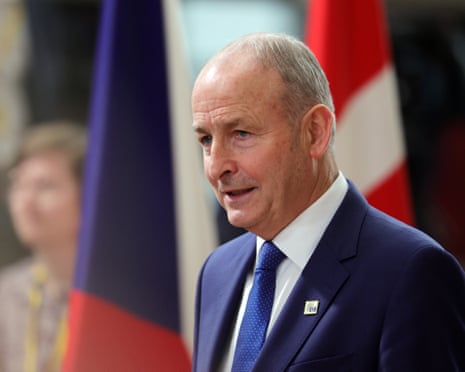
But he said the focus should also be on what the EU can do itself, and that's primarily to do with advancing Ukraine's accession process to the bloc.
"I would say to my colleagues across Europe that now is the time to be ambitious over the next number of months to open all clusters in respect of Ukraine and Moldova. The people of Ukraine need that as a very strong signal, given the extraordinary pressure they are under from the Russian attacks on civilians and civilian infrastructure."
He said "the most fundamental thing we can do in Europe now is to recommit to opening all clusters in respect of Ukraine's application." "That would send a powerful signal to the people of Ukraine that Europe is really progressing its pathway to accession," he said.
The recent attacks are "appalling and horrific, and it illustrates that Putin is not interested in peace."
"That's why we must manifest our support for Ukraine in the practical ways … and certainly the membership agenda is one of those."
Sweden's Ulf Kristersson also offered his backing for Ukraine, as he criticised Donald Trump's diesel deal with Russia.
"We very much regret this agreement on diesel. It's obviously not a very big part, but still, it's in the wrong direction. And every step now to help the Russians to increase their the financing of the war is a bad sign.
So we very much stick to view on this."
EU leaders are now arriving for the European Council summit in Brussels and understandably they get asked about the latest situation in Ukraine.
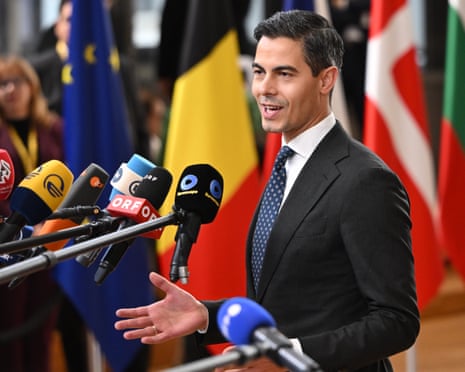
Dutch offered his strong backing for Ukraine and president saying "there is only one reason why this senseless war of aggression is continuing, and that's because Putin chooses to do so."
"He is the one that can end this war by starting negotiations for just and lasting peace. And as long as he doesn't, the Ukrainians will have to defend themselves and defend European values, and we stand shoulder to shoulder with the Ukrainians."
He urged other leaders "to do more financially, militarily, and non-militarily, because a lot of European countries are lagging behind in the support for Ukraine."
"So let's step up our game and make sure that they can win this senseless war."
As Ukraine reported problems with Starlink satellite internet terminals and US data that warns of Russian ballistic missile attacks, Kyiv also faced the harsh reality that its European allies cannot offer any ready-made alternatives, Reuters reported.
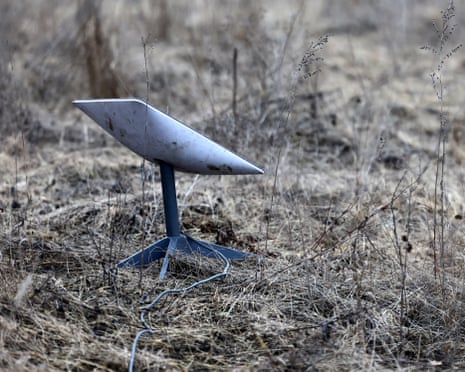
European countries have voiced strong support for Ukraine and Zelenskyy. But the problems with vital data highlighted that Ukraine and Europe depend heavily on US systems for both low-orbit satellite communications – provided by SpaceX via Starlink – that feeds into early-warning systems.
A US satellite constellation called the Space-Based Infrared System provides early missile warnings.
As for Starlink, Europe does not have a ready-made alternative that Ukrainian soldiers could attach to their drones, although European governments and companies are working on long-term options.
Shares in European satellite operator soared on Wednesday following news of Ukraine's difficulties with Starshield, fuelled by investor bets that European providers could benefit from growing strains between Washington and Kyiv.
Billionaire tech mogul Elon Musk has suggested that the US government could be behind the decision to restrict the speed of SpaceX's satellite-technology used by Ukraine's military.
In a post of X, he appeared to suggest the Trump administration was behind the move, which Ukraine says restricts its ability to use key defensive weapons.
Musk said:
"Starshield systems are owned and controlled by the US government. Any limits on speed or usage are decided by the US military and ultimately POTUS.
Starlink is a commercial service owned and controlled by SpaceX. Usage of Starlink is limited to civilian or defensive activities and cannot be used for offensive military action, as doing so would be inappropriate for a commercial company."
In further posts overnight, reacting to Zelenskyy's comments on his relationship with Donald Trump,
In a TV interview with Piers Morgan, Zelenskyy said he felt "betrayed" by Trump's decisions and worried about "losing a strong partner," playing a critical role across Ukraine's defence.
For what it's worth, Trump denied that his administration had cut intelligence sharing on Tuesday, but Zelenskyy said in an interview with US broadcaster NPR, aired on Wednesday, that military advisers had received threats from the US that intelligence sharing could be limited in the future.
The issue is likely to come up again today and tomorrow as EU leaders meet in Brussels for key political talks on the future.
With today's discussions focused on the bloc's internal matters, including the EU's next budget, Ukraine is expected to come up on Friday when Zelenskyy joins other leaders in Brussels. But the ongoing crisis in Ukraine's relations with the US risks overshadowing the entire meeting.
I will bring you all the updates throughout the day.
It's , it's here, and this is .
Good morning.