o we have to reassess Manchester City now? In my columns, I have repeatedly engaged with this club and its key figures. Looking back at what I have written over the years, I believe it remains beyond question that the team have achieved greatness. I always loved watching them: they were a true unit on the pitch, a finely tuned orchestra.
I would also write all over again that the conductor, Pep Guardiola, masters his craft like few others. I could recognise his teams even if they were wearing the wrong shirts and the game was broadcast in black and white – by the passes, the distances between the players and the intelligence of their interplay. It is no wonder Guardiola inspires others to become managers; look at Vincent Kompany, Mikel Arteta, Enzo Maresca, and perhaps some time Ilkay Gündogan and Rodri.
As a player and a columnist, I never had an issue with Manchester City. Precisely because, for many years, the club avoided buying the most obvious superstars. Guardiola said it himself: the most valuable of the valuable do not go to a club like City, who aren't even the biggest football brand in their own home town.
Many became world stars in Manchester. Kevin De Bruyne had been discarded by Chelsea, Rodri's true class was overlooked in Madrid for a long time, Gündogan's career was on the brink after injuries, and most recently Gianluigi Donnarumma was no longer wanted in Paris. In Germany, City signed players from Hamburg, Frankfurt and Wolfsburg. Erling Haaland in 2022 was the first player they targeted who was also pursued by Bayern Munich. City did not operate like Paris Saint-Germain did in the era before Luis Enrique.
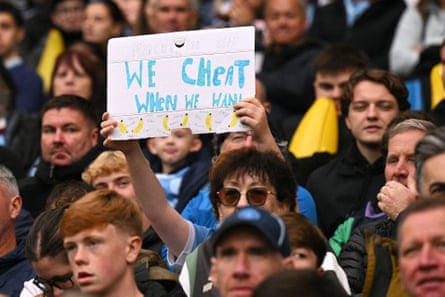
From the outside, City fundamentally did not do much differently from the other 10 or so top European clubs. But what are achievements on the pitch worth if they are accompanied by rule-breaking? The club has been found guilty of breaching the Premier League's financial regulations between 2009 and 2018. It allegedly invested almost €1bn more than allowed and declared. The league leaders face potential forced relegation or having titles stripped. City continue to deny wrongdoing and are appealing against the decision.
It is right for the Premier League to crack down on unfair competition. I also appreciate that Germany is holding on to the 50+1 rule, which the federal cartel office recently upheld. It ensures that the majority of voting rights must remain with the parent club – the non-profit section of a professional club. The exceptions that have applied to Leverkusen and Wolfsburg are under review.
The bedrock of our football culture is 50+1. This rule exists only in Germany, yet it speaks to a spirit that fits perfectly with the European sports model: 50+1 maintains a balance; on the one hand it allows for investment, on the other it guarantees participation. It strengthens the rights of members and fans. Perhaps it is because of this rule that the average attendance in Germany is higher than anywhere else in the world.
What is the ultimate purpose of football? It is a business, but its infrastructure is still developed by the general public. That is how I have always understood sport. Even as a professional, it was clear to me that my privileged life was made possible by many people working on a voluntary basis. Through my role as tournament director of the European Championship, these political connections have become even clearer to me.
The stadium and football clubs can remain the final places where people gather and society debates its issues only if the elite and the grassroots stay connected, and the public is involved in the process. Football must not be detached from its roots, as was the case with Manchester City. This becomes possible when rules are enforced by an institution. Ideally, not by a commercial entity but by a non-profit one such as Uefa.
In business, as in politics, I am observing a shift in mindset. Today, it is deemed necessary to invest in non-profit institutions. More and more companies realise that football allows for a genuine exchange with the population – that it provides the perfect vehicle to set up corporate social responsibility projects.
This is what is needed in these politically turbulent times. In our fragmented world, political parties, churches and the media have lost credibility. In sport, however, people still come together. It is a tool to foster social cohesion. Therefore, I consider 50+1 to be a distinct competitive advantage for the Bundesliga.
I also welcome the fact that rules mean something in another case. Uefa is standing firm against Gianni Infantino, who recently wanted to privatise the World Cup and its profits. Along with his friend Donald Trump, he was seen by many as breaking the normal rules when Folarin Balogun's suspension was lifted. The outcry from the global football community was loud, and it is possible that the Fifa president will fall.
When behaviour like that in Manchester and at Fifa is punished, it is a good thing. Football must prevent questionable ideas from distancing it even further from its grassroots. Only then can it drive engagement in civil society, and only then can it strengthen Europe.
Philipp Lahm's column was produced in partnership with Oliver Fritsch at the German online magazine Die Zeit.