French authorities have issued an overnight curfew, which will come into effect , for Place de la Republique and the streets around Les Halles in according to Libération and France24.
The measure will apply to three categories of people: unaccompanied minors, people wearing personal protective equipment, and those concealing their faces.
Authorities had earlier issued the country's first curfew to run for two days starting on Monday in the northern city of and surrounding cities of , and , France24 reported citing prime minister 's office.
Ahead of leaving for a campaign rally in Wichita, Kansas, again claimed – without evidence – that the riots throughout France are due to mass migration.
"I told Emmanuel [Macron], you should close up your borders," the US president said. "I've known him for probably eight or nine years. I told him as soon as I met him, I said, 'you're making a big mistake'. We closed our borders. He didn't."
in Paris
The near-universal chorus of condemnation that greeted 's address to the nation on Sunday, after one of the most violent days of rioting and looting in France's recent history, was a stark reflection of just how weakened he now is.
A month-long protest by high school pupils over crumbling and crowded classrooms converged with broader frustrations over soaring living costs, rapidly widening inequality and falling public spending, bringing together students, teachers, trade unionists and a resurrected movement.
Those largely peaceful protests were swiftly hijacked by masked groups who torched vehicles, ransacked businesses and severely damaged public infrastructure, including setting fire to Limoges' city hall and invading that of Marseille.
Macron acknowledged the "deep anxiety" of young people but offered no concrete policy initiatives, no cabinet reshuffle and no new public spending, merely telling his prime minister to organise consultations and asking opposition politicians to take a stand.
The response, across the political spectrum, was damning. The Greens' leader, , said that rather than "even beginning to make any kind of mea culpa", Macron was "summoning us to the PM's office like pupils to the blackboard".
On the far right, the National Rally's called the speech "lamentable" and said Macron had "nothing left to say" to the French. The party's figurehead, , said the country was "caught in a vice between violence and impotence".
The centre-right's said Macron was "totally overwhelmed", while on the radical left, accused the president of relying on "inaction and police brutality" in doomed hopes that the protests would simply fizzle out.
Perhaps most damagingly, even Macron's former prime minister said he would have preferred "decisions and initiatives that might lead to a return to order and the restoration of state authority … Our country needs to be governed."
Criticism is to be expected from rivals positioning themselves six months before a presidential election to choose Macron's successor. But its sheer ferocity underlines his isolation, the disdain in which he is held, and the anger he inspires.
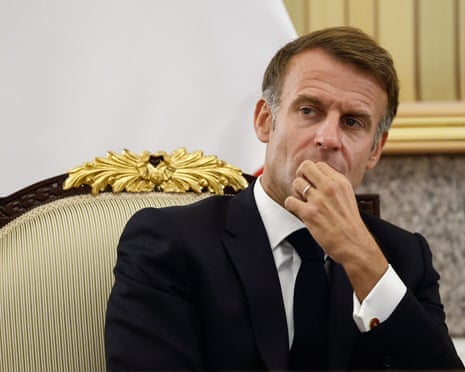
It's a structural trap that he has largely set for himself. Macron came to power in 2017 as a "Jupiterian" president – a deliberate strategy aimed at elevating the head of state above daily politics, projecting distant authority and technocratic brilliance.
But over nine years in the Élysée, that high-handed style – partly born, his critics say, of Macron's complete lack of basic political experience as an elected official in a town hall or as a constituency MP – has morphed into .
It has been compounded by catastrophic strategic errors, and France's spiralling economic problems. Macron lost a functional parliamentary majority by refusing to meaningfully campaign between the presidential and legislative elections of 2022.
Two years later he dissolved the national assembly. That gamble backfired spectacularly, with voters returning an even more deadlocked parliament split between a divided left, a much-diminished centrist bloc and Le Pen's far right.
Without a working majority, the government repeatedly resorted to controversial constitutional manoeuvres to force through laws without a parliamentary vote, laying it – and Macron – open to further accusations of democratic illegitimacy.
Compounding that institutional deadlock is a looming fiscal crisis. In decades gone by, French presidents facing mass protests on the streets could in effect buy a degree of social tranquility with targeted spending packages or public sector concessions.
But France's national debt, at 119% of GDP, is at its highest level since 1946. Its budget deficit, at 5.1%, is also among the highest in the EU. There is just no money in the bank to ease the cost of living squeeze that brought 550,000 people on to the streets on Saturday.
The markets are worried: France's borrowing costs are higher than Greece's. And with few fiscal options, the government's clearest response – in time-honoured French tradition – has been teargas and baton charges, sometimes against schoolchildren, further aggravating tensions.
The consequences for the presidential election could be profound. The centrist coalition built around Macron's brand has all but collapsed. If the protests and violence persist, the main beneficiary will be the law-and-order champions of the far right.
The US state department has issued an alert warning Americans to avoid demonstration areas in major French cities after days of violent protests that have rocked the country.
The alert issued by the US embassy in Paris noted violent demonstrations on 17 October and the new curfews planned in cities including Lille and Paris.
"Avoid the areas of the demonstrations," the warning said.
Justice minister Gérald Darmanin announced 2,513 people had been taken into custody and 67 people had been imprisoned since the violence that marred the demonstrations this weekend, Liberation reported.
Eleven people were arrested on Monday after disturbances at a shopping centre in Vaulx-en-Velin, near Lyon, BFMTV reported.
Here is the decree from the Paris police prefecture on the curfew which will be from 11 pm until 6am.
"The central median of the Place de la République" and "an area [...] delimited by the following squares and streets within it: Place Maurice-Quentin; Rue Berger from Place Maurice-Quentin to the corner of Boulevard Sébastopol; the section of Passage des Lingères that leads onto Rue Berger; Boulevard Sébastopol from the corner of Rue Berger to the corner of Allée André-Breton; Allée André-Breton."
The prefecture clarifies that "residents who can prove, by any means, that their residence is located within the aforementioned areas, workers [...], members of the public emergency services, and shopkeepers are not subject to" the decree.
Demonstrations will also be prohibited from 8pm to 6am in other parts of the capital, such as Bastille, Châtelet, or near places of power like the Elysée, Matignon, the National Assembly and the Senate.
A curfew has also been announced in central , taking effect from Monday at 9pm local time until 6am on Tuesday.
, the mayor of the southern French city of , has also issued a curfew "to protect the people of Nice" starting from Monday evening 9pm local time to 6am. The curfew will remain in effect each night until Sunday, and will only apply to minors, he said.
According to Libération, only certain areas of the city are affected: the city center, Old Nice, the Trachel district, and the Gare du Sud (southern train station).
Here's Ciotti's social media announcement.
French authorities have issued an overnight curfew, which will come into effect , for Place de la Republique and the streets around Les Halles in according to Libération and France24.
The measure will apply to three categories of people: unaccompanied minors, people wearing personal protective equipment, and those concealing their faces.
Authorities had earlier issued the country's first curfew to run for two days starting on Monday in the northern city of and surrounding cities of , and , France24 reported citing prime minister 's office.
The prefect of the Nord department has issued an order imposing a curfew for minors starting at 8 p.m. local time in certain areas of the cities of Lille, Douai, Wattignies, and Denain.
"These orders are issued in close collaboration with the mayors concerned," the prefecture said.
In Coulaines, a town of 8,000 inhabitants near Le Mans, the mayor, Christophe Rouillon, also announced on Facebook that he would be implementing a curfew "in the evening for minors who go out alone ," starting at 11 p.m. on Monday.
The right-wing mayor of a town in Maine-et-Loire has decided to fly the flags at the town hall at half-mast and remove the portrait of Emmanuel Macron following the demonstrations in France.
"I condemn in the strongest possible terms the violence and damage committed by those who flout our laws, vandalise our towns, and show contempt for the values of the Republic," Frédéric Mortier, the mayor of Longué-Jumelles, said.
"France cannot accept that some refuse common rules, reject the requirements of integration and challenge the authority of the State," he continued.
The mayor added that he had also decided "to take down the portrait of the President of the Republic in the town hall", explaining that the attitude of the head of state "in the face of this situation is unworthy of the gravity of the events and the expectations of our fellow citizens".
Last weekend there were mass protests across France, with more than half a million people estimated to have been involved. The unrest included rioting, looting and violent clashes with outnumbered police in cities including , and . The interior minister conceded that police "lost control" in some cities, while President demanded a full security review.
François Gatel, Minister for Territorial Collectivities, told the National Assembly there will be "the mobilisation of an exceptional fund to support the reconstruction of public facilities."
He added it will be "a one-stop shop to support disaster-stricken communities" to coordinate and facilitate the process. The minister also promised regulatory "flexibilities" to ease the work.
Four police officers were injured and a police station was vandalised in the Garenne district of La Roche-sur-Yon by "around sixty individuals dressed in black and wearing balaclavas" who fired fireworks and other projectiles, Liberation reported.
in Paris
Just before 1am on Monday morning, two motorbikes carrying one passenger each stopped at a traffic light on a backstreet near rue de Rivoli, one of central Paris's busiest shopping streets.
"You've got to go where there are a lot of people, where they've done the shop windows," said one motorbike rider to another. Minutes later 10 other men, their faces covered with ski balaclavas, came down the street on foot pursued by a police van.
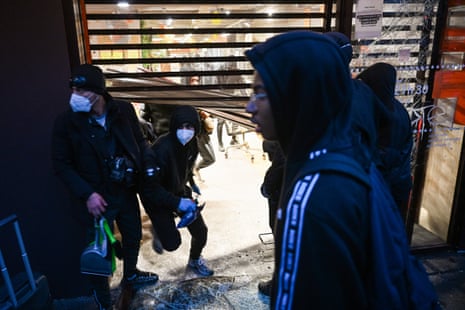
Soon after televised speech on Sunday night telling the nation it was "unbearable to see our streets ransacked", groups of men looted shops in central Paris for hours for a second night running. Dozens of people attempted to smash windows near Les Halles shopping centre and grab goods. Others broke into an electrical shop in Belleville in the north of the city.
"Men were battering shop windows, trying to break in, then they were chased by police," said a 73-year-old woman near Les Halles.
"There were different groups running everywhere with police chasing on foot or by car, and at the same time, some people were setting bins and bikes alight. The groups breaking into shops aren't hostile to passersby so you'd see local residents walking down the street on their way home late at night, and masked teenagers running past in the other direction carrying looted goods. It's so strange – it's like two different universes in parallel worlds."
She said:
"It says a lot about society – it shows we have neglected our education system and that we're living in a consumer society where all we say to our young people is: 'buy, buy, buy'. In this type of extreme capitalism, some people don't have enough money to buy all of this and so they attack."
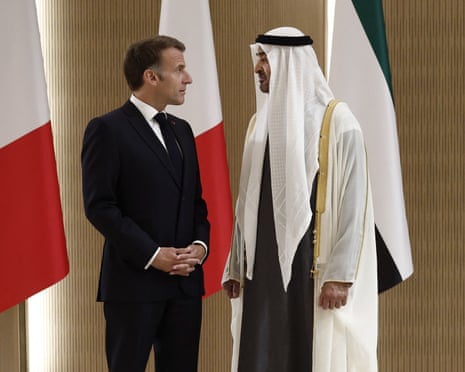
Meanwhile, as France was busy cleaning up its streets, the country's president Emmanuel Macron – who last night delivered an address to the nation on the events – arrived in Kuwait for a Gulf trip aimed at securing additional petrol and diesel supplies to bring down pump prices, Reuters reported.
During the trip, he is also visiting the United Arab Emirates.