ast month, just before his 30-night residency at Madison Square Garden, Harry Styles was spotted walking the streets of New York. According to the paparazzi who trailed him throughout his journey, he walked eight miles – all the way from Brooklyn into Manhattan – in loafers.
If, like me, you own a pair of loafers, your first thought is probably: that doesn't sound like a good idea. On Instagram, Grazia called Styles' shoes "perhaps the least sensible footwear for such an undertaking".
You might imagine that single outing would have taught Styles a lesson, but he was photographed a few days later in the same pair of loafers, which all the evidence suggests are dark brown, pre-distressed Prada "Shuffle" shoes that cost £910. At that price I wouldn't even wear them outside – they look soft and flimsy, like a cross between a moccasin and a ballet slipper.

However, following Styles' example, I'm suddenly determined to get more mileage out of my own, underused slip-ons. I mean to wear them every day, all day, for a week – and to walk at least eight miles in them, if not in one day, then at least cumulatively.
But first I have a question: could it be bad for my feet? What are the actual risks of such an undertaking?
"A loafer by construction has a smaller volume in the forefoot than a shoe that has a substantial fastening," says Dr Helen Branthwaite, chief clinical advisor at the Royal College of Podiatry. In other words, a slip-on shoe is narrow at the front because, without laces or straps, it's the only way it can hold on to your foot. "This may cause some compression to the toes if the shape and volume of the front of the shoe is not the same as the wearer's foot."
I send a link to a Styles/loafer pap shot to Christophe Champs, an orthotics specialist and the founder of the Podo clinic in London. "The main problem I see in that picture is a summer look," he says. "Summer is the worst season for us." Pounding hard city pavements in insubstantial shoes with no heel contour or arch support – slippers, loafers, flip-flops – can cause real problems. During this past hot summer, Champs says his clinic saw a fivefold increase in patients presenting with plantar fasciitis – a painful inflammation of the tissue connecting your heel to your toes.
For a couple of years the fashion world has remarked upon a gradual decline in the number of trainers appearing at runway shows, and the corresponding trend for loafers. "The younger customer is asking for styles that were particularly hot in the 1970s," shoemaker Tim Little, owner of footwear brand Grenson, told Esquire in January. "Thin, slim-soled, often tasselled, and, above all easy on the feet." GQ also recently declared that loafers were the "most crucial shoes of 2026".
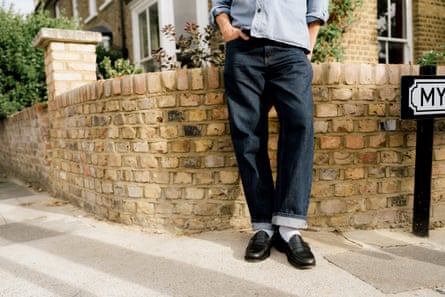
It's raining the first time I decide to wear my loafers all day, and I'm pretty footsore by suppertime, having covered no more than three miles. Along the way I've experienced both toe compression and heel slippage. But the shoes also hurt because I've never worn them long enough to break them in properly, even though I bought them years ago. Mine are sturdy, thick-soled penny loafers, quite unlike Styles' pair.
Styles' shoes, I've come to understand, are a fashionable slip-on subset sometimes known as a "scrunch loafer". They're so completely without structure that they look as if they've been run over by a steamroller. Perversely, Styles' loafers have laces.
But, according to Champs, there is a bigger and more common problem than walking eight miles in scrunch loafers: the widespread habit of wearing running shoes on one's daily commute. He says the soles of most cheap modern trainers are too high, too light and too cushioned to provide proper support. "You look at people from behind and it's painful," he says. "They're on big fat sponges. So at least Harry doesn't have this."
His compromise recommendation for men's walk-to-work footwear is a well-made dress shoe. "It's time now to bring patients back into dress shoes," he says. "But when my patients see my shoes they tell me, 'Christophe, that for me is wedding and funeral.'" When he holds up his shoe to the Zoom camera for me, I'm surprised to see they're not unlike my loafers, albeit with a pair of his own orthotic inserts tucked inside (Champs got into the orthotics game because of foot injuries he suffered as an athlete).

On my second day in loafers, I manage five miles in total, but by the evening I can feel my crowded fourth toes beginning to climb up over their larger neighbours. I'm beginning to see the appeal of Styles' £910 slippers – at least your foot isn't boxed in all day. And while it would probably be wise to alert fans to the dangers of emulating his choice of long-distance travelling shoe, it doesn't mean it's necessarily a problem for Styles himself.
"If Harry Styles is comfortable in loafers, and he can dance and walk in them, then he must have a strong foot, with a complementary shape to the shoe in question," says Branthwaite, pointing out that Styles is a trained performer. "If someone else wishes to walk eight miles in his shoes, then they would also need to do the same training and practice."
In Champs' opinion, Styles' footwear, while wholly inappropriate for an eight-mile hike, is by no means the worst option. "Those shoes are not so bad for a short walk," he says. "It's actually more dangerous to wear decent shoes that are out of shape because they've been used for too long. Shoes need three things: to be recent, decent and laced up."
That's enough advice to persuade me to give up my loafer marathon halfway through day three, and long before I've walked eight miles in them. Then again, looking at all the other shoes in my cupboard, it's possible they're still my best bet.
Later I was made aware of even more recent paparazzi shots that showed Styles wearing flat-soled light blue trainers. Maybe he's learned his lesson after all.