
Emma was 17 when she met a man on a dating site. On a video call, she says, he secretly took screenshots of her naked after she had undressed for him.
According to Emma, he obtained more during the relationship and threatened to share them if she did not do what he wanted.
"If I were to end the relationship, he would expose them. If I were to not do what he said, he would expose them," she says.
Sextortion, or sexual extortion, is often associated with demands for money, but Emma's case shows intimate images can also be used as a means of control.
Reports of sextortion have risen sharply, with the Metropolitan Police, National Crime Agency and Childline all recording increases last year.
Emma is not her real name and the BBC is disguising her identity.
She had never dated anyone before and had been talking to a 26-year-old man for a while on a dating site before they had a video call.
They liked the same things. "He seemed like a normal guy," says Emma, who is from London and now in her 20s.
His camera was not working, he told her, but he could see and hear her fine. By then she trusted him. The conversation turned intimate and Emma undressed.
Nothing about it felt wrong to her at the time and she had no idea he was taking screenshots.
"I'm a very trusting person, so I never thought it would happen to me. You can either call it naivety or always seeing the best in people."
He regularly threatened to expose them as a way of controlling her and getting her to do what he wanted, or prevent her from ending their relationship.
What frightened her most was not what it would mean for her, but what it would do to her family - above all her father, who she believed could lose everything, including the career he had spent his life building, if the images were released.
"That he would ruin my father. That was it. That's all he had to say.
"He would ruin me. But I didn't really care much for myself."
She says he cut her off from the people around her.
"I became more secluded, more isolated, more drawn back. I completely broke, I suppose. He really managed to break everything.
"You're a teenager, so you've already got the teenage problems. And to have something like that happen when you haven't even started your life, it stops it, ruins it. You don't really see a future any more after it."

Childline, the NSPCC's free counselling service for children and young people, told the BBC it was increasingly hearing from children who were pressured by ex-partners into sending more explicit images to stop existing ones being shared, or threatened with images stolen from their devices.
Other sextortion tactics involve the creation of fake nude images, sometimes using AI tools, while some victims are blackmailed for money by someone they met online.
It delivered 1,043 counselling sessions in the year to March 2026 in which a young person mentioned threats to share sexual images - an average of 87 a month and 52% more than the 685 the year before.
"When children are contacting Childline, they talk about feeling incredibly distressed," says Rani Govender, associate head of policy for child safety online at the NSPCC.
"They're really worried about what their family or friends might think about this, so they can feel really isolated as well and quite cut off from the usual support mechanisms."
Govender says some children who report images to online platforms are not seeing action taken quickly enough.
The NSPCC is also calling on technology companies to use existing tools to prevent children being exposed to this kind of abuse.
In June, the government gave technology companies three months to show meaningful progress towards blocking the ability of children to take, share or view nude images, warning that it would legislate if they failed to act.
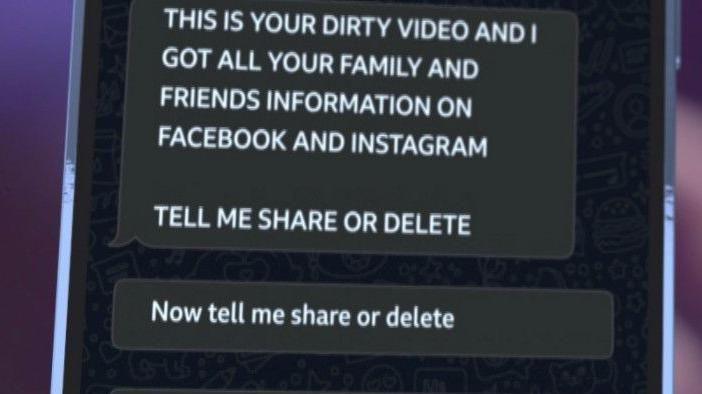
In many of the cases now being reported, the motive is financial - and some teenagers have taken their own lives after being targeted.
The National Crime Agency, the UK's lead agency against serious and organised crime, runs the CEOP Safety Centre, which takes reports of online child sexual abuse.
The Safety Centre received 1,473 reports of financially motivated sexual extortion in 2025 - 163% more than in 2023.
Separate figures obtained by the BBC show the Metropolitan Police recorded 983 blackmail offences in 2025 in which the word "sextortion" appeared - up from 533 the year before, a rise of 84%.
The NCA says sexual extortion is nonetheless significantly underreported and believes the true number of offences involving children is much higher.
Sean Sutton, the agency's former head of partnerships and education, says the response from police is the same in every case.
"In policing, we will say a hundred times out of a hundred, this is never your fault. You have been coerced, you've been cajoled, you've been manipulated, you've been threatened.
"Always, if you can, report it, because the offender could be doing this to a number of other people too."
Emma never went to the police. She says she did not report it because by then she had turned 18: "I always thought because I had turned 18, so I was technically an adult." She deleted the messages to try to heal - something she now regrets.
Taking or possessing intimate images of someone under 18 is a criminal offence regardless of how old the victim is when they come forward, and reports can be made at any time.
"I wanted it all gone. I wanted all of it to be forgotten," Emma says.
She later received support from the Marie Collins Foundation, which helps victims and survivors of online sexual abuse.
"It's vital that they know they are not to blame, that support is available, and that no-one should ever face this abuse alone," the charity says.
Emma agreed to speak in the hope of helping others. "Firstly, you're not alone. That was my biggest enemy."
More than a decade on, she says the effects remain.
"I have to wake up every single day and pick up the pieces. I have to drag something that someone has put on me. And that's unfair. I didn't ask for it."
Get in touch
Do you have a story to share with the BBC London investigations team in confidence?