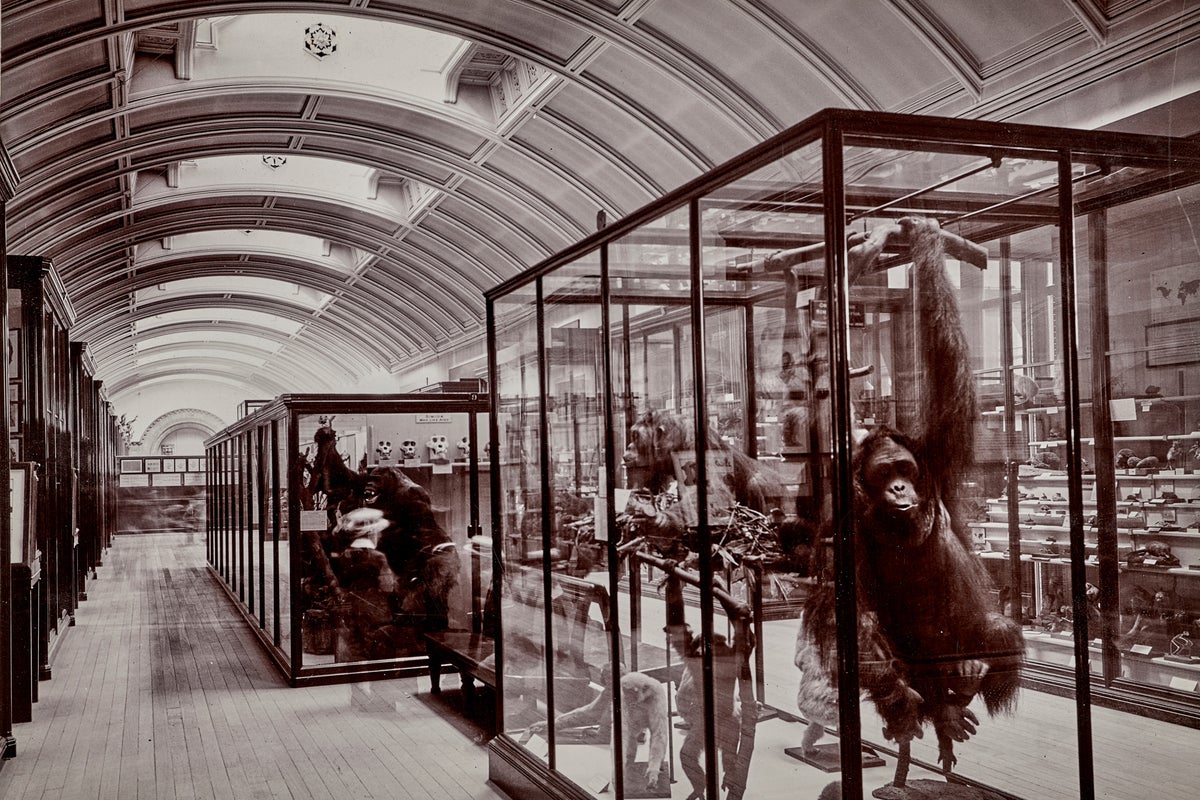
A hidden gallery at the Natural History Museum that has been closed since the Second World War will reopen.
For the first time in over eight decades, the Nature and Us space at the London institution will welcome visitors this September, having been closed to the public since 1943.
The move forms part of NHM150, a transformation project that will launch a new or revitalised gallery each year leading up to the museum's 150th anniversary in 2031.
The gallery will initially reopen for 18 months on September 16 with Nature and Us, supported by the Natural Environment Research Council, where visitors can explore our evolving relationship with nature through 50 remarkable objects.
A miniature model of a Crystal Palace dinosaur is among the key specimens and historic objects that illustrate how early scientists and artists once imagined prehistoric life.
The space will also display the Victorian skeleton of a monk seal named Jenny to show how wild animals were exploited for entertainment.
Further items include a bryozoan-encrusted Star Wars toy from the 1980s, showing how everyday objects acquire new meanings through nature and time, alongside a 400,000-year-old hand axe whose discovery reshaped our understanding of when humans first existed.
Visitors will also be allowed to touch a replica jaw from one of Britain’s earliest domesticated dogs, dated around 14,300 years ago, showing the long relationship between people and dogs.
Dr Doug Gurr, director of the NHM, said: "Reopening this remarkable gallery is an exciting moment for the museum.
"For the first time in over 80 years, visitors will be able to step into this beautiful historic space and explore our changing relationship with the natural world.
"It’s another important step in our NHM150 transformation as we create new spaces that inspire people to become advocates for the planet."
Located on the second floor of the main museum’s Waterhouse building in South Kensington, the space historically served as both an osteology (skeleton) gallery and a mammals gallery.
After the museum’s original herbarium was damaged during the Second World War, the gallery was repurposed to house botanical collections and closed to the public.
Its original wooden herbarium cabinets remain in place, reflecting its history as a working scientific collections space.