With your art collective Centre for Political Beauty you built a replica of the memorial on a property next to the home of an AfD politician. Now you've written a history book about the Nazis' rise to power. Don't we already know everything there is to know about the 1932 elections, the Reichstag fire and the Enabling Act of 1933?
About three years ago I became interested in how Hitler's National Socialist German Workers' party (NSDAP) rose to prominence when Germany was still a democracy, because I hoped it could tell us something about the success of rightwing extremist movements today. From looking at historical sources, I realised that the Reichstag elections of 14 September 1930 were in many ways more important than what happened in 1932 and 1933. And I expected it to be an open-and-shut case. But the more I looked into it, the more I realised that most of the theories we have to explain the rise of the Nazis don't make sense – the data tells a completely different, far darker story.

Why were the 1930 elections so important?
The numbers behind the vote were astonishing. In 1928, the NSDAP got 800,000 votes and 12 seats in the Reichstag. A few weeks before the 1930 election, Hitler's propaganda chief Joseph Goebbels, history's grand master of exaggeration, still thought they had a chance of going up to 50 to 60 seats at best. Yet on the night, the Nazis got 6.4 million votes and 107 seats. That's a ninefold increase over the space of two years. In one night, a small splinter party from the political fringes overtook the three established parties of the right – the Centre Party, the DVP and the DNVP – coming in second place behind the Social Democrats. It was an enormous shock. It was the moment at which a racist sect of loudmouths and club-wielders, a party of absolute cranks, came to be politically legitimised.
You call the NSDAP a "party of cranks". Didn't Hitler have a certain dark charisma?
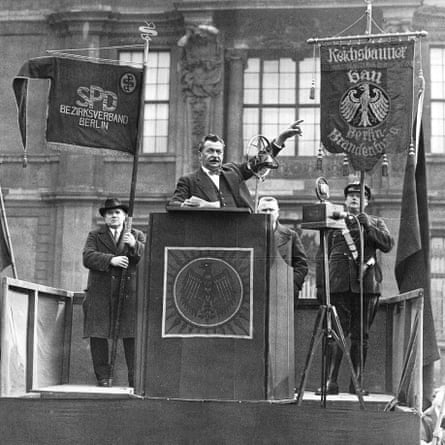
Among German historians, this has long been the dominant theory to explain the Nazi party's success: that Hitler had an irresistible inner aura that captured the masses. There's a second theory that is very similar, the idea. It argues that the NSDAP was so irresistible because it had a leader that spoke to Germans' yearning for authoritarianism. The problem is: I couldn't find any evidence before the 1930 vote to support those theories. Because in 1930, every party was practising a star cult around their own political leader, even the Social Democrats. The Nazi party didn't have a USP in that respect. And the Nazis didn't even seem to be wholly on board with the principle themselves at this stage. Several people in the party complained about the "Byzantine" star cult around Hitler, which is also why the campaign wasn't really tailored around him as a personality. Let's remember that in 1930 Hitler wasn't even on the ballot, because he wasn't a German citizen: he was a foreigner who had a criminal record for trying to mount a coup and was at risk of being deported.
I had grown up seeing Hitler as a monster, but one with a certain political talent. And after 1930, that's not entirely untrue. But when you focus on 1928 to 1930, even his biographer Ian Kershaw concludes that the NSDAP's success had very little to do with Hitler. He was going through an absolute dip in form. He only held 29 speeches in 1929, half of what was customary, and 21 of them were all in Bavaria. In 1930 Goebbels spent half the year complaining about Hitler's prevaricating: when he travelled to Munich to track down the NSDAP leader, he didn't even bother looking at the party headquarters. "The Reich leadership is at [Hitler's favourite coffeehouse] Café Heck or the cinema," Goebbels wrote sarcastically. In 1930, Hitler wasn't a political genius. He was a lazy criminal who slept in until noon.
If not Hitler, was propaganda chief Goebbels the figure behind the rise of the Nazis? One explanation being revisited these days is that political crises tend to go hand-in-hand with media crises: that the Nazis pounced expertly on new forms of media like illustrated news, radio and film.
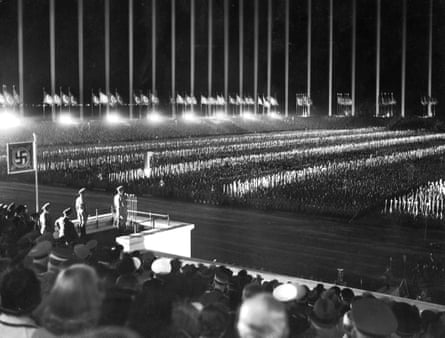
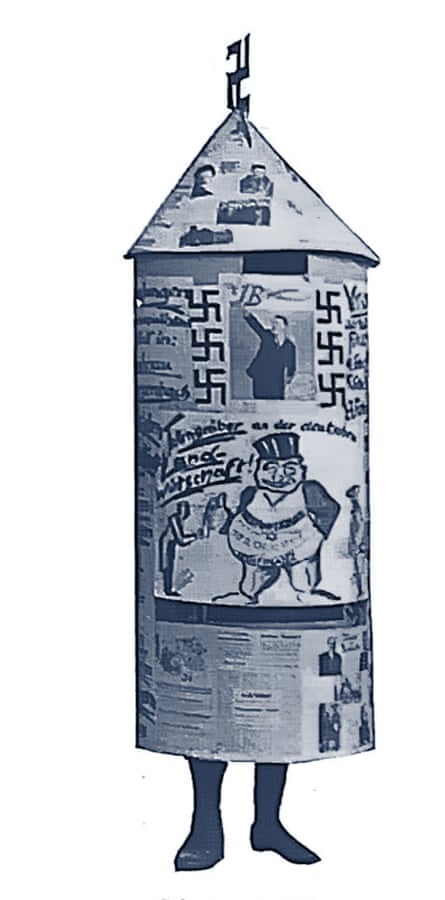
When we talk about the Nazis, everyone has these images in their head that point to this slick propaganda machine: the Nuremberg rally, the cathedral of light, all these awe-inspiring spectacles. And it's true that pre-1930 Goebbels invested a lot of effort into building up propaganda newspapers inspired by American formats, such as Der Angriff, Völkischer Beobachter and Illustrierter Beobachter. But early Nazi propaganda was an embarrassing, amateurish joke. I've looked through every edition of Illustrierter Beobachter, and the images they presented to the reader were laughable, such as SA men dressed as advertising pillars. It just wasn't professional. The sales figures were pathetic: nobody was reading these newspapers. Compare it to the means that the other parties had at their disposal: they put up neon signs on street corners and hired planes for aerial advertising. Propaganda just doesn't explain the NSDAP's success.
What about the economy? The on Wall Street had ed a year beforehand, German exports were collapsing and unemployment was on the rise.
It's always tempting to fall back on economic factors when explaining the rise of fascist movements. We are hearing it again in Germany now: the economy is crumbling, the trains aren't running on time, so people are going to fall for the fascists again. But if I look at historical sources from the run-up to 1930, I come away thinking that voters weren't that stupid. Take the unemployed. Over the last 30 years, historians have established a pretty good picture of who voted for the NSDAP. And we can say with certainty that in regions where unemployment was high, the Nazi party performed relatively poorly. If anything, unemployment was a factor contributing to anti-fascist resilience. And as to the idea that the Nazis managed to attract young first-time voters, the same applies: the NSDAP also performed badly in areas with high rates of first-time voters. The young were also running away from this party.
The global economic crisis may explain why the NSDAP managed to double its support in 1932 and attain 37.3% of the vote. But as an explanation for the ninefold boost in 1930, it falls short. Wall Street's Black Thursday didn't fully arrive in Germany until July 1931, when several major banks collapsed – 10 months after the Nazis got 107 seats in the Reichstag. The Weimar Republic's GDP went into a tailspin, with a 36.6% collapse, only over the course of the two years that followed – by the end of 1930, it had merely shrunk by 7.1%, and we don't know how much of that was as a result of the election outcome. There's a risk here of confusing cause and effect.
What if we look at the democratic parties instead?
One of the central tenets of the Nazi party's campaign was the alleged corruption of the established parties, but there is very little evidence that this was actually the case. The most striking – and also the most puzzling – thing I learned was that all of the three big rightwing parties of the Weimar Republic had put political hardliners in charge between 1928 and 1929. If voters had really been desperate for tough rightwing policies, they could have voted for the Catholic Centre party, the nationalist liberal DVP or the monarchist DNVP – all parties in a pole position to turn their promises into practice.
Didn't they just experience what many conservative parties are finding out now: that when they copy the positions of the , voters tend to prefer the original?
I think that's a platitude that simply isn't true. Because in 1930 Hitler wasn't the original, he was a washed-out copy of what was offered by the DVP or the DNVP. The DNVP ran a more antisemitic campaign than Hitler, and yet it was the biggest loser of the election, shedding 7.3% of the vote. What strikes me as much more important is credibility. In 1930, the nationalist-liberal DVP was attacked by its own party newspapers for betraying the legacy of its former leader Gustav Stresemann, who had died a year earlier. It's not unlike the situation we now have with Germany's Christian Democrats: a party that under Merkel was absolutely centrist and managed to retain loyal voters but then picked a figure from its right wing as their new leader in Friedrich Merz. And voters are switching to the AfD. The central lesson to me is that conservative parties can only win from the centre.
You say credibility is . Then why do corruption scandals barely seem to hurt the modern parties railing loudest against 'the system'?
It's true that the NSDAP in 1930 was absolutely riddled with scandals: back-stabbing, power struggles, corruption, the whole spectrum. And many German journalists at the time believed they were just one more scandal away from complete collapse. There were some excellent and brave journalists leading some really good investigations. But it didn't work.
I look at far-right parties across Europe now, and I see undercover reporters revealing the AfD's remigration plans, leading to the biggest protests in postwar German history. And these kinds of investigations are extremely important. But fascist or rightwing extremist parties seem to be immune to this kind of stuff. They are like lightning rods: the scandal is a flash of energy that passes straight through them into the ground and then it's gone. A corruption scandal might temporarily damage a party, like the "Ibiza affair" did to the Austrian Freedom party, but five years later they are back at double their strength.
So why the Nazis perform so strongly in 1930?
As paradoxical as it sounds, it might be for the same reason that voters turned away from the Nazis in 1928: its propensity to violence. Ever since Hitler had been in the NSDAP, he had talked about one thing: executing his political opponents. And the Nazi party remained absolutely consistent in that respect. In the run-up to the 1930 vote, it didn't talk about social policy, it didn't talk about building the autobahn. It just had murder plots.
How does that help us understand the rise of fascist or extremist movements today?
It's hard to admit this from a modern perspective, but historical fascism's lust for violence didn't make it repulsive but extremely attractive to a lot of German voters. And we are seeing similar things with the AfD today, where fantasies of violent retribution seem to be integral to campaign events on market squares. We are witnessing the poisoning of an entire society, and as a democracy we should ask ourselves whether criminal law shouldn't apply when political parties communicate that way. Communication is one thing, political plans are another. The NSDAP had both. But we know that the AfD is a radical party that seems to want to ethnically cleanse Germany. If the AfD is voted into power, one of the most highly advanced economies in the world could experience something similar to what happened in Bosnia and Herzegovina.
-
Philipp Ruch's Der Rückfall (The Relapse) is published by Penguin