In these early days of AI evolution, experts suggest parents help guide their kids through the new technology as much as possible. But the reality is that the world of AI is a scary one for many parents, who may already correctly believe their children are far more au fait with it than they will ever be.
Economist and author Daniel Susskind, who studies how AI affects work and society, believes that making the most of AI involves embracing the extraordinary opportunities it brings, and he outlines the way to do this in his new book, What Should My Children Do? How to Flourish in the Age of AI.
He says: “We must find a way for the next generation to flourish with AI – and I strongly believe that we can.”
Here are some of his suggestions for how young people can make the most of AI…
Get back to basics
Susskind says although it’s impossible to predict what jobs will be in demand and what skills will be needed when AI really starts to impact the job market, basic skills like literacy, numeracy and critical thinking will still be essential.
“They are the foundations for every other skill: we need them firmly in place if the next generation is to flourish,” he stresses. “That means we must keep teaching these basic skills, even if AI does them better – as it increasingly seems to do.”
Teach AI properly in schools
The next generation must be taught to use AI effectively, Susskind stresses, and to do this properly “a serious chunk of time” needs to be dedicated to it in schools and universities.
“It is a new core skill that must be mastered,” he says, pointing out that this could include reorganising existing subjects and adding standalone AI classes.
But he stresses: “The biggest challenge of all is to teach the next generation to use AI without setting them up to forget crucial basic skills. We have to help them to flourish with this new technology, and also to flourish without it.”

Teach and test all subjects
Susskind suggests that being able to cope with and without AI means teaching and testing it and other subjects equally, and points out: “Fortunately, we’ve been here before – the electronic calculator in the Eighties.”
He recalls that when calculators started to be used in classrooms, maths education was divided in two, with some taught with a calculator to help young people solve hard problems, and some taught without a calculator so maths didn’t fall into disuse. And both were tested, he says, so both were “taken seriously”.
He says: “We need to do the same with AI now, adopting this tried and tested strategy – ‘teach both, test both’ – in every subject that we teach.”
Remember AI isn’t the same as social media
Susskind says he shares a lot of the worries people have about the impact of social media on young people, and supports many of the proposed age restrictions. But he stresses: “AI is not the same thing as social media, and I fear that well-informed restrictions on social media are being bundled together with knee-jerk restrictions on AI – for instance, banning ChatGPT in the classroom. This would be a big mistake – not all screens are the same.”
He says that while AI often relies on smartphones and social media to select what users see on feeds, “Social media all too often dehumanises, consuming too much of our attention and distracting us from the real world.
“AI used elsewhere has the potential to empower, to help make our lives go far better.”
He says the potential harms of social media often “cast a blanket suspicion” over AI, and poisons how we think about it generally.
As a result, he says: “Well-informed restrictions on social media are being bundled together with knee-jerk bans on ChatGPT and other AI systems. On the contrary, some screens are extraordinary and can be used to do remarkable things, if we use them in the right way.”
Engage thoughtfully with challenges posed by AI
AI presents some “very real dangers”, warns Susskind. “Chatbots, for instance, that nudge users towards suicide or have explicit chats with teens.”
And he says that with particular technologies, such as AI companions: “The risks may be so great that we ought to keep the next generation away from them altogether.”
But while it’s increasingly acknowledged that social media, for example, can have negative effects on some young people, Susskind says there’s little of that clarity with AI. “These technologies are both new and entirely unlike anything we have ever seen,” he says.
“We are all still figuring out how to make best use of them, still only glimpsing the full measure of what they can do.”
However, Professor Sonia Livingstone, director of the Digital Futures for Children Centre at the London School of Economics and Political Science, says that while Susskind “is full of inspiring ideas” about how children can flourish in the age of AI, and his advice is valuable, “It’s not practical for most parents, I fear.”
She says the best thing is an enthusiastic parent ready to share and learn with their child, but warns: “For many parents, the task is daunting – supporting children with AI requires time, energy and expertise. Ensuring they retain traditional skills as well as gain new ones is double the effort.”
She says Digital Futures for Children research shows parents are talking to their children less about tech and relying more on parental controls to keep them safe.
“Our research also shows children are excited, curious and experimental with AI, but largely unsupported by adults as they explore its possibilities. So there’s a clear gap between family practices and what’s needed to enable children’s confident and safe learning about AI.”
She says ideally, children will be taught to understand AI critically at school, while families talk together about its pros and cons at home.
“Parents should talk to their children about AI’s pitfalls,” she explains, “especially misinformation, political bias, cognitive ‘offloading’ and emotional manipulation, and possibilities – notably, access to information, learning by asking all kinds of questions, and ways to create or code professional-level outputs.
“We need to provide children with recommended apps, and suggested challenges, just as we recommend books or games that facilitate learning and play safely.”
And AI expert Dr Mhairi Aitken, director Our AI Collective CIC, adds: “Children aren’t only affected by AI through the ways they use AI tools, but even more so by the ways others use AI in ways that affect their lives.”
She says this includes schools using AI to monitor pupils’ work, behaviour and attendance, and official bodies using AI to make decisions about families in relation to health and social care, housing and many other important areas.
“So when we consider what children need to know about AI, it’s crucial we don’t simply focus on teaching them how to use AI tools,” she stresses. “We need to teach them about how those tools are built and the impacts they have.”
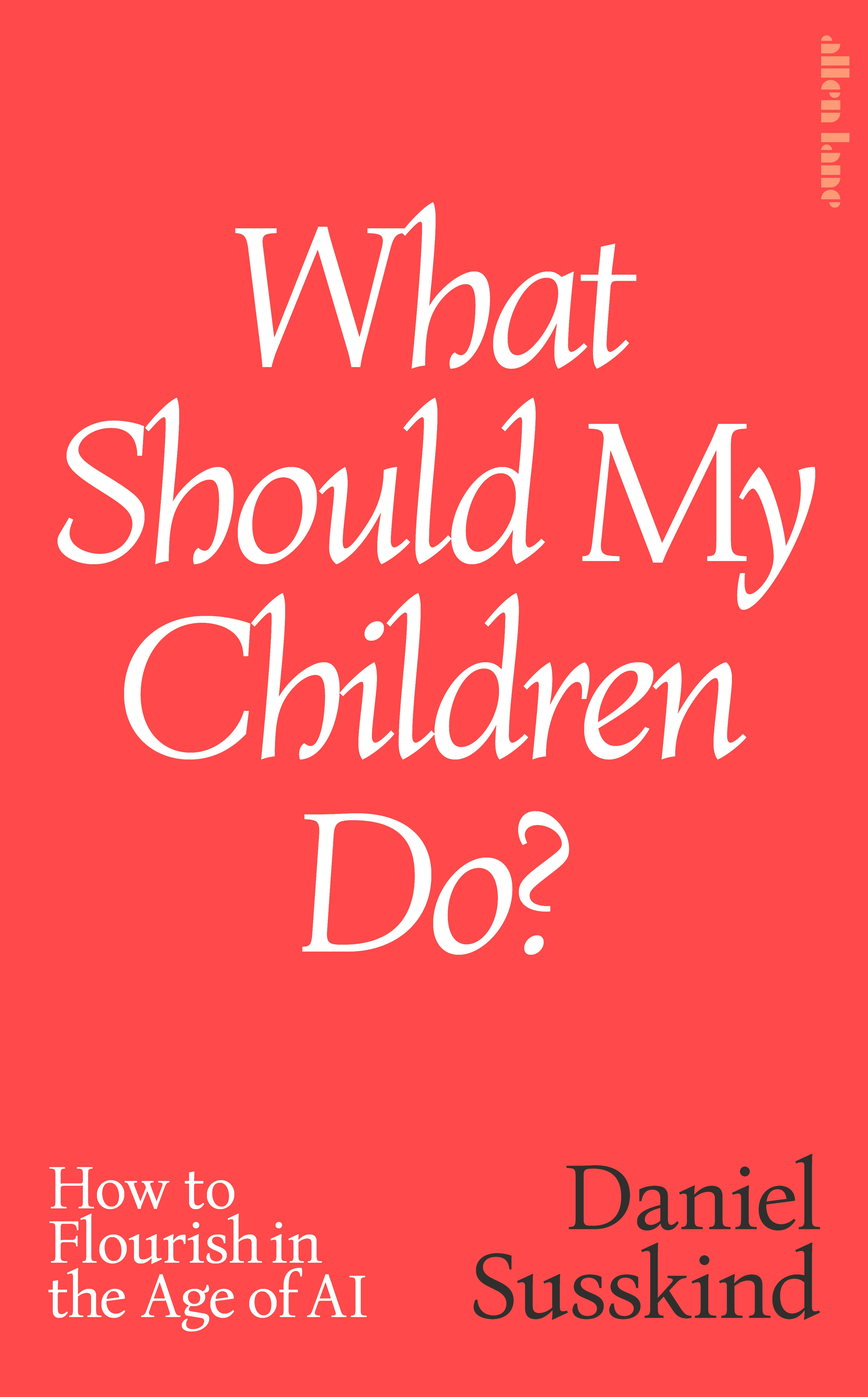
What Should My Children Do? How to Flourish in the Age of AI by Daniel Susskind is published by Allen Lane, priced £20. Available now.