t's not that Shane Brown somehow didn't know about the US Senate election in South Carolina. Nor was he unaware that the outcome of the race between Senator Darline Graham and her Democratic challenger, Annie Andrews, was shockingly competitive when he refrained from voting Tuesday.
The campaigns would not let him forget it.
"Oh, text messages, phone calls, TV, you name it: it was everywhere," Brown said of the onslaught of political advertising he endured. "Like, the joke at work was the first person who stops texting me is the one we'd probably vote for."
No one stopped texting Brown, who typically votes Republican. By election day, he said: "Nobody really won me over."
In a stunning upset, Andrews was elected to the seat previously held by the late Republican senator Lindsey Graham, after defeating his younger sister, a political novice encouraged to run by Donald Trump.
The electoral earthquake has left political observers in South Carolina reeling, trying to understand how Graham could have stumbled in a state as fireball red as South Carolina. Looking at who came to vote and who stayed home reveals part of the answer.
"I think there's one stat of the day," said Tyson Grinstead, Republican national committeeman for South Carolina. From 2024 to 2026, "there were 500,000 people who voted in the 2024 presidential election who did not come back in the midterm."
"Of that 500,000, 400,000 were Republicans," he said.
Midterm elections are historically lower turnout affairs than presidential elections, and in most midterm elections the drop-off in voting numbers is larger in South Carolina. But more Black voters and other traditionally-Democratic voting groups showed up than would otherwise be expected this year, Grinstead said. And more Republicans stayed home.
The post-mortem really will be: why did that happen, and what can we do about it moving forward?" Grinstead said, adding: "The story of the night isn't that South Carolina is getting materially bluer; it's that we weren't able to turn out the statewide vote we normally do."
The results of other contests tell part of the story as well. In an election that sent a Democrat to the senate from South Carolina with a comfortable five-point margin, voters also elected a Republican governor and lieutenant governor, secretary of state, treasurer, attorney general and other statewide offices by similar margins.
"South Carolina is not a Democratic or purple state; South Carolinians remain a conservative lot," said state senator Shane Massey, majority leader of the Republican caucus in the South Carolina senate. "But they were upset with how some elected officials handled their work."
The 62-year-old Graham was appointed by South Carolina's Republican governor Henry McMaster to serve out the remainder of her brother's term after his sudden death in July. Though initially viewed as a caretaker, she was publicly urged to run for office by the president, upending the contentious GOP primary to replace her brother.
"Senator-elect Andrews's victory shouldn't be confused with broad ideological support for her platform," Massey added. "It was primarily a rejection of the alternative and a desire to send a message. Voters expect their officials, Republican or Democrat, to address real problems rather than just screwing around."
Berkeley county, one of South Carolina's fastest growing counties in the fastest growing state, voted for Trump by a margin of about 16 points in 2024. On Tuesday, Andrews drew a nine point victory margin – a shift of 26 points toward a Democrat and among the largest swings in the state.
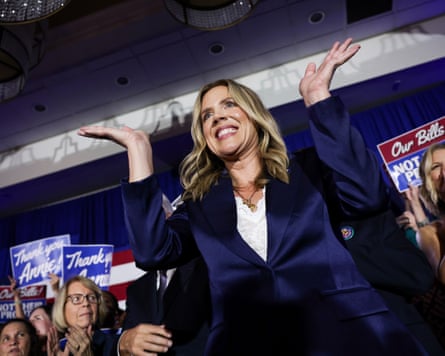
Some of that can be attributed to the congressional race to fill the seat vacated by former US representative Nancy Mace. The winner, retired admiral Nancy Lacore – fired by defense secretary Pete Hegseth in a purge of female and nonwhite general officers – flipped its partisan control in a race that goosed Democratic turnout across the first congressional district.
And some of that can be attributed to Graham's weakness as a candidate.
Voters said they felt like Graham had been selected for them, and they had seen that play before.
"I only voted Trump, honestly, because I couldn't vote for Kamala because she was forced. We didn't get a choice," said Brown. "That was my issue with Darline, too. It was the same exact thing to me … They selected her. The powers that be said: 'This is the person you guys get to vote for.' And that's not the way it should be."
She has had to dig out from under a series of public gaffes that called her competence into question, beginning with her comments during a primary contest debate in August against US congressman Ralph Norman that "national security is not my thing" and "I'm not that informed on national security".
Norman picked at Graham as the campaign wore on, in an act of sour grapes that makes the conflict between Haley Stevens and Abdul El-Sayed in Michigan look like a shopping cart collision. A low-key write-in campaign for Norman fueled conservative skepticism about Graham. Party activists remain bitter about it all.
"You know, here's this woman who was most likely at Belk buying a pocketbook on 10 July, and she gets put in the Senate," said Randal Wallace, a South Carolina real estate professional, Republican political commentator and former Myrtle Beach city councilman.
"And then they asked her to run. And who's going to turn the president of the United States down when he asks you to run? And our party couldn't get behind her to help her through this whole thing?"
Wallace is furious.
"Norman does this little wink and nod, 'Well, my family's not going to vote for her,' and then he called her a fraud," Wallace said. "He sent a signal to everybody up there and to all of his people not to help her. And they didn't. And they succeeded. Annie Andrews is your senator. But I promise you, I'll never forgive this."
As the campaign became more competitive in the final stretch, Graham's aides increasingly limited her availability to the press and the public, pulling her abruptly from the spin room after her sole general election debate with Andrews. The Democrat's campaign pounded Graham with advertising, bought with donated money from around the country.
South Carolinians have weathered a deluge of political ads before: Jaime Harrison lit $130m on fire trying to beat Lindsey Graham in 2020. The result was a 10-point loss. But this time, there was no Lindsey Graham to raise money, Massey noted.
"Following Lindsey Graham's death, we had a chaotic sprint primary format," Massey said. "The nominee was selected in mid-September, leaving Darline Graham only six or seven weeks to run as a first-time candidate, compared to nominees in other states who had months. Lindsey had spent most of his campaign funds in the primary under the assumption that he could easily raise whatever general election money he needed."
Annie Andrews raised $24.2m for her campaign. Graham raised only $1.9m.
The underlying anger of the electorate also contributed.
In the county Wednesday afternoon, Derek Rosado loaded $450 worth of groceries into the back of his truck at a Publix in Moncks Corner. He found Andrews's victory last night delightfully surprising.
"I mean, something's got to change," Rosado said. "And I think with the Democrats finally taking over again, I think they'll bring the prices down. They see what's going on, and it's not just South Carolina, it's the world.
"I mean, let's be real: why are we fighting over in Iran? Why are we in a war there? Still going on with the Middle East stuff, spending trillions of dollars for a war that's not even ours."