ressed in a Royal Air Force uniform and sporting a trim moustache, Andrew Scott looks slightly queasy – as well he might. Behind him is a huge map of the Channel, and in front of him is Brendan Fraser, looming with a request: "I need a forecast," he says.
Starring in the film Pressure, based on a true story, Scott plays the meteorologist Gp Capt James Stagg – the man who must tell Gen Eisenhower – played by Fraser – whether conditions will be suitable for the D-day landings scheduled to take place on 5 June 1944. But a large storm is approaching the Normandy coast.
The film, showing in cinemas in the UK and Ireland from 9 September, unites two topics that ceaselessly fascinate the British: the second world war – and weather.
It is also a rare treat for meteorologists, who are not hugely represented on the big screen and are delighted to be portrayed as the heroes of a film.
Dr Stephen Burt of the University of Reading, an adviser for the film, said the challenge Stagg and his colleagues faced was enormous. "To do a forecast beyond 24 hours was, in the 1940s, like trying to land a man on the moon," he said.
Scientists had only recently started to use upper air data to predict the weather, he said, and largely relied on surface measurements of pressure, temperature, dew point, wind speed and direction, aand experience-based intuition.
One difficulty is that most of our weather comes in from the Atlantic. "Nowadays we have satellites and so on and we can see what's coming, we have observations coming from the US," he said. "But then there were … just a couple of ships, a couple of submarines maybe and some aircraft observations. And that's it."
Crucially, the week before D-day was the hottest May week on record, Burt said – a high that was only broken this year. Then a huge storm blew up, with another close behind.
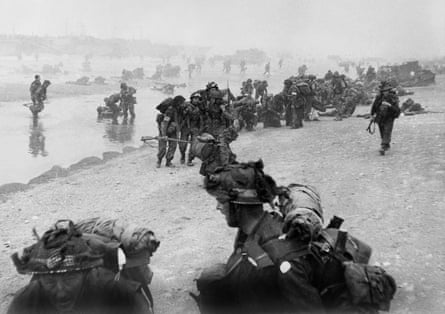
Prof Ed Hawkins of the University of Reading, an expert in historical weather data collection and examination, including D-day, explains that there were three teams working on the D-day forecasts – although only two are depicted in the film – all feeding into Stagg. But they took different approaches and produced different forecasts.
It was up to Stagg to reconcile the results and present a recommendation to Eisenhower that would, ultimately, affect 160,000 Allied troops. "Stagg was in a very difficult position. He left his very pregnant wife to come and do this very important task," Hawkins said.
The teams were split about the forecast for 5 June – with Stagg concluding the conditions would be too perilous. The landings were postponed. But by the evening of 4 June a consensus emerged: there appeared to be a small but suitable window on 6 June. The invasion was back on.
"They managed to do the forecast, and the invasion, and get away with it," said Burt.
Burt and his colleagues agree that even modern systems based on artificial intelligence have struggled to accurately predict conditions for 6 June 1944 using data available from the time.
"[I'd] still have been chewing my fingernails on morning of the sixth," said Burt.
Catherine Ross, a Met Office archivist, said film-makers used exact replicas of records from June 1944. "We were able to provide images of every single weather chart that was being produced at the time. We had codes and examples of how the observations were sent in and all sorts of documentation," she said.
She notes that even before modern technology, allied forecasters were on the front foot in terms of access to data. They already had data from the UK and across the Atlantic. "But because of Bletchley Park they had broken the Enigma code, so they had access to all of the German weather observations as well," Ross said.
While the German forces may have been aware of the storms, they were not aware of a potential break in the weather. "Sometimes there's no Atlantic on the [German] chart, which is where the weather was coming from in early June 1944," she added.
It is no spoiler that D-day was a success for the British, but the film sheds new light on the drama that unfolded behind the scenes.
"It's the most famous forecast ever made by the Met Office. It's probably one of the most important weather forecasts in history," said Ross.