Supporting the right for people of African descent to return to the continent has become a key pillar of the growing global push for reparatory justice from Britain and other colonisers.
When Ghana's president, John Dramani Mahama, visited Jamaica this month he addressed the issue of repatriation for Jamaicans and others whose ancestors were kidnapped from Africa and sold into transatlantic chattel slavery.
His visit coincided with a month-long series of emancipation celebrations and came as Jamaican officials prepare to travel to the UK to formally lodge an unprecedented petition with King Charles to seek legal guidance on their slavery reparations claim from Britain.
Speaking in Jamaica's parliament, Mahama described repatriation as "a right of all persons of African descent".
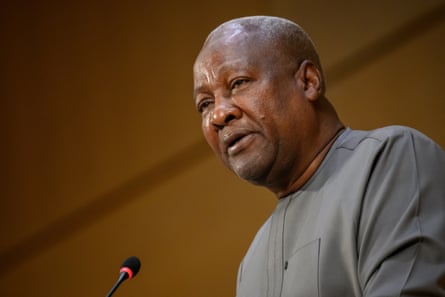
He said this was why Ghana had in 2000 passed the Right of Abode Act, which allows eligible people of African descent to apply for the right to live and work in Ghana without a visa.
His country was also "considering a new homeland return bill that will codify residence and citizenship pathways for all members of the global African family".
This was welcomed by the Caribbean reparations movement. Repatriation and resettlement is one of 10 points outlined in the Caribbean Community Reparations Commission's vision for reparatory justice.
For the Jamaican author and cultural activist Barbara Blake Hannah, Mahama's visit was a signal that Africa was beginning to open its doors, and "an achievement in the struggle for repatriation".
Like many Rastafarians across the Caribbean, she yearns to be repatriated to the continent from which her ancestors were kidnapped and transported across the Atlantic in the most inhumane conditions to become the property of Europeans.
"When you become a Rastafarian, there are certain things you get taught as principles … one of them is to return home," said Blake Hannah, who started becoming a Rastafarian in the early 1970s.
In her new book, The Jamaica Reparations Handbook, Blake Hannah, a cultural liaison for Jamaica's ministry of culture, describes this drive to return to Africa, as "the most powerful and continuous demand made by Rastafari".
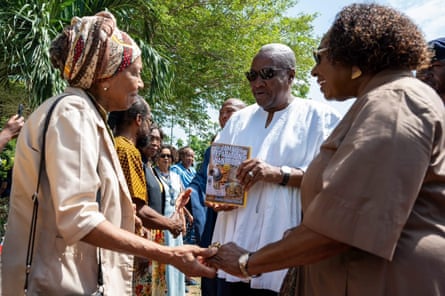
"Every Rasta wants to return. So, Rastafari said we need reparations to finance our repatriation … so, reparations was to be the payment for our return to Africa," she said.
Aaron "Ras Iron" Alexander, the president of the Iyanola Council for the Advancement of Rastafari and Pan African People in St Lucia, agreed.
"We've been the vanguard of these issues, which we have been championing for many decades. And because of it, we were vilified and branded insane. And now we see that these issues are fast becoming part of one of the most important movements of the 21st century: the fight for reparations," he said.
For Dr June Soomer, a founding member of the Saint Lucia National Reparations Committee, repatriation is inseparable from identity. Returning to Africa either physically or by connecting with the history and culture that was ruptured by transatlantic enslavement was important for all people of African descent.
"In every attempt at rebellion … those who jumped over the ships in chains, the aim was to go back to Africa," Soomer said.
Describing her first visit to Johannesburg, she added: "My heart started to beat differently. You felt like you were coming home. So, I understand how Rastafarians feel disconnected from their origin. And if you're looking at origin and identity, it is very important to go back to Africa."
In her book, Blake Hannah argues that "the cruelty of slavery was not erased by emancipation" and there was no attempt to restore the heritage, land rights, language and customs that had been ripped away from African people.
"Rather, it was expected that all citizens should aspire to copy the colonial behaviour, create versions of their own, and conform to the rules that kept 'The System' operating in a continuous repetition," she writes.
She sees repatriation as a spiritual homecoming, but also a right of those who lost their true identity through the trauma of slavery.
Steven Golding, of Jamaica's National Council on Reparations, stressed that repatriation was not solely about physical relocation. It was about rebuilding the economic, cultural and psychological ties severed by slavery.
"It doesn't necessarily mean all of us are going to physically move to Africa … but by recognising your citizenship, the continent recognising you as a citizen … that is what repatriation means," he said.
Repatriation was also about undoing the mental damage of slavery and colonialism, he said.
"We lost our language, we lost our culture, we lost our religion … it was systematically done," he said. "Repatriation reflects the reclaiming of those things."
But Golding, who is the president of the Universal Negro Improvement Association and African Communities League, which was founded by the Jamaican pan-Africanist Marcus Garvey, stressed that there was precedent for physical repatriation.
"Because the issue is the trafficking of the people, a fundamental part of the remedy has to be the return of the people," he said. Golding points to Ayuba Diallo and Abdul Rahman, two African princes who were kidnapped in the 1700s and trafficked by Europeans, but were later repatriated.
He also refers to the 18th and 19th centuries, when Britain and the US established Sierra Leone and Liberia specifically to repatriate freed Africans. Then in the 20th century, the Ethiopian emperor Haile Selassie gifted land to African people in the diaspora.
Following this, Garvey's movement placed African redemption and repatriation at the centre of its political philosophy.
"It's not some highfalutin 'smoke ganja and we want to go home' concept," Golding said. "It really comes from a sound socio‑economic political theory".
The Rastafari movement, he added, emerged directly from Garvey's Black nationalist project, which envisioned Africans in the diaspora returning to help develop the continent.
The idea of people returning to Africa, Golding said, was becoming a policy conversation, with Ghana and several other countries offering forms of citizenship or right-of-return programmes for people of African descent.