roviding a large dinghy for use in the choppy seas of western Europe was not a problem, as long as the order was for more than 20 vessels, they said. The sales manager at the Chinese company even had an online brochure for an undercover Guardian reporter, posing as a prospective client, to peruse.
They had a production capacity of 500 boats a month and, yes, it was possible to get even bigger ones for the right price. They could do a seven or even an eight-metre military-style dinghy for $1,678 (£1,238) a boat, without the engines, but that would be lacking CE certification, the mandatory mark that shows a product meets EU health and safety requirements.
"We can sell this big boat to China warehouse only," wrote the sales manager on the Made in China messaging platform. From there, it was up to the client to export it and get the right certification.
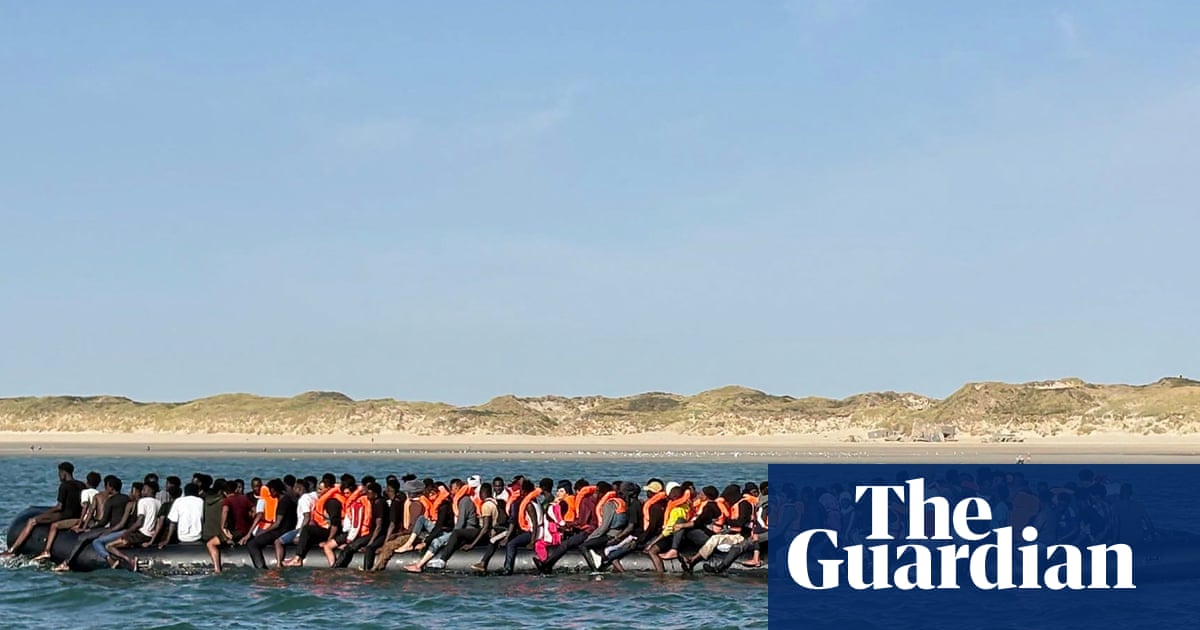
In the early hours of Monday morning, a full-to-the-brim dinghy of a type similar to that being offered by the Chinese salesperson arrived in the UK after crossing the Channel with a record 230 people onboard. French authorities say there have been 11 such "mega-dinghy" crossings of the Channel so far this year. Last week one of those carrying 173 people capsized after its engine caught fire.
It is a clear and perilous trend. An analysis by the Migration Observatory at the University of Oxford, based on Home Office figures, shows how the number of people travelling on a dinghy has sharply increased since the crossings first began nearly a decade ago.
In 2018, there would be an average of seven people per small boat. That ticked up to 13 by 2020. The number shifted up to 27 by the following year and by 2022 it was 41. The average number of people on a dinghy crossing is up to 66.5 people in the first six months of 2026. These are often no longer small boats. The length of the dinghy that arrived this week was 15 metres.
Where are the "mega-dinghies" coming from? The sales manager offering boats to an undercover Guardian reporter worked for a company called Wuxi Funsor Marine Equipment that is described on its own website as a subsidiary of the Weihai Yamar Outdoors Product Co Ltd.
Weihai Yamar, which is headquartered in an industrial park in Wenquan Town in Weihai, in the eastern Chinese province of Shandong, was put under economic sanctions by the UK in July last year for offering rigid inflatable boats for sale on online retail platforms to organised crime gangs smuggling people across the Channel. Weihai's largest shareholder at the time is now the main shareholder of Wuxi Funsor Marine Equipment. Weihai Yamar has denied advertising lifeboats and boats for migrants online.
The likely onward journey of dinghies from eastern China can be traced thanks to the recent trial of Adem Savas, a Turkish national identified by the National Crime Agency (NCA) as one of the key enablers of small boat crossings.
Between 2019 and 2024, Savas was said by the NCA to have supplied inflatable boats, outboard engines and equipment to gangs across Europe, enabling thousands of crossings, including around half of all Channel crossings in 2023, generating millions of pounds in profit.
Savas was the primary equipment supplier to a Kurdish smuggler, Hewa Rahimpur.
The boats and engines were sourced largely from China, transported from Turkey through Bulgaria, and stored in Germany before onward distribution to smuggling networks in Belgium and France.
A Netherlands-based haulage firm facilitated the logistics. A raid coordinated by Europol in December 2024 resulted in 25 searches in Germany and the seizure of equipment and cash.
Savas pleaded guilty in a court in Bruges to people-smuggling and being a member of an organised crime group and was sentenced to 11 years' imprisonment and a €400,000 (£340,000) fine. Savas's co-defendants received combined sentences of 38 years.
A spokesperson for Europol said the shift to larger boats was plausibly an indication that the gangs were getting desperate.
"I can confirm that Europol – and within our agency specifically the experts forming the European Centre Against Migrant Smuggling (ECAMS) – is aware of this development," the spokesperson said.
"We are in constant exchange with the appropriate authorities in both France and the United Kingdom on this phenomenon and also have a dedicated operational taskforce running that concentrates on smuggling of migrants with boats (no matter if relatively small boats or, as of recently, larger boats) across the Channel.
"As with any criminal phenomenon, a change of tactics used by criminal networks may be the result of law enforcement pressure."
Mihnea Cuibus, a senior researcher at the Migration Observatory, said the mega-dinghy phenomenon made economic sense for the gangs as they faced pressures on their supply chains from the authorities.
"It's simply much more efficient, much more profitable for gangs to pack as many people as possible on one boat," he said. "What we've seen in the last few weeks with some of these so-called mega-dinghies is an acceleration of this longstanding trend.
"It's very likely to do with increased enforcement in and around the French coast in particular. We've seen the authorities work, quite differently, targeting the supply chains and making it hard to get hold of the small boats in the first place."
Weihai Yamar did not respond to a request for comment.
-
Additional reporting by Lyndon Li