oo many animals are regarded as "bugs". And, if anything is a bug, it is a short step to it becoming a "pest". Too many of us have a learned fear – it's not innate – of anything with six legs or antennae.
I'm a big fan of the invertebrates and I love the Guardian's invertebrate of the year competition because it focuses people's attention on the little things rather than the typical animal superstars – the pandas, tigers and orangutans. In their diversity and varied ecology, the million-plus invertebrates on our planet often lead far more intricate and interesting lives than large animals with spines, like us. We urgently need to generate a much broader awareness of their beauty and importance. All these small creatures are as integral a part of our ecosystems as the fluffy things that we may want to put on our calendars.
I've always tried to champion invertebrates on Springwatch. One of my greatest joys filming the series over the years was meeting a naturalist who knew about tree slugs. I'd spent my life looking at trees with slime trails going up their trunks but I'd never bothered to get a ladder and investigate. So the discovery that every night these slugs venture out and climb to the tops of oak trees and then slither back down again before dawn breaks is amazing. And it's all happening just over the fence.
I'm 65 and the other day I caught an insect in my kitchen that I'd never before thought to identify. It turned out to be a parasitic wasp, one of more than 330 species of netelia, a genus of ichneumonid wasps. It was a cinnamon colour, with huge eyes because it is nocturnal and parasitises large moth caterpillars. It actually packs a powerful sting for humans, which I had no idea about. We are constantly learning about the miraculous alternative worlds unfolding all around us. In this invertebrate universe, there is an enormous repository of fascination just waiting to be discovered.
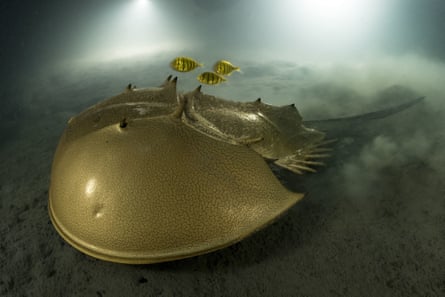
I have previously encountered the third-placed invertebrate in this year's competition. I once visited a beach in Florida where horseshoe crabs had spawned and died. There were so many that you couldn't walk on the beach. It was like some sort of Jurassic apocalypse. Absolutely extraordinary.
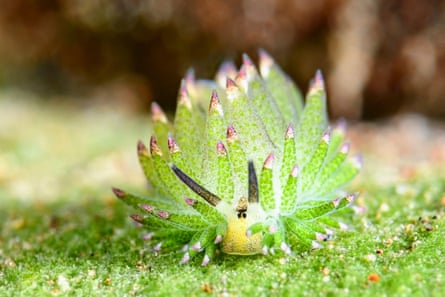
I didn't know much about this year's winner, the leaf sheep, until it appeared on the Guardian shortlist. Then I read up on it a bit more. Physically, they are one of these animals that might as well come from another planet; they have an amazing structure and life cycle. Taking in algae and using it to power yourself – only four and a half billion years of evolution could come up with something that wacko. It's absolutely brilliant.
Learning about these animals and celebrating them is important, but we want to know what we can do to help them too. The tempting thing to say is plant nectar sources and allow your garden to go a bit wild, if you're lucky enough to have a garden. We take joy in making spaces for these creatures in our local neighbourhoods and that's a battle, but it's not going to win the war.
We are running out of time – and here in the UK, we've got to lobby for better pesticide regulations. They've done it in France and reduced pesticide use on farmland. We banned insect-killing neonicotinoids in 2018 and yet this year, they have again been approved for "emergency" use on sugar beet crops. This should be causing an outcry. We need the public to pressurise the government into reforming and reducing pesticide usage.
We are at a point of absolute crisis in our relations with the natural world, and we've got to protect our invertebrates. We need a wider public awareness of them and their importance if we want invertebrate life and therefore the bats and birds and everything else – including us – to prosper. Awareness is good, but it's not enough. We must take action.
-
Chris Packham is a naturalist, broadcaster and campaigner