
Poppy Gibson had only just given birth when she thought she was going to die.
Eleven years ago, while pregnant with her second baby, she developed pain in her side which doctors thought could be the baby putting pressure on her lung.
Doctors then feared Poppy, from Rayleigh in Essex, was ill with pneumonia and decided to induce her at 36 weeks.
While her baby was healthy, her condition worsened and after suffering from seizures, doctors realised she had sepsis, with her husband Richard told to prepare for the worst.
"I can still remember overhearing the doctor... he told my husband to prepare for death," the now 36-year-old said.
"Although I couldn't communicate, I remember looking at him and he was crying, and he never cried.
"I just thought, I know he'll take care of my boys for me."
She has only been able to talk about her experience in the past two years and for September's Sepsis Awareness Month, she shared her story to raise awareness of the illness that can affect anyone.

At about 34 weeks pregnant, Poppy began experiencing shortness of breath and said "something felt different" compared with her previous pregnancy.
An X-ray found a shadow on her left lung.
"I'm only 5ft so it could have just been the strain on the body, but they were worried that it either could be from compression from carrying a large baby, (or) it could be pneumonia," she explained.
Poppy was given pneumonia medication, but nine days postpartum, she went into septic shock and had seizures.

An MRI revealed an abscess on her left kidney that had become septic and it was drained while she also had two blood transfusions.
She described knowing she might die as "terrifying".
"When I finally started feeling better, I wasn't the person that I was when I went in," she continued.
"My milk supply had dried up and when [my baby] could finally come visit, he was a stranger."
Poppy said the hardest part had been her mental recovery. She still worried about even minor cuts for herself and her children.

Three years ago, Sue Puddefoot, 62, from Saxmundham, Suffolk, went into Ipswich Hospital for a hip replacement.
Her husband Mark noticed she looked "absolutely awful" and doctors decided to test for an infection where her blood markers came back extremely high.
Doctors believed she had suffered a septic shower, where bacteria or toxins from an infected site are released into the bloodstream, rapidly triggering sepsis.
Due to being so unwell, Sue missed her son's wedding.
"It's really strange because I don't think it's actually hit me, it didn't hit me what I'd been through and the severity of it," she said.
Sue recovered, but quickly went downhill again, feeling very cold and shaking despite a normal temperature.
Doctors believed she had a second septic shower and Mark said "it had been very touch and go".
She had seven blood transfusions and years on she suffered from some memory loss and struggled to regulate her body temperature.
"I hadn't known anyone that had sepsis before," Sue said.
"It's worrying that there's so many people that haven't heard of it."
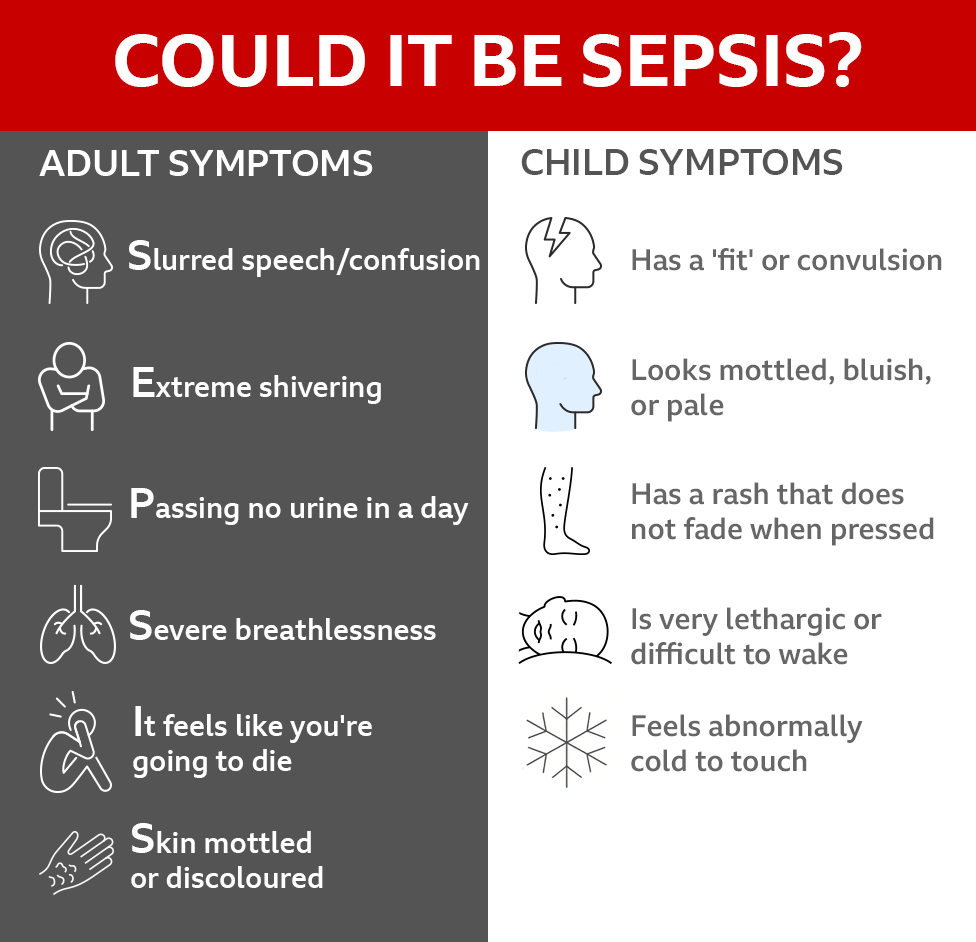
According to the UK Sepsis Trust charity, sepsis affects about 245,000 people a year causing 48,000 deaths each year.
It occurs when the body overreacts to an infection or an injury, and it starts to damage its own tissues and organs.
In children they could have very fast breathing, be convulsing, be very lethargic or have a rash that does not fade when you press it.
Meanwhile maternal sepsis, which develops during pregnancy, childbirth or in the months following, has a 10% mortality rate in the UK.

Amy Breslin is a midwife and a maternal medicine consultant for the UK Sepsis Trust. She said maternal sepsis typically masks itself extremely well.
"We really want people to be able to trust their instincts and act quickly," she said.
"So whether you're pregnant, have had a miscarriage or termination, given birth recently or if you feel seriously unwell, don't assume that it's part of what you're going through, and just ask, 'Could it be sepsis?'."
Prof Ramani Moonesinghe, NHS England's deputy medical director, said it was "vital" the NHS had an "ambitious plan" to tackle the illness and urged everyone to be aware of the signs.
"Key to tackling sepsis is catching it early – the longer sepsis goes undetected the less chance a person has to survive or make a full recovery," she added.
"That's why the NHS will be trialling new wearable devices that will allow people's vital signs to be monitored at home – so that if they deteriorate, they can get tested and treated faster."
Do you have a story suggestion for Essex? Contact us below.
Get in touch
Follow Essex news on BBC Sounds, Facebook, Instagram and X.