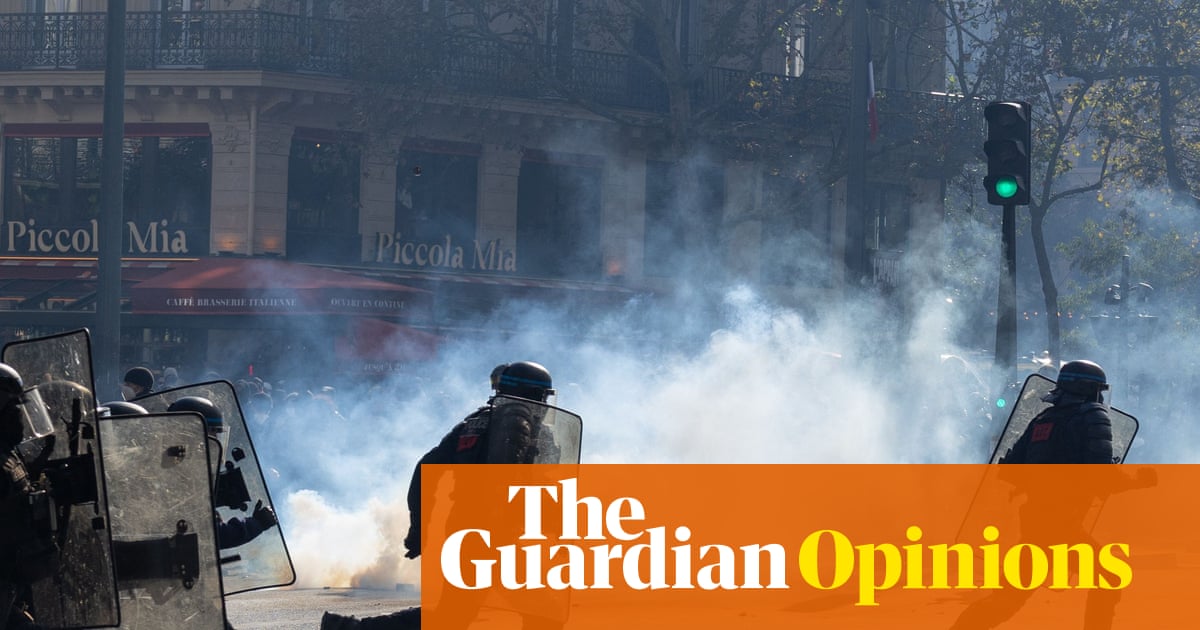
he first thing I learned on the streets of Paris this weekend is that there is no arguing with teargas. I arrived at Place de la République just after 1pm yesterday. The mood was festive until police started firing volleys of teargas into the square from Rue du Faubourg-du-Temple.
I didn't see the inciting incident – if there even was one – and tried walking into the cloud of CS gas hanging in the air. It was impossible. The gas clings to your nose and burns your eyes, and you quickly start struggling to breathe. I retreated towards the Boulevard de Magenta, blinking furiously to stop the stinging.
This approach to the crowd had been adopted by the authorities early in the day, causing chaos across the city and setting the tone for what would follow. A friend had to return to her home with her elderly parents because police had fired teargas "at random" at a crowd of young people in Strasbourg-Saint-Denis in the 10th arrondissement.
I headed back up the Boulevard de Magenta. There I met protesters including a student at the Sorbonne, who had come to "support the highschoolers first and foremost, and to demand more money in public schools, from primary schools to universities". Another major factor that he said had motivated him to come out on to the street "was the repression faced by highschoolers, who are under 18", such as an incident in Lens, where a police grenade blew a 15-year-old's hand to bits.
Other protesters I spoke to came from various sections of society: young, old, white and from ethnic minority backgrounds. People were there in their capacity as workers in a union, students in a lycée or individual citizens who had come out in anger at the rising cost of living. The price of petrol, the original motivating factor behind the 2018 (yellow vest) movement, had prompted several people to come out after it hit a record €2.4 per litre at the end of last month.
This section of the protest was completely peaceful, marching away from République, making lots of noise and climbing on scaffolding to fly flags, but otherwise doing nothing beyond articulating political demands. Between 550,000 and 800,000 people took to the streets across France as part of protests like these.
When I returned to République around 4pm, I saw that the situation had descended into chaos. Stun grenades were exploding everywhere, and protesters were throwing bottles at the police. Smoke from a blazing car filled the air. A branch of Nicolas, a chain wine shop, had its window smashed in and black-clad protesters looted it – not for the wine but for missiles to throw at police in retaliation for the stun grenades.
I was unable to stop and talk to people amid this fury, but my sense was that this was a combination of black bloc – anarchists who come out to many protests to cause trouble – , young and middle-aged people who were furious at the government and the police, and, of course, opportunistic young men looking for a scrap. As ever with street protests, many people, many motivations.
There were cries of the old slogan ("Resign Macron"). Beyond the organised group of hobbyist rioters, the dominant emotions seemed to be fear and rage. With each stun grenade the non-violent parts of the crowd were thrown into panic, but would then regroup and stand their ground while the rioters continued throwing missiles. Perhaps the feeling could be summed up by a poster I saw the day before the protest: "Lost hope, 17/10 to find it again. Fuck just about everything 17/10. We are already in hell meet on 17/10".
So what next? With more than 1,800 arrests, what will become of these people, this movement, these riots?
There is a sense among certain parts of the French population that making enough noise, including acts of vandalism, sends a signal to power. And indeed, there is some evidence to suggest this is the case. Neoliberal reforms have been rebuffed successfully on several occasions in France, primarily through strike waves or roundabout blockades – though these too had the presence of a radical fringe, willing to set fire to things.
As the dust settles, what will be the political repercussions? Marine Le Pen, attempting to profit from the situation, has positioned herself on the side of those angry at the cost of living, while condemning the looters. In a statement she described the French people as caught between the "austerity and fiscal hammering of those in power and the insurrectionary activists". She promised to "free" the French "from Macronist toxic policies and protect them from the violence of the far left". Carefully omitted was the fact that her party is proposing deeper austerity than even the Macronists, but the images of fire and looting that will be broadcast on every news channel reinforce her narrative of restoration of order to the streets.
Meanwhile, the French left, chiefly represented by Jean-Luc Mélenchon, is defending the protesters and seeking to channel their anger into the presidential campaign, focusing on the violence of the police over that of the rioters. The left may also be able to make gains from this tense situation.
While the government seems determined to continue with its budget unimpeded, it may only be a matter of time before another such explosion occurs. You can't argue with teargas, but it will only hold the inevitable at bay for so long.