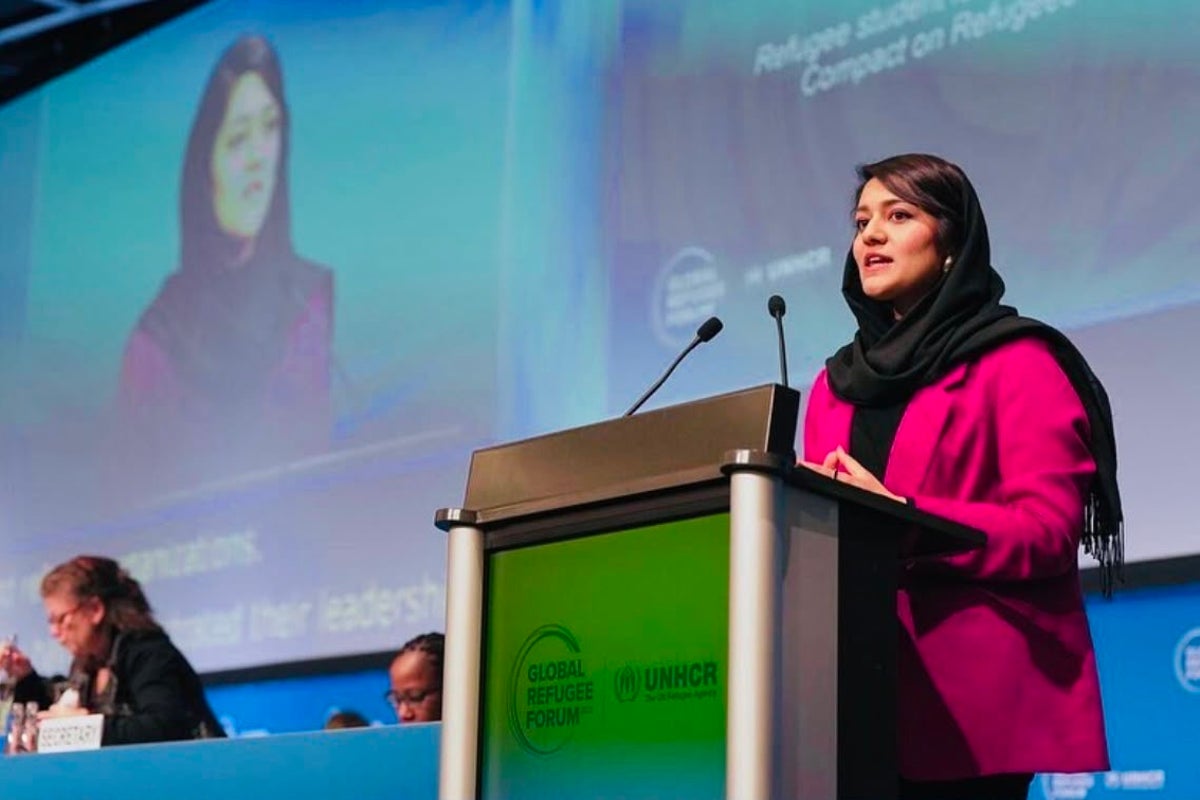
An Afghan human rights activist who was offered a place on a prestigious course at Oxford University has been blocked from entering the UK.
Aisha Khurram, a 27-year-old from Kabul, was awarded a rare place on a masters course in diplomatic studies at the university in May, just two months after the government implemented an “emergency brake” on visas for people coming from Afghanistan, Myanmar, Cameroon and Sudan.
She is one of 15 Afghan people offered places at the University of Oxford this academic year, freedom of information data shows, most of whom will be unable to start their studies after the Home Office reported a high number and proportion of visa-linked asylum claims are linked to the sponsored study route.
Ms Khurram told that after surviving the Taliban, separating from her family and having to retake her degree, she was heartbroken she couldn’t complete her education at one of the world’s most prestigious institutions not because of her ability – but because she’s Afghan.
“I think for me the most painful part was I actually crossed all the most difficult barriers. I survived [the] Taliban. I survived displacement. I had to rebuild my education and I had to get an offer from one of the most prestigious universities in the world.
“And then at the final stage I wasn't able to access what I've rightfully earned not because I was not qualified enough, but because I hold a passport that is not admissible to the UK government.”
The course at Oxford would have “opened the door to so many opportunities” for Ms Khurram as she hoped to fulfil a dream she’s had since finishing high school to study diplomacy, work in the foreign service for Afghanistan and “represent the rights and interests of the Afghan nation on the international stage”.
Ms Khurram was in her last semester of studies at Kabul University when she was forced to flee the Taliban in September 2021 after being informed of potential risks to her safety because of her experience as the first female Afghan youth representative to the United Nations in 2019.
After missing the main evacuation pathways, she travelled across eight provinces and exited her homeland through Iran, before receiving temporary humanitarian residency to Germany, where she had no proof of her previous academic achievements – or the fact she was due to graduate.
She eventually received screenshots of her transcript from a former administrator of Kabul University and was able to complete a bachelors degree at Bard College Berlin under a scholarship for Afghan students.
Education is a passion for Ms Khurram, who survived suicide bombings while exercising her right to learn in Afghanistan.
“We had the right to education,” she said. “But at the same time there was a lot of security challenges. I personally survived a lot of suicide bombing attacks that were close to my school.
“I usually say it’s a gamble to survive in Afghanistan. Even back then we had the rights but the security wasn’t there. But we continued.”
Ms Khurram has worked with the United Nations to help connect girls still in Afghanistan with international universities and continue their interrupted higher education while the Taliban restricts their rights.
“There was a lot of campaigns to make sure that Afghan girls continue to study secondary education into alternative pathways, but nothing was spoken about higher education. And I think that was quite alarming because Afghan girls being represented in the higher education landscape was the peak of Afghanistan’s achievement over the past 20 years.
“If we have lost that generation of Afghan women in higher education, then we definitely guarantee the loss of secondary and primary education because if we preserve them, that can trickle down to other generations as well.”
Ms Khurram, who has been separated from her family for five years, said she often thinks of her young cousins who aren’t able to receive an education past the age of 12 under the Taliban’s strict laws against girls.
“I cannot imagine what it would feel like because growing up in Afghanistan the sole pleasure I had apart from studying was also being able to enjoy those moments of beautiful social life with my peers and my sisters [in the classroom]”, she added.
The Universities of Sanctuary network, representing over a third of UK universities, accused the government of blocking one of the few routes where “talented students from conflict-affected countries can access world class education and rebuild their futures.
“Students who secure humanitarian and sanctuary scholarships from UK universities are typically among the most academically outstanding applicants in highly competitive global selection processes,” they said in March.
“Preventing students from these four countries from travelling to the UK risks denying some of the brightest young people the opportunity to continue their education and contribute their skills and knowledge to society.”
A University of Oxford spokesperson said: "We receive a significant number of talented students from countries affected by war and persecution. As a University of Sanctuary, we are committed to ensuring that outstanding offer-holders from crisis-affected backgrounds can take up their places at Oxford."
A government spokesperson said: “The UK will always offer sanctuary to those fleeing war and persecution, but we must restore order and control to our borders.
“Asylum claims by Afghan students and skilled workers have risen sharply and begun to outstrip the number of visas issued. In order to ensure our border security and reduce pressure on our asylum system, we have taken unprecedented action to stop this.
“We remain committed to welcoming the brightest talent, but this must be done in a fair and managed way.”