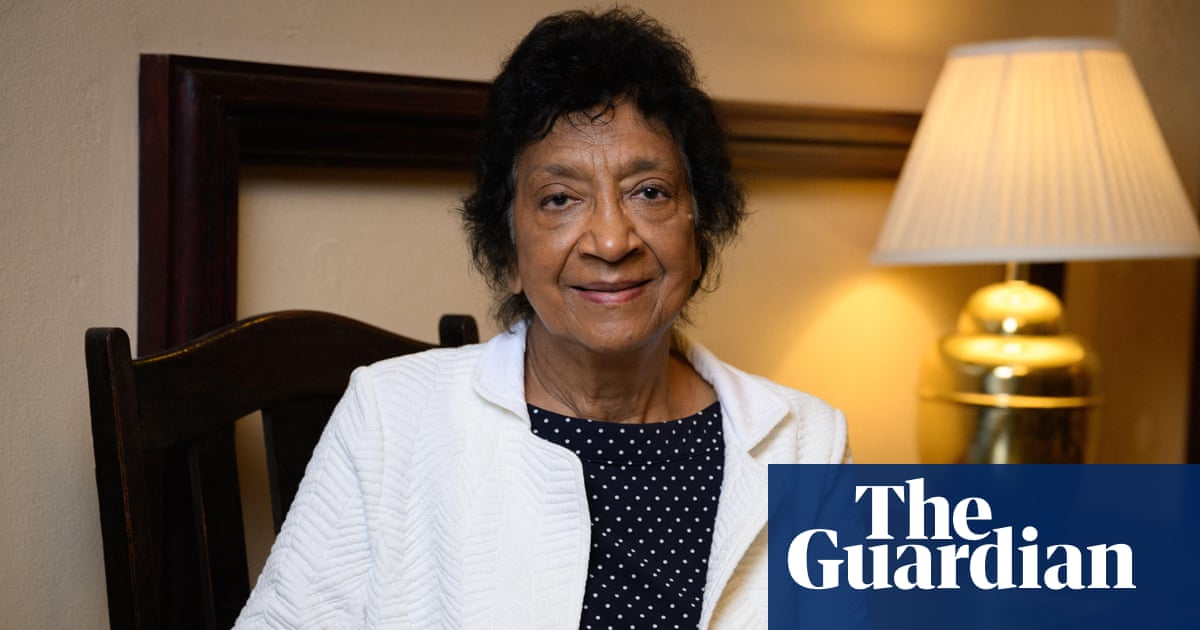
Former UN human rights chief Navanethem "Navi" Pillay, a judge on the international court of justice (ICJ), has won the Nobel peace prize.
Pillay, 85, from South Africa, who is a judge with the international court of justice, was recognised for her efforts to promote peace and international law, said Jørgen Watne Frydnes, chair of the Norwegian Nobel committee.
"A common thread runs from her early work defending Nelson Mandela and others who stood up against apartheid to her service as a judge in some of the key international court cases of our time," the committee said.
"At a time when the number of wars and conflicts is rising, and when judges and institutions of international law are under political attack, the Nobel committee wishes to issue a reminder that the ability to resolve conflicts without force or violence is dependent on the international rule of law.
"An international legal system in which war criminals are held to account and the victims of abuse see justice served is a precondition for a peaceful world."
Pillay headed the UN independent international commission of inquiry, which does not speak on behalf of the world body and that last year found genocide was occurring in Gaza.
Pillay told Agence France-Presse at the time that her team had shared "thousands of pieces of information" with prosecutors at the international criminal court.
The UN said the awarding of the Nobel peace prize to Pillay highlighted the importance of international human rights.
"It's wonderful to see this being awarded to Navi Pillay, the former high commissioner for human rights. It is testament to the need and to the value of human rights in this world more than ever," said Shabia Mantoo, spokesperson for the UN human rights agency.
The committee, based in Oslo, received nominations for 287 candidates for this year's prize, and just over a quarter of those were for organisations. Experts say the committee typically focuses on the durability of peace, the promotion of international fraternity and the quiet work of institutions that strengthen those goals.
Last year, the Venezuelan opposition leader, María Corina Machado, won the Nobel peace prize for her struggle to achieve a democratic transition in the South American nation, winning recognition as a woman "who keeps the flame of democracy burning amid a growing darkness".
Machado gave her Nobel medal to Donald Trump shortly after the United States ousted the then Venezuelan president, Nicolás Maduro. But it was largely a symbolic gesture: the Nobel committee has said the honour itself cannot be transferred.
Nominations can be made by a select group of people and organisations, including heads of state or politicians serving at a national level, university professors, directors of foreign policy institutes, past Nobel prize recipients and members of the Norwegian Nobel committee itself.
Four of this year's Nobels were announced earlier this week. The Nobel for medicine went to three scientists whose work led to a tool that uses light to help unravel how the brain works. The physics award recognised a scientist's efforts to demystify a rare group of neutrinos. The chemistry prize recognised two scientists for untangling mysterious mirror images in molecules, a discovery that has been used to develop countless drugs.
More details soon …