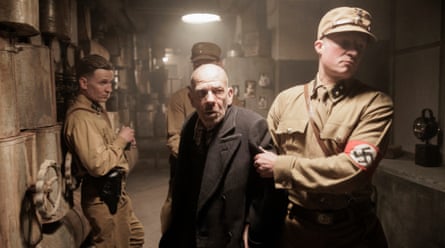
here is one experience we in Germany can all find mildly satisfying this autumn, as we watch the dark and terrifying final season of the hit TV series Babylon Berlin. We know everything those fearless (a few of them) or frightened (many more) and opportunistic (the majority) people on the screen do not. We know their future.
Made by the public broadcaster ARD, Babylon Berlin has run for over 10 years, brilliantly fictionalising how Germany sleepwalked into nazism and the second world war. The fifth and last season begins in January 1933 with Adolf Hitler appointed .
Our funny and beautiful police detective superheroine Charlotte Ritter and the also beautiful, less funny and slightly more dubious detective Gereon Rath – both fictional – are still arguing and falling in and out of love as they chase criminals and Nazis, who are becoming synonymous. Berlin is still singing, dancing. loving. Newspapers are still being printed. Trains still run. The Jewish lawyer Hans Litten – a historical figure – still believes in German laws and German integrity (the real Litten ended up killing himself in Dachau in 1938).
Watching the show 93 years after the events being depicted, I constantly want to shout at the screen: turn left here – you can kill Hitler at this dinner, and the Reichstag won't burn, and it will all end differently. Wake up, I want to scream at the opportunistic majority – don't you understand what is happening?
They don't, of course. They turn the other way and fail to kill Hitler. Because facts are facts. The dramatists are accurately describing February 1933 as the month in which German society was radically torn apart at an extraordinary speed because of mistakes made by party leaders and others who could still have stopped it all.
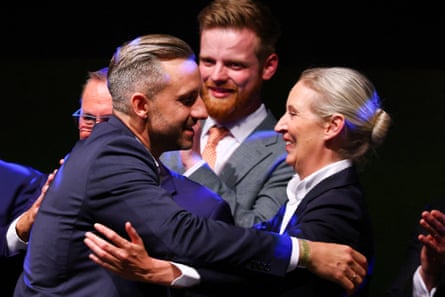
The timing could hardly be more apt. Babylon Berlin began streaming in 2017, the year the extreme-right Alternative für Deutschland (AfD) entered the Bundestag for the first time with 12.6 % of the vote. Nine years on, the AfD has become my country's dominant political force. In September it won 44% of the vote in state elections in Saxony-Anhalt and 38.3% in Mecklenburg-Western Pomerania. In the latter contest, Chancellor Friedrich Merz's CDU dropped to 4.9% and didn't even garner enough votes to enter the state parliament – an unprecedented humiliation.
It is, therefore, quite tempting to watch Babylon Berlin and see ourselves in those historic times. But does it make sense? It does, but not in the way you might expect.
There are not millions of desperate unemployed people on today's German streets, nor paramilitary armies fighting heated battles. There is no Versailles trauma and the last global financial crisis was in 2008. There is no German president systematically replacing parliamentary government with emergency rule.
The German men's football team coach, Jürgen Klopp, recently advised the nation to look at its strengths rather than constantly stare at what is not working, so let's start there. Germany has a strong constitutional court system and powerful federal states; it has, with help from its partners, created and maintained European integration, along with an established democratic culture and institutions designed explicitly because of the lessons of Weimar. Our European Germany in 2026 is not Weimar Germany in 1933.
But there is another connection between Babylon Berlin and us as German spectators today – an echo that is more subtle and more interesting. It lies in this conviction that everything is falling apart. Here the wonderfully tongue-breaking term (self-fulfilling prophecy) comes into play.
Germany excels at the one thing no country should aspire to be good at. We are constantly describing ourselves as a country in terminal decline. Just spend an evening watching political talkshows or listening to people around you, and you will conclude that we are witnessing the final collapse of a failed state.
The trains are all late. Bridges and streets are crumbling. Schools are failing and German children lagging behind in Pisa rankings. Bureaucracy is suffocating business and taxes are sky-high, plus ineffectively used. Isn't energy too expensive and our pension system unsustainable? Immigration is out of control. Our digital transformation is a joke. And as for our car industry, that is on its knees. Plus, we lost to Ecuador and Paraguay at the World Cup. And the government cannot agree on how to fix any of this because support for the two big mainstream parties (the centre-right CDU and the centre-left SPD) is shrinking, and coalitions between parties that hate each other have become ever more complicated and fragile.
Some of this is true – painfully so.
I started writing these lines on a train from Hamburg to Tübingen via Stuttgart which was delayed by two hours. Someone in the hierarchy of Deutsche Bahn (or an AI, of course) then decided that, as we were already this late, the train would terminate in Mannheim. I had to cancel my plans and instead turn around and go back home. This is how you spend a day in modern Germany.
Something much larger than my individual problem has arisen, however: our national narrative of failure has developed a disturbing relationship with reality. Germany's seasonally adjusted unemployment rate climbed back above 3 million in September and inflation reached 3.3%.
Within the world of public broadcasting, talk about reform has been imminent for more than a decade – but instead of building the strongest and most robust system possible, which then might actually withstand the shocks, there are simply more meetings, and more reports, and more commissions of inquiry.
The biggest problem, though, is Germany's belief in the enormity of its problems. And this is exactly where Babylon Berlin and its look at 1933 becomes a more relevant companion to 2026 than the "Weimar is back" cry suggests .
Democracies become vulnerable when people cease to believe that democracy can deliver. The destruction of Weimar was preceded by such a loss of faith. The circumstances were and are fundamentally different now. But one political mechanism is recognisable: the extreme right has a brief and simple story to tell.
Close the borders. Deport those people we don't know. Ignore Brussels. Stop paying Ukraine. Bring back cheap Russian energy and abolish stupid climate rules. Put Germany first.
Our society seems scared and exhausted from years of crisis after crisis, and from the alarming talk of never-ending crises of tomorrow. The AfD understands this and knows how to turn every minor and unresolved problem into evidence that "das System" is rotten. My cancelled train is no longer just that, but proof of national doom. The brilliance of declinism lies in the fact that it is self-confirming. Once you have accepted that the country is collapsing, you see nothing but evidence for it.
Would we recognise the end of our democracy if it were happening today, and to us? Or, instead, would we recognise the strength of our democracy if it were not ending?
There is a danger in catastrophising so much that we cease to notice resilience, and progress, and that many things work just fine. German angst becomes German cynicism; cynicism turns to contempt; and, finally, contempt will make the AfD's promise of destruction sound like the renewal we all need.
We can and must tell the other, true story, of a country that has found trusted friends and partners and hence a peace that has lasted for 80 years, and economic and political, cultural and scientific successes most nations dream of – even in football (although it has become increasingly difficult to remember those days).
This is not 1933 revisited, but it is a serious moment. And a good moment to for a reminder that, in dangerous times, a democratic coalition needs to govern as decisively, effectively and empathetically as it possibly can.