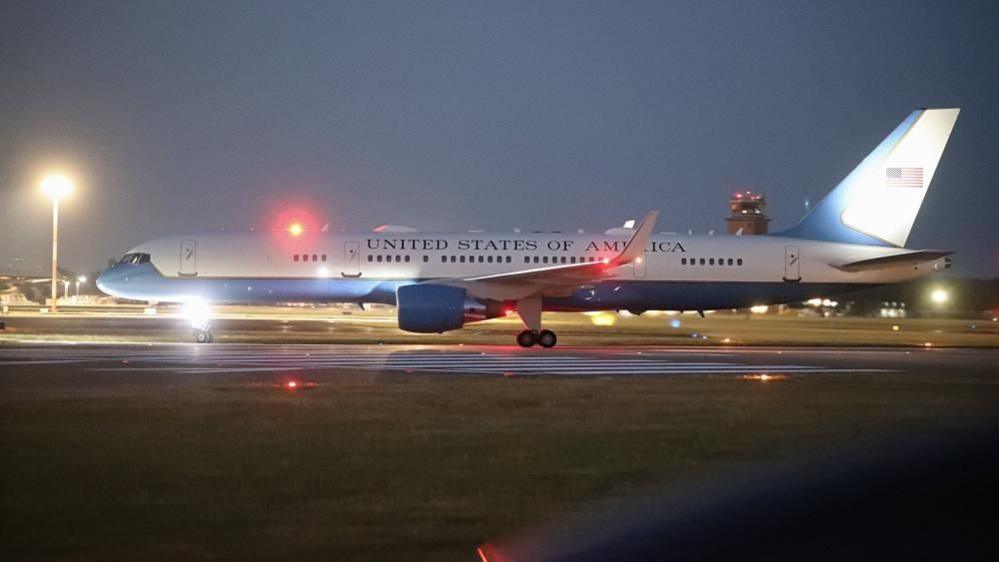
On 8 July, US President Donald Trump boarded Air Force One in plain sight of television cameras as he departed the Nato summit in Turkey.
But when the mighty Boeing aircraft left Ankara, the president had reportedly already been secretly spirited away via a catering truck to a C-32A, a military version of the Boeing 757, which flew the president to RAF Mildenhall in the UK.
Those left on board were unwitting decoys and had no indication that Trump was no longer travelling with them.
But deception of this kind is not unusual.
"That's very common," said Ronald Kessler, an author who has written extensively on the agency. "There's a long history of strategies to mislead anybody who might be trying to harm the president."
Robert McDonald, a former high-ranking Secret Service agent with experience working on presidential security details, told the BBC that smaller-scale deceptions are used frequently during motorcade operations.
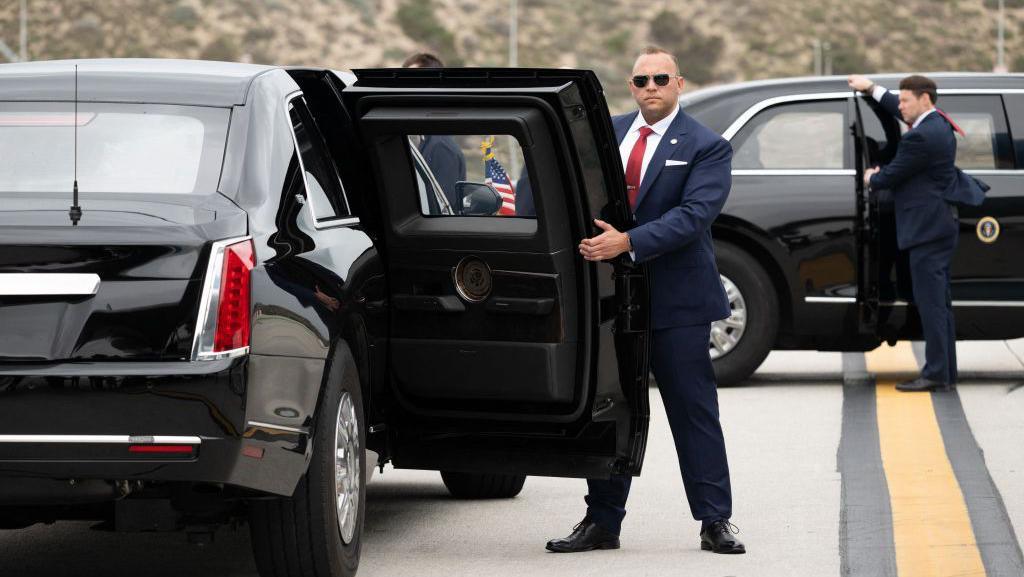
These motorcades - which often include dozens of security and support vehicles, as well as ambulances and vans carrying White House reporters - typically include two "Beasts", as the enhanced limousine carrying the president is known.
While one vehicle carries the president, the other travels nearby as a decoy, switching locations while en route to the destination.
"It's what we call a shell game," said McDonald, who drove one of the vehicles during the Bush administration. "Even in DC if we headed to Andrews [Joint Base Andrews - where Air Force One flies from], those two limousines would change position, like under a highway overpass."
"But that would happen out of sight of anybody other than those in the motorcade or in that tunnel," he added. "Different things are used to mix up the bad guy."
Similarly, Marine One - the president's helicopter - routinely flies in groups of three, changing positions so that potential threats are not sure which is carrying the US leader.
Even more elaborate deceptions are carried out for complex, high-risk trips abroad.
"I would say it does not happen often," former Secret Service agent Paul Eckloff told the BBC World Service's Newshour programme of the aircraft switch. "But it is an option that the Secret Service and others in executive protection always have."
"When the president travels to war zones, there are frequently tactics and techniques used to create doubt in an adversary of which aircraft or which movement that he's going to make," he added.
In March 2000, for example, then-President Bill Clinton flew from India to the Pakistani capital of Islamabad on an unmarked executive jet that landed after a decoy jet with all the livery of Air Force One.
Three years later, the White House claimed that President George W Bush would spend Thanksgiving in Texas, only to arrive in Baghdad in a blacked-out Air Force One.
In all three of those cases, the media on board was aware of the deception but had been asked to not report it in real time.
The exact nature of the perceived threat to the aircraft in this latest case remains unclear.
The Secret Service has so far not commented on the incident, while the White House has neither confirmed nor denied it, saying only that it uses every tool available to protect the president.
While contingency plans for a variety of scenarios are developed ahead of time, experts say that the Secret Service needs to maintain flexibility and remain poised to improvise in the face of new threats as they emerge, particularly overseas.
But according to McDonald, the extraordinary measure of secretly moving President Trump from the aircraft suggests that the potential danger was deemed, likely by multiple agencies, to be serious.
"That tells me that the threat level in Turkey was relatively substantial and quite high," he said, adding that the president's staff, the Secret Service and the White House Military Office were almost certainly immediately alerted.
"Those people likely got together in a room and were presented with this intelligence," McDonald explained. "And a plan was put together to negate the threat from whatever intelligence was received."
McDonald's assessment was echoed by Marc Polymeropoulos, a 26-year veteran of the CIA who served in both Iraq and Afghanistan and oversaw clandestine missions around the world.
"The key part of this is the nature of the threat, and what was so severe that the Secret Service would put forth such a deception operation," he said.
A key question going forward, according to Polymeropoulos, is whether the government and intelligence community then had a duty to warn those on the aircraft.
"Let's say the plane was blown out of the sky, and we knew about it," he said. "We don't do that…we can't. If we know ISIS is going to attack a target in Moscow, we warn the Russians. Why do we warn the Russians? Because if there's an American citizen killed in that, we can't let that happen."
How much danger those who remained on the aircraft were in - or whether they were in danger at all - remains unclear.
Journalists on board reported that they were repeatedly instructed to keep their window blinds down, a "not uncommon" practice McDonald said shows that steps were still being taken to protect the passengers.
"A large plane flying overhead where somebody could see it, with the shades up and windows illuminated, could tell somebody that it's a particular type of aircraft," he said. "I appreciate the need for transparency, but [the passengers] are also part of the roadshow. We've got to make sure that you and everybody gets home safe."
The Secret Service, he added, is under no legal obligation to inform of potential threats or detail operations being carried out to protect the president and his entourage. That decision would need to be made by the White House or other agencies.
"The Secret Service is not in the business of public relations," he said. "We're very good at keeping secrets, as our name says. Everybody doesn't need to know everything."