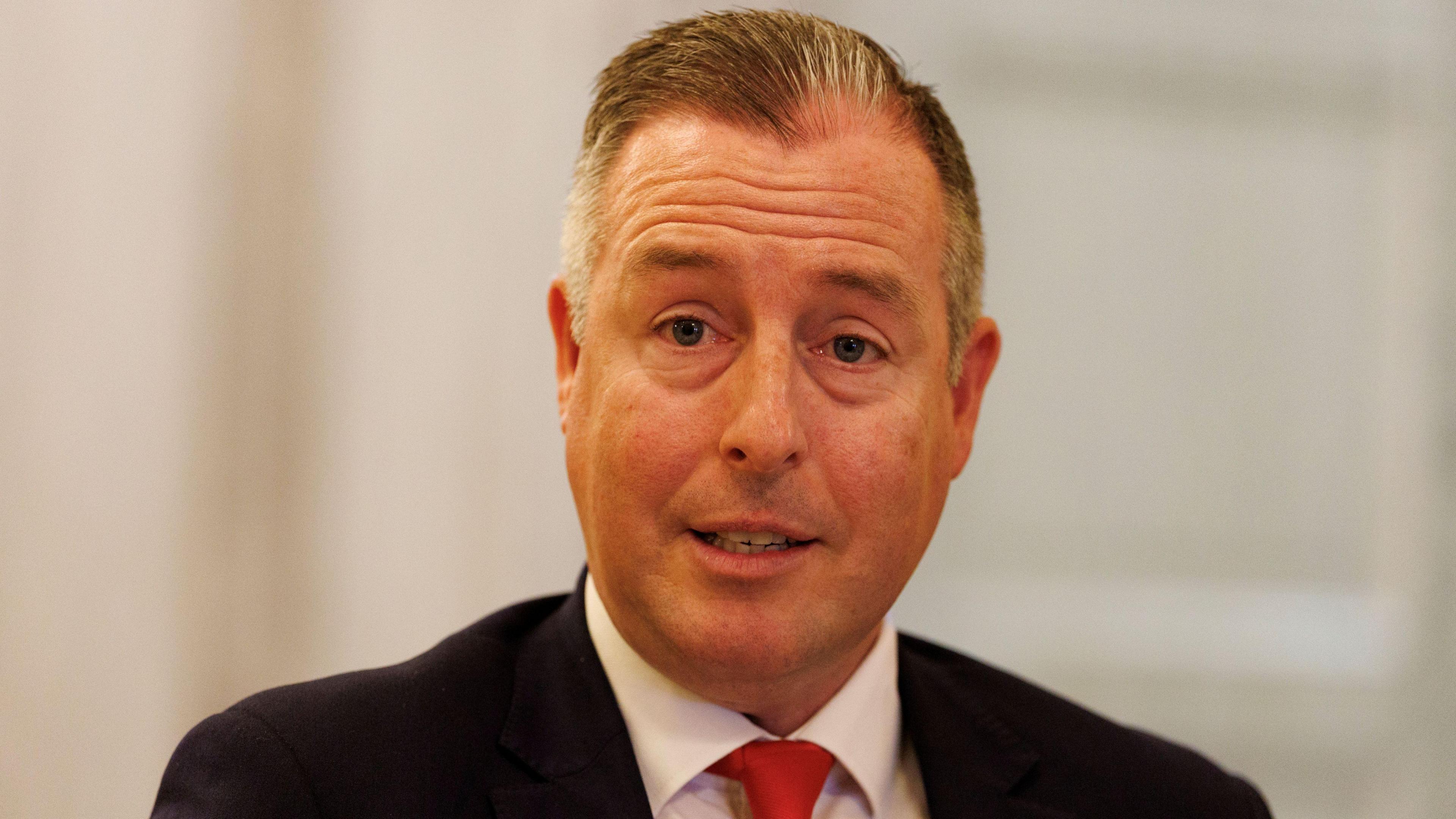
Campaigners for integrated education in Northern Ireland have "lost their way", Stormont's education minister has said.
Paul Givan said there was a need for "real and frank conversations" about the sector and how "real integration" is achieved.
He said many integrated schools have faced "significant challenges in achieving and sustaining" what are regarded as "reasonable numbers" of both Catholic and Protestant pupils.
The minister announced his department was "reviewing the way information is collected for the purposes of assessing reasonable numbers" to support schools and "bring greater clarity to the process".
Integrated schools aim to mix pupils from Protestant, Catholic and other backgrounds.
About 8% of children in Northern Ireland currently go to formally integrated schools.
In a written ministerial statement to the Northern Ireland Assembly, Givan said his department remains "fully committed" to supporting integrated education.
"However, that support must be exercised within the framework established by the assembly and interpreted by the courts," he added.
"The law requires schools seeking integrated status to demonstrate that they are likely to provide integrated education, including 'reasonable numbers' of Protestant and Roman Catholic children.
"That requirement cannot simply be disregarded."
The Democratic Unionist Party (DUP) minister called for a focus on "outcomes rather than labels" and "genuine integration rather than designation alone".
He added: "In recent years it is hard to avoid the conclusion that those campaigning for integrated education have lost their way - failing to deliver schools which meet the legal requirements and often making implausible claims regarding the likelihood of achieving 'reasonable numbers'.
"This is the time to rediscover the original intent of this laudable movement."
'Reasonable numbers'
Givan said a requirement for "reasonable numbers" of Catholics and Protestants had often "not been achieved even for schools which transformed many years ago".
He said of the 19 schools transformed to integrated status between 1991 and 2016, in 12 of them the majority community outnumbers the minority by at least two to one.
"Three schools that have transformed – all more than seven years ago – have fewer than five pupils from the minority community," he added.
Givan added the "overwhelming majority" of transformations have come from the controlled sector, while "very few" Catholic-maintained schools have entered the process.
He said the "possibility of amalgamation between schools serving different traditions deserves serious consideration" as part of a "sustainable long-term approach".
Givan said the challenges should not be considered "a criticism" of schools, "rather they are a product of the statutory scheme and historic trends".
The minister said his department "believes that greater emphasis should be placed on actions undertaken before a school submits a transformation proposal".
The department is also seeking to change monitoring forms to "explicitly take account of community background as well as declared religion".
'Disappointed' by minister's statement

Áine Lesley, principal of Malone Integrated College in Belfast, said she was "disappointed" by the minister's statement and described his remarks about campaigners as "very unfair".
She expressed concern the plans would create "extra barriers" and "deter some schools from going through that transformation process".
"I'm just really disappointed in terms of the focus put on 'reasonable numbers' and the barriers that's going to pose to integrated education," she said.
"Because it's more than about numbers - it's about children, it's about choice and it's about opportunity."
However, William Kitchen, an educationalist and author, welcomed the minister's statement.
"I see it as adding clarity to a picture that was starting to become pretty muddied and pretty difficult to understand," he said.
"The reality of this situation is that the numbers themselves and those metrics themselves were parameters that the integrated movement set for themselves whenever the movement started.
"So if the situation has changed and integration as a movement is about something different, then they need to redefine themselves."
How many pupils go to integrated schools in Northern Ireland?
The first integrated school in Northern Ireland, Lagan College, was set up in 1981 with the aim of educating Protestant and Catholic pupils together.
It opened with 28 pupils in a former scout centre and has since grown to around 1,500 pupils.
There are now over 28,000 pupils in integrated schools.
In 2025, a decision by Givan to reject moves by two big schools in Bangor to switch to integrated status was controversial.
In rejecting the bids, Givan said that there was not enough evidence that there would be enough Catholic pupils at each school for it to provide integrated education.
Some non-integrated schools also have a mix of pupils from different religious backgrounds and those who are not religious.
The Department of Education has a legal obligation to give more support to integrated education, since Stormont voted in favour of a new law in March 2022.
Givan said that "for political parties and support bodies, we need real and frank conversations about the purpose and nature of integrated education".
"We need to be honest about what delivers real integration," he added.
"Too often, easy solutions are promoted as advancing integration when they do little to bring children from different backgrounds together in a meaningful way."