"They assume that my ambition is positional. They assume that my ambition is a title or a seat. And my ambition is way bigger than that. My ambition is to change this country."
The words were delivered slowly, deliberately and with some steeliness by Congresswoman Alexandria Ocasio-Cortez. Her audience, crammed into the pews of Rockefeller Memorial chapel at the University of Chicago, burst into spontaneous applause. That was in May. In the three months since, the speculation around Ocasio-Cortez's ambitions – for herself and for America – has only grown louder.
Friends and foes alike wonder if the stars are aligning for the New York congresswoman to run for US president in 2028. They point to voters raging against the machine – including the ageing Democratic party establishment – and hungry for change. They note how progressives pushing for economic justice and universal healthcare have won a string of impressive victories in mayoral elections and congressional primaries over the past year.
Then there are the opinion polls. Last month a Granite State Poll from the University of New Hampshire found Ocasio-Cortez leading a potential Democratic field in that crucial state. She has the kind of name recognition that money can't buy, nearly 10m followers on Instagram alone and fans ranging from the Democratic Socialists of America (DSA) to Nancy Pelosi, the former speaker of the House of Representatives.
As Barack Obama, Donald Trump and Joe Biden showed, presidential elections have a habit of finding the right person at the right time in the right place. Ocasio-Cortez, a 36-year-old with a progressive agenda and can't-be-taught social media smarts, could meet the moment for a nation eager for a fresh start after a decade of Trumpism.
If modern politics is about pendulum swings, it is hard to imagine anyone who better personifies a rebuke of the octogenarian Trump and his nativist "Make America great again" (Maga) movement. This week a Zogby Strategies national poll found that a generic democratic socialist candidate leads generic Maga candidate 45% to 33%.
Ashik Siddique, a co-chair of the DSA, of which Ocasio-Cortez is a member, said: "If she were to throw her hat in the ring, there would be a lot of excitement for it from members of Democratic Socialists of America. We definitely want to see a strong working class voice in the 2028 presidential primary."
Ocasio-Cortez has not ruled out a run for president and her actions have done nothing to quell the notion of a campaign in stealth mode. Last year she joined her mentor, the independent senator Bernie Sanders, on a "Fighting Oligarchy" tour that drew huge crowds. More recently she has crisscrossed the country to support progressive candidates, further enhancing her national profile.
In the past week alone she made two moves that intensified political pundits' chatter. First Ocasio-Cortez used Instagram to announce that she is freezing her eggs, a decision she described as a move to "feel more in control of my life". She acknowledged the "political risk" in sharing personal family planning details but stated her goal is to normalise conversations about the professional and personal challenges women face. The internet quickly became awash in speculation that Ocasio-Cortez ended her relationship with and engagement to long-time partner Riley Roberts , driven by reports from Puck News and others noting she had long since stopped appearing with him in public and mentioning his name.
Then, when asked by ABC interviewer Jonathan Karl about the cultural battles of the 2020 pandemic era – including calls from some on the left to defund the police – she laughed and, quoting a New York city council ally, remarked: "Woke One was crazy" – apparently trying to draw a strategic line between hard-fought struggles for racial justice and the performative excesses of lockdown isolation that became an easy target for the right.
Unlike many would-be presidents of the time, Ocasio-Cortez does not appear to be driven by personal ego, according to those who knew her, which may prove to be her political superpower. She was a volunteer organiser for Sanders' 2016 campaign, his first presidential run and one that built a national movement around his vision of democratic socialism, even as he lost to former secretary of state Hillary Clinton.
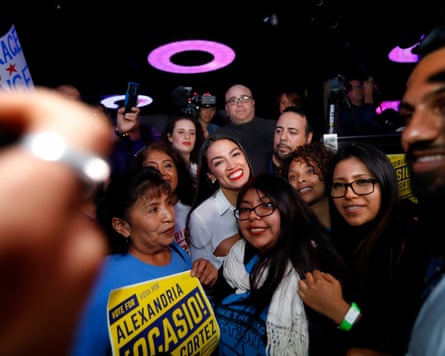
When she decided to run for office herself, the former bartender and waitress had virtually no money but was assisted by progressive organisations such as Brand New Congress and Justice Democrats. In 2018 she beat 10-term incumbent congressman Joe Crowley, a member of the Democratic leadership and potential future speaker, in a New York primary.
Corbin Trent, her first communications director in the House of Representatives and the co-founder of Justice Democrats, was there on the night she ousted Crowley. He recalls that the political industrial complex began trying to map her career path before the ink on the ballots was even dry.
"Primary night, she beats Joe Crowley," he recalled. "I get phone calls from elected officials and other people and their question is, what's next? What's the pathway here? What's she going to run for? What higher office would she seek? This is literally a few hours after the polls close in the primary. That's the way DC thinks. Not, hey, what can we do with Medicare for all or this or that or any of the other things?"
As Ocasio-Cortez's national profile exploded – bringing in $15m in her first electoral cycle and attracting unprecedented demands from foreign heads of state – Trent tried to lay out a long-term strategic map. He suggested upstate New York events to prepare for a statewide Senate run. But she resisted the logic of political careerism.
"To my chagrin and frustration that never was a way in which she could plan or operate. She did not have an idea in her head of this ultimate prize of president or governor or senator."
Instead, Trent argues, her appeal lies in a rare authenticity – an ability to validate the deep-seated economic anxiety of Americans. "Alexandria has two things going for her. She's genuinely curious about other people. It's not like she has to pretend to be. I've had politicians ask me, 'How can I be more genuine?' Well, that's probably not going to help if you have to fucking ask me that.
"Two, she is genuinely open about herself. Some people believe that nobody cares what they think or who they are and then other people don't want you to know who they are. She doesn't suffer from either of those failings."
Other observers agree that Ocasio-Cortez has that X factor missing from so many professional politicians: relatability. Chris Scott, a political strategist who served as the coalition director for Kamala Harris's 2024 presidential campaign, said: "When you talk about AOC's humble beginnings being a bartender that's a lived experience story that resonates, especially with millennials, with their upbringing.
"What you are starting to see – whether it's conservative or progressive - is people are leaning more and more towards candidates with lived experience that they feel they relate to as politics gets more polarising."
That said, Ocasio-Cortez has now been in Washington long enough to draw accusations of going from outsider to insider. The activist who critiqued the establishment and championed the Green New Deal has spent recent years working closely with Democratic leadership. This week she received warm praise from Pelosi, who told a Politico summit in Sacramento, California: "I think that she has been so operational, and it's just wonderful. I know it's a joy to work with her."
The transition has caused some on the far left to wonder if the system has simply co-opted its most dangerous critic. Cenk Uygur, a controversial political commentator and co-founder of the online progressive news show The Young Turks, watches Ocasio-Cortez's recent evolution with a mixture of policy agreement and tactical despair.
Ocasio-Cortez has described Israel's actions in Gaza as a "genocide" and last month voted to block US military aid to the country. But Uygur has not forgotten her high-profile appearance at the 2024 Democratic National Convention, where she delivered a rousing speech praising vice-president Harris's efforts to secure a ceasefire in Gaza — a claim that many leftwing activists viewed as a dishonest whitewashing of the administration's complicity in the conflict.
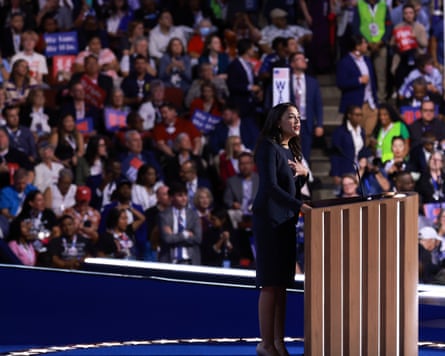
"Why did she basically fib on Kamala Harris's behalf during the DNC and pretend that Kamala Harris cared about Palestinians and was trying to keep the Israelis in check?" he said. "Because she secretly loves Israel? No, it's because she wanted to prove to mommy and daddy that she's a good girl. If you're a good girl you support Kamala Harris and, if you need to, you fudge her record.
"Then you go tell Jonathan Karl that your side is 'crazy' and you changed and you can't explain what you changed into or how you changed or why you changed. But the message is super clear both for the establishment and progressives: 'I'm not going to challenge the system so establishment, you can rest easy, I'm not a threat.' And they have rested easy. That's why she's getting enormously positive coverage."
The 2028 Democratic presidential primary election is expected to be crowded and noisy. If Ocasio-Cortez runs, she might face challenges from fellow progressive Congressman Ro Khanna of California along with heavyweights including Harris, Pete Buttigieg, Gavin Newsom and Jon Ossoff. Some Democrats, scarred by Clinton and Harris's defeats in 2016 and 2024, might be reluctant to nominate Ocasio-Cortez out of perceived expediency if they believe the US is still not ready to elect its first female president, a fear expressed by former first lady Michelle Obama among others.
The congresswoman faces another potentially formidable hurdle. Centrist Democrats have long argued that the democratic socialist wing of the party might succeed with white, college-educated voters but struggles to connect with African American communities, pointing to primary races where progressive insurgents have hit a wall. That could prove decisive in an early primary state such as South Carolina.
Nina Turner, a national co-chair of Sanders' 2020 campaign, who has just been travelling in South Carolina, said: "There are some rumblings in some segments of the Black community that DSA and progressives in general are not doing what it takes to court Black voters and in some ways are leaving us behind for other people who are of colour but not Black.
"That's real and so DSA as well as progressives are going to have to do something to say, no, we understand the Black plight and we understand that the survival of working-class people comes through Black liberation. They have not done a good job of doing that. I'm hoping that they will."
Antjuan Seawright, a Democratic strategist in South Carolina, suggests that Ocasio-Cortez's national viability depends on her remaining a disciplined team player who addresses universal, kitchen-table concerns. He said: "I would love her to run as far away as she can from being any sort of liability in places where we know we have to win in November where we've lost before because people have been used as a weapon of mass political destruction and distraction.
"If she continues to talk about health care in such a way that is accessible and affordable for all Americans without burning down the system, but making some alterations to the system, she will be a positive voice to the conversation."
If she runs, Ocasio-Cortez can also expect a crude onslaught from Republicans and a rightwing media machine that has spent years demonising her as a radical communist who threatens the essence of America. Her "Woke One was crazy," comment has been seen as an attempt to assuage the concern.
Tara Setmayer, a former Republican communications director on Capitol Hill, said: "That was a very interesting strategic decision to do that and that's her way of trying to moderate. But she's palling around with Bernie Sanders and hasn't completely, as far as I'm aware, repudiated [the influencer] Hasan Piker and some of those leftwing folks. People are not going to forget that and, in this day and age of the internet, it lives forever."
Setmayer, cofounder of the Seneca Project, a women-led, bipartisan political super political action committee, argues that, instead of campaigning for the White House, Ocasio-Cortez could seek to cement her legislative power by challenging Chuck Schumer for his New York Senate seat.
"If I were advising her, given the failures, unfortunately, of women candidates for the Democrats over the last two election cycles, it would behoove her to run for Senate," Setmayer said. "She's almost guaranteed to win that Senate seat.

"It would provide her more gravitas and she's young enough that she could do a term or two – or a term and a half like Barack Obama – and then run for president. I don't think that she can go from being a congresswoman to a serious presidential candidate without some time in the Senate."
History, however, is littered with examples of White House aspirants who waited their turn and missed their moment. There are others, such as Obama, who said "carpe diem" and rode a wave all the way into the Oval Office.
Ocasio-Cortez, who would beat Theodore Roosevelt and John F Kennedy to become the youngest US president in history, has said her ambition is way bigger than that. The calling to change America may prove irresistible.
Kurt Bardella, a political commentator and former congressional aide, said: "When you look at the current trajectory of the Democratic party, she is the natural successor to the Bernie Sanders-Elizabeth Warren coalition. She is one of the most gifted communicators in all of politics.
"She is someone who engenders a tremendous amount of passion, either for or against. She does possess the unique quality of: people give a shit. She's got a lot more going for her than most people. She never has to worry about standing out. The attention vacuum that we live in, and the way that content works, she is in a league of her own."