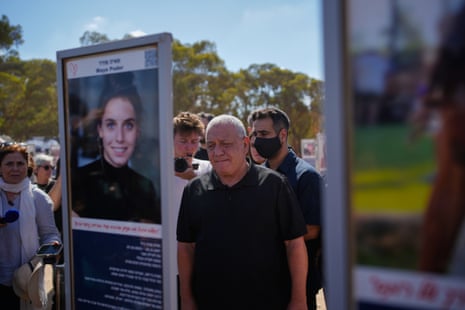
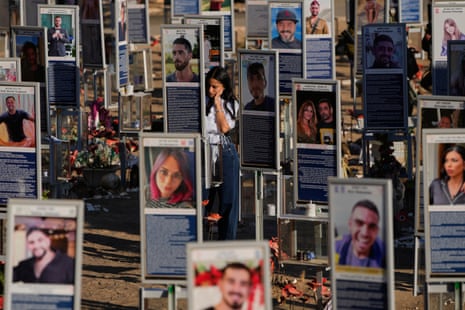
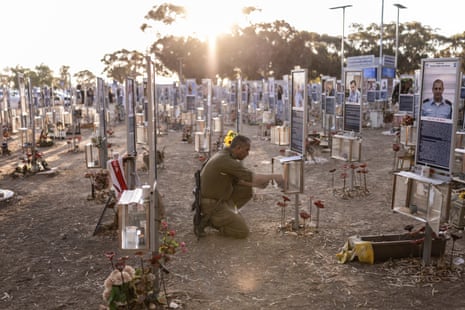
Israelis gathered at the site of the Nova music festival, where Hamas-led militants killed 378 people and took 44 others hostage.
Katia Zohar, whose 23-year-old daughter Bar Zohar was killed, called the start of the attack at 6.29am "the minute that changed our lives forever".
"Sadly I remember everything," Zohar said, according to AFP news agency.
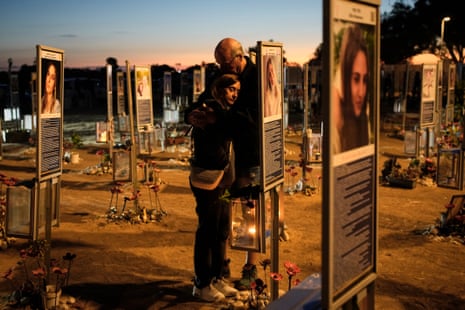
"The moment she called for me to come and pick her up because there were missiles in the air. Then the second time when she called from the road, screaming that they were shooting at her."
Anna Davitashvili, 53, paid tribute to her eldest son Shaun, 25, who was killed at the festival alongside friends, by playing the last track of techno music that the partygoers were dancing to when the attack began.
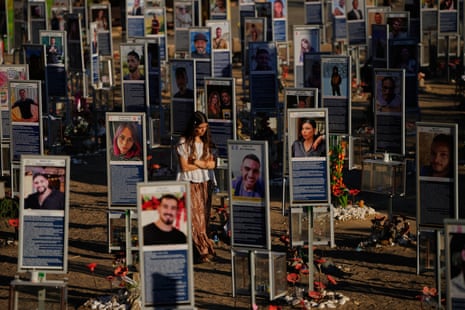
"I feel him here, I'm terribly sorry that I couldn't save him, I couldn't help him get out of this massacre," she said.
The Nova festival near Re'im took place about 3 miles from the Gaza border, from where Hamas militants used motorised paragliders and trucks to launch the dawn attack.
As mourners paid their respects at the Nova site, AFP reported loud bangs across the border in Gaza as the Israeli military carried out new strikes, despite a ceasefire being declared in the Palestinian territory last October.
In Gaza, Palestinians recalled life before Israel launched a devastating war that transformed the Strip beyond recognition and displaced nearly its entire population.
Hamas's 7 October attack on southern Israel ignited a war that would kill more than 74,000 Palestinians in Gaza and reduce the territory to rubble. A ceasefire declared last October has brought little relief for Palestinians, who continue to face humanitarian and economic challenges as they struggle to rebuild their lives.
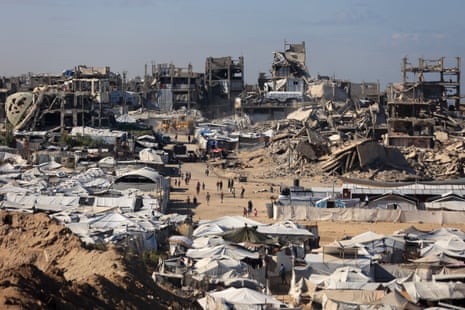
The ceasefire deal has left the Israeli military in control of about two-thirds of Gaza, where it has carried out sporadic strikes and razed large areas to the ground. In its latest assault, the Israeli military carried out airstrikes in Beit Lahia in northern Gaza and in Khan Younis in the south, killing at least two Palestinians and wounding others, the Gaza health ministry said. The Israel Defense Forces (IDF) claimed it had struck a militant target in Beit Lahia, without providing details. It did not immediately comment on the strike in Khan Younis.
Umm Mohammad, a mother of five displaced from Gaza City in the north, lives with her husband and children in a makeshift camp in the central city of Deir Al-Balah. She said they were "one happy family" before the war had ripped them apart.
"The war displaced us. My son left Gaza, the other went to a separate tent, my daughters left with their husbands to other parts of the Strip and we rarely meet," she told Reuters.
On this day, she said, "we recall how happy, despite all problems, we were before the war broke out, destroying everything we loved".
Israel held state events on Monday, the national memorial day for the attacks. The date for official remembrance is set according to the lunisolar Hebrew calendar, one of two official calendars of the State of Israel, rather than the Gregorian calendar.
The attack was launched on the Jewish holiday of Simchat Torah. Memorial day was set for two days later, because memorial events can't be held on the holiday.
Flags were lowered at government buildings, military bases, police stations and the communities attacked by Hamas, and Israel's leaders gathered at Mount Herzl cemetery in Jerusalem for two events. One remembered security forces killed on 7 October, and the other the civilian victims.
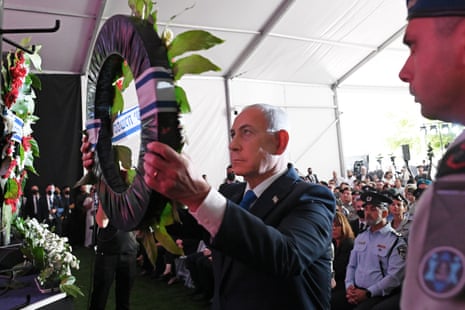
A bereaved father interrupted the speech by prime minister Benjamin Netanyahu at the second event to accuse him of negligence. "You did not protect my son on 7 October, you did not protect 1,200 people murdered in one day, Shame!" Yaakov Godo shouted, before being ushered away.
Many survivors and bereaved families accuse Netanyahu of putting his political survival ahead of the lives of Israeli citizens. Top US and Israeli officials have said the prime minister rejected ceasefire deals that could have halted the war in Gaza and brought hostages home sooner.
The UK prime minister, has paid tribute to the victims of the 7 October attack on its third anniversary.
In a statement posted on X, he said:
Three years on from the October 7 attacks on Israel, we remember those who were senselessly killed by Hamas terrorists.
The impact of the attacks has been felt not just in Israel, but in Jewish communities across the world who still bear the burden of the tragic events that day.
In the years since, we have seen a disturbing rise in antisemitic behaviour in the UK.
A year ago we witnessed a horrifying terrorist attack on the Heaton Park Hebrew Congregation in Manchester, with further attacks against Jewish people and institutions since.
I want Britain's Jewish community to hear this from me directly. We stand with you. Abuse and violence against you, in any form, will not be tolerated. Not on our streets, not online, not in our schools or universities.
That's why we are funding protection for synagogues, schools and community buildings, and why we will come down hard on antisemitism wherever it is found – in classrooms, on campuses and in neighbourhoods.
At home, we are committed to protecting our citizens from vile hatred. Abroad, we continue to work towards a two-state solution, with Israelis and Palestinians living side by side in peace and security.
An attack on Jewish people in Britain is an attack on all of us. Antisemitism has no place in this country, and we will do everything we can to stamp it out."
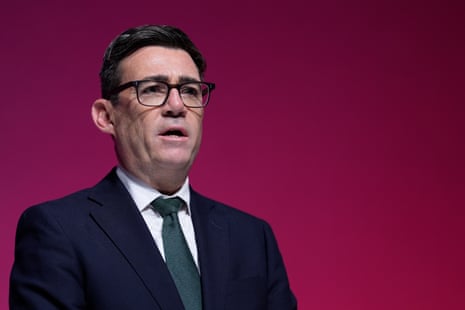
The Israeli military said it launched several security operations across the West Bank overnight, arresting dozens of people suspected of being involved in terrorism, including expressing support for the 7 October attack, the Israeli military said.
A young man was shot and wounded by Israeli soldiers during one of the campaigns in Jenin, according to Wafa, the Palestinian news agency.
The security campaign coincided with the anniversary of the 7 October attack, as officials held vigils across the country. It also came as Israeli prime minister Benjamin Netanyahu sought to project strength ahead of elections at the end of the month – his role in keeping Israel safe being a major part of his campaign strategy.
Netanyahu had previously warned of an unspecified threat to Israel's security during the country's election, prior to the attempted hijacking of the Flydubai flight to Tel Aviv last week. He repeated warnings yesterday, saying that Hamas could be planning an operation to attack Israeli border outposts in Gaza. The Israeli military said it was on high alert.
Netanyahu's image as Mr Security in Israel has taken a hit as voters have blamed him for failing to stop the 7 October attack. New revelations by Israeli magazine Haaretz, which alleged Netanyahu and his security agencies were warned prior to the attack, have hurt his election chances, despite Netanyahu's denial of the claims.
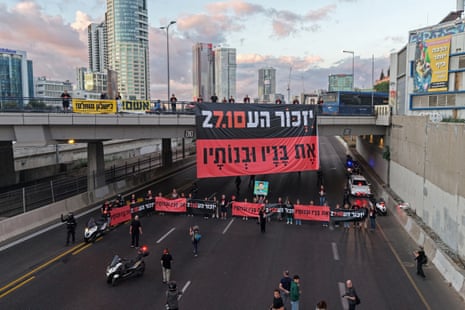
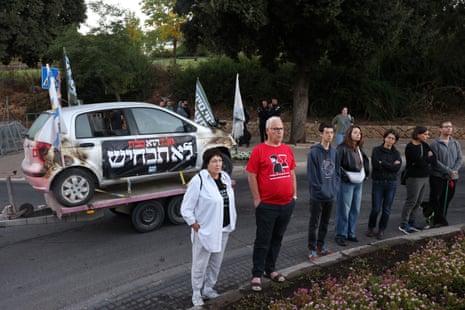
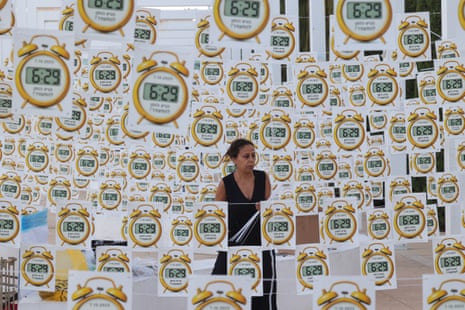
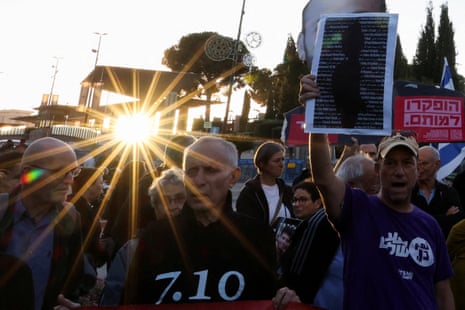
At 6.29am, the time Hamas launched its attacks, protesters blocked the main Ayalon highway in Tel Aviv, and gathered at road junctions around Israel, to remember the dead and call for a change of government.
They carried banners reading "the people shall remember their sons and daughters", a reference to the Yizkor memorial prayer for loved ones who have died. The date 7/10 was worked into the Hebrew script.
Many demonstrations included signs calling for a state commission of inquiry into the attacks, something prime minister Benjamin Netanyahu has resisted fiercely, and calling on voters to remember the attacks when they cast their ballots on.
There were also protests outside the Knesset, Israel's parliament. Near the private home of Netanyahu in the beachfront town of Caesaria, bereaved families and other protesters played audio of calls for help from the Nova music festival, where more than 370 people were killed.
Israelis gathered at the site of the Nova music festival, where Hamas-led militants killed 378 people and took 44 others hostage.
Katia Zohar, whose 23-year-old daughter Bar Zohar was killed, called the start of the attack at 6.29am "the minute that changed our lives forever".
"Sadly I remember everything," Zohar said, according to AFP news agency.
"The moment she called for me to come and pick her up because there were missiles in the air. Then the second time when she called from the road, screaming that they were shooting at her."
Anna Davitashvili, 53, paid tribute to her eldest son Shaun, 25, who was killed at the festival alongside friends, by playing the last track of techno music that the partygoers were dancing to when the attack began.
"I feel him here, I'm terribly sorry that I couldn't save him, I couldn't help him get out of this massacre," she said.
The Nova festival near Re'im took place about 3 miles from the Gaza border, from where Hamas militants used motorised paragliders and trucks to launch the dawn attack.
As mourners paid their respects at the Nova site, AFP reported loud bangs across the border in Gaza as the Israeli military carried out new strikes, despite a ceasefire being declared in the Palestinian territory last October.
Extraordinary images here from , showing rows of human figures at Trumpeldor beach representing the more than 1,200 people killed in the 7 October attack, with a message in Hebrew that translates to "total failure".
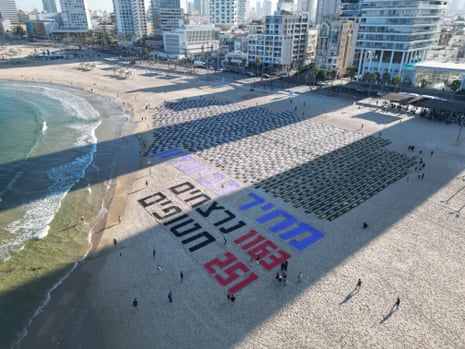
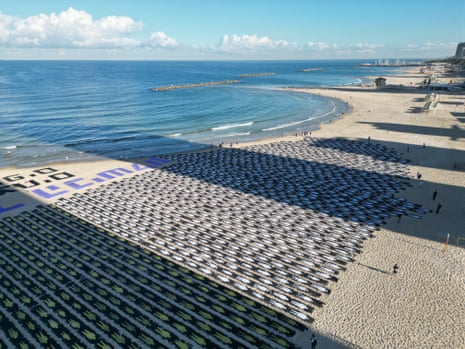
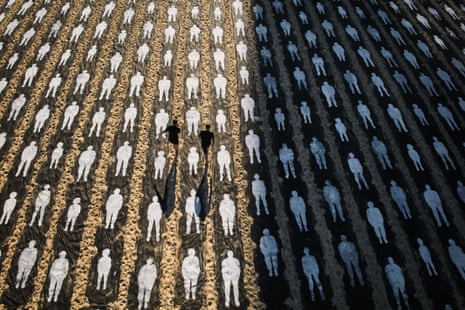
The display was part of a protest to demand answers from the government on the failures that led to the deadliest day in Israel's 78-year history.
Speaking at the beach protest, whose son, Ron Sherman, was killed by an Israeli airstrike while in Hamas captivity in Gaza, urged people to "vote for a country that takes responsibility and protects its children" at the general election on 27 October.
"Without an investigation, we cannot be sure this won't happen again," she said, according to the Israeli newspaper Ynet.
"Yinon Magal is demanding that I apologise to Netanyahu," she added, referring to the right wing Israeli commentator who earlier this week labelled people who blamed prime minister Benjamin Netanyahu for the death of hostages in Gaza as "despicable".
"I will not apologise for the fact that my son was kidnapped, for the fact that I demand to understand how the greatest disaster in the country's history happened," Sherman said, adding that Netanyahu and his government "are the ones who need to apologise".
Anti-government protesters in Israel have filled the Dizengoff fountain in Tel Aviv with red dye as part of events across the country calling for an independent state inquiry into the failures that led to the 7 October attack and demanding accountability.
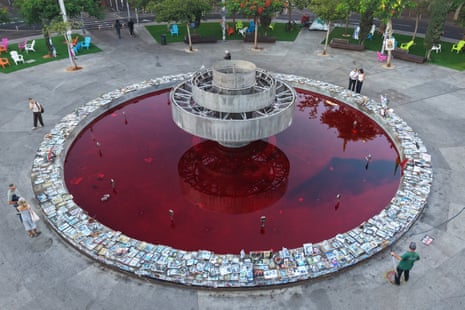
Families of victims and hostages also gathered outside the Knesset to observe a minute of silence and hold signs accusing the government of abandoning those affected by the Hamas onslaught three years ago.
Gal Goren, whose parents Avner and Maya were killed on 7 October 2023, addressed protesters outside Israel's parliament.
"How do you write three years of longing? How do you talk about 1,097 days that are actually one day that never ended? What do you say about three years of guilt, shame and regret?" he said, according to the Israeli newspaper Haaretz.
"What have we not cried out about in front of this cursed place and everywhere else? What did we not warn about? What did we not demand? What did we not lose?"
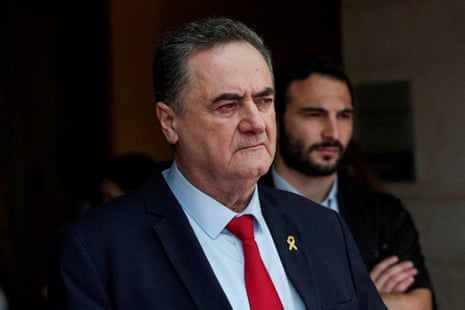
Israel's defence minister, said he had put the military on high alert yesterday, a day before the third anniversary of the 7 October attack.
Without providing evidence, his office said the instruction came "in light of intelligence regarding Hamas's intentions on that day".
"If, heaven forbid, our forces are harmed, the ones who will pay the heavy price will be Hamas and the population of Gaza – beyond all proportion," the statement added.
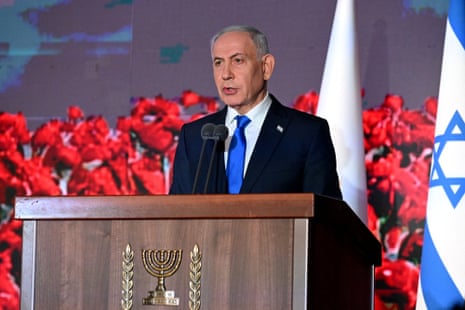
has contended that Israeli security chiefs collectively failed to foresee the surprise Hamas attack three years ago, while his critics argue that the Israeli prime minister, who has resisted an independent public inquiry into what happened, should personally answer for the security failures.
Israeli citizens will have their first chance since the deadly attack to pass judgment on Netanyahu, who is seeking an unprecedented seventh term, in the crucial general election on 27 October.
A new book by Haaretz reporters suggests Netanyahu was personally alerted by the UAE president that Hamas was planning a large-scale offensive against Israel a week before the attack, but failed to act on the warning.
The claim, which comes amid a crucial election campaign, prompted Israeli opposition leaders to describe the prime minister as "unfit" for office, even as Netanyahu denounced the report as an "absolute lie" and denied he spoke to the Emirati leader at that time.
Haaretz said the Hamas leader Yahya Sinwar, later killed by Israel, had warned a former Palestinian official that the militants were preparing "a terrifying operation" which he described as an "earthquake".
According to the report, the UAE president, Mohamed bin Zayed Al Nahyan, spoke to Netanyahu a week and a half before the attack, and told him Hamas was planning a major operation.
Read more:
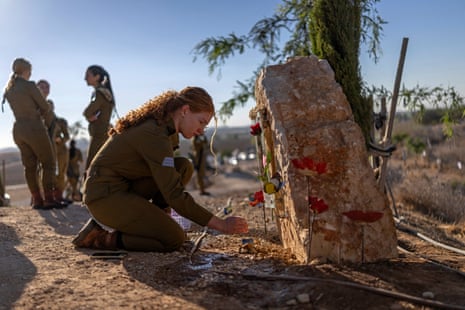
Here are some of the latest images from Israel, as the country marks three years since the 7 October attack:

Keith Siegel spent many of his long hours in Hamas captivity in Gaza etching everything that happened after 7 October 2023 into his memory. For 484 days, he recited to himself every place he was held, the dates he was moved and every attack or humiliation he endured or witnessed.
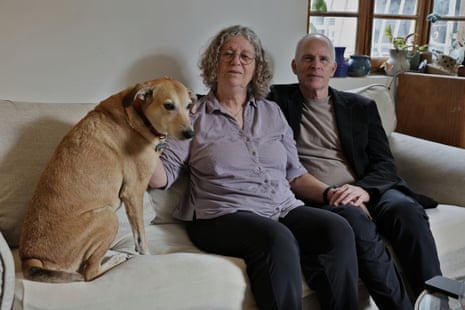
He aimed to store intelligence that could help Israeli forces free other hostages if he was released, to keep track of time as the days slid by and be able to tell his family what happened to him. Now his body is free, but he cannot loosen those memories.
"I'm living a kind of dual life," he said in an interview in Tel Aviv. "I'm here for some of the time, and I'm in Gaza some of time. It's very challenging to convey in words what it was like."
Siegel and his wife, Aviva, were among 251 people taken captive to Gaza on the deadliest day in Israel's history, when Hamas militants broke across the border to launch a wave of attacks on kibbutzim, border towns, military bases and music festivals.
"What happened to me in Gaza, what happened with Keith in Gaza, it's there all the time," said Aviva.
"I understand that it's going to be a process of healing. There's always things that remind me, and if I don't remember, then he reminds me. If I'm cooking lunch or making a cup of tea and I turn around and see Keith with tears in his eyes, because he just read something or let himself feel."
Read more:
We are starting our live coverage on the third anniversary of the Hamas-led 7 October attack on southern Israel, in which about 1,200 people were killed and another 251 taken captive to Gaza.
Israeli communities shattered by the massacres, torn between rebuilding their lives and remembering lost friends and relatives, have spoken to my colleague Emma Graham-Harrison about their experiences.
Israel responded to the attack by launching a devastating war on Gaza, during which at least 74,243 people have been killed, according to the territory's health ministry, whose figures are considered reliable by the UN.
In 2025, a UN commission found that Israel is committing genocide in Gaza, citing tens of thousands of civilian deaths and massive destruction. Israel denies accusations of genocide, but the war, which is continuing despite a nominal ceasefire, has left it isolated on the world stage.
Israel held a national memorial day on Monday for the victims of the Hamas attack and also remembered the soldiers who lost their lives fighting in Gaza.
Flags were lowered to half-staff at the Israeli parliament – the Knesset – and the president's residence in the morning, while two state ceremonies were held at the Mount Herzl military cemetery in Jerusalem.
Many Israelis are still grappling with the trauma of the 7 October attack, the deadliest in the country's history, with the memory of the assault and its aftereffects continuing to loom large and feature heavily in political debate.