Everyone at Exmouth Marina knew there was an unexploded German bomb in the water. Old hands at the dock had been saying so since the end of the second world war. But the marina had been dredged and re-dredged and nothing had ever come up. It had started to sound like an old wives' tale. The marina is a busy stretch of water: a commercial port until the late 1990s that had since been converted into a home to private yachts. A bomb, you'd think, would have a hard time staying hidden. But in the middle of the afternoon on Wednesday 14 January 2026, 81 years after the end of the second world war, Steve Hockings-Thompson, the manager of Exmouth Marina, got a call from the crew of a dredging vessel telling him he'd better come out to the boat. "I thought: 'Oh crikey. We've got a bit of an issue here,'" Hockings-Thompson told me recently.
He went out to the dredger, a squat barge that hauls silt and other debris from the marina floor on to a flat deck that resembles a steel sieve. Sitting on the deck was a huge hunk of metal, caked in mud and stones. As Hockings-Thompson got closer and saw its distinctive conical shape, he knew it was a bomb – a big one. The dredger was loaded with 20,000 litres of diesel fuel, so if the bomb detonated, it would be disastrous. He called the police, who quickly came to the scene. "And then," he said, "all hell broke loose."
To deal with the explosives, they called in the army. The call was picked up at the control centre at Vauxhall Barracks in Didcot, a small town in Oxfordshire. This is the headquarters of the 11 Explosive Ordnance Disposal and Search Regiment (11EOD), a specialist army division responsible for all kinds of bomb disposal – from improvised devices planted by terrorist groups to second world war-era munitions.
When the Exmouth bomb was called in, Maj Andrew Boyce, who was managing operations for the regiment, was confused. "We were talking about 'the bomb', which I'd been told was a 50kg," he recalled. "And then somebody on the phone tells me it's a 250kg. I'm like, how have you confused a 50kg bomb, which is the size of a fire extinguisher, with a 250kg bomb, which is the size of a hot water tank?"
The reason for the confusion soon became clear: the Exmouth Marina bomb was not the first to be discovered that day. Another second world war bomb had been unearthed a few hours earlier at a building site in Plymouth, 50 miles away.
In Plymouth that morning, Luke Templeton, director of S.I UXO, a private contractor that goes in ahead of construction companies to look for unexploded bombs, had known what he was looking for. His company's historians had already spent a fortnight doing a detailed risk assessment of the site, drawing on historical documents showing the Luftwaffe's flight paths and local records of airstrikes. From this, they'd worked out that it was highly likely there were two bombs buried somewhere on the building site. Using specialist equipment, they had found a 50kg bomb buried more than four metres down. After inspecting the bomb up close, Templeton called the police.
As far as Boyce knew, this was the first time since the immediate postwar period that two unexploded bombs had been discovered on the same day. The two bombs were in the same part of the country, and had been reported to the same police force, Devon and Cornwall. "We're used to having confusion with location or devices. We're not used to having two devices," said Brig Darren Fisher, who at the time was a colonel overseeing the operations. Once the confusion had been straightened out – it was a 50kg bomb at the building site in Plymouth, and a 250kg bomb floating on the dredger in Exmouth – the response began.
When most people think of bomb disposal, they imagine a lone figure in a bomb suit carefully approaching an improvised device as bullets fly overhead, holding steady as they unpick wires, knowing that one wrong move will kill them. This image was forged in Belfast during the Troubles and Helmand province during the invasion of Afghanistan, and it is not unwarranted; bomb disposal is commonly described as the most dangerous job in the military. But, in Britain in 2026, the daily reality of the job is quite different.
Although the same team deals with terrorist incidents, such as the 2017 Manchester attack on an Ariana Grande concert, it is unexploded second world war munitions that make up the core work of the UK's bomb-disposal teams. The Luftwaffe dropped more than 60,000 tonnes of bombs on Britain over the course of the war, and the Ministry of Defence estimates that roughly one in 10 of these failed to explode on impact. The reasons range from the grim – poor manufacturing quality due to a reliance on forced labour in concentration camps – to the prosaic: a bomb might have landed at an odd angle, or on soft ground that absorbed the impact before the fuze could fire. ("Fuse" is the general spelling for electrical safety devices and burning cords, while "fuze" refers to engineered explosive detonators.) Britain also dropped munitions on its own land during training exercises and deliberately buried surplus after the war in an effort at disposal. Eight decades on, the physical remnants of the war still account for about 2,000 of the 2,500 incidents that military bomb-disposal teams respond to in an average year.
The calls often come in from metal detectorists and magnet fishers, hobbyists who throw strong magnets into waterways to see what comes up. They surge on bank holidays, when people are out walking and notice things underfoot, or catching up on tasks such as clearing out a grandparent's home. Not long ago, the bomb-disposal unit was called to deal with a 2in mortar that had been used for 20 years as a paperweight. Increasingly, calls come from construction sites, as buildings get taller and companies dig deeper, which has led to a growing industry of private contractors actively searching for unexploded bombs. "We're expanding cities, building new homes, and an accident could happen," said Templeton. "If a 250kg bomb went off in a city, it could knock a whole street down."
The passage of time has not rendered these explosives less dangerous. In June 2010, three bomb-disposal experts in Göttingen, Germany, were killed by a 500kg American bomb found beneath the site of a new sports arena. In 2020, a 250kg bomb exploded beneath a crab boat off the Norfolk coast, seriously injuring five of its seven crew. In 2021, another bomb exploded beneath a drilling rig near Munich's main railway station, injuring four. Because it was a global war, this is a global problem. This year, a second world war bomb beneath a stilt house in Indonesia detonated, killing five people and injuring 20.
These decades-old devices are difficult to read or predict. "You don't really know why [a particular bomb] didn't function, which is part of the problem," said Lt Col Andy Hambley, the commanding officer of 11EOD. Years of corrosion, shifting ground and rust make the fuzes less predictable, the machinery harder to read.
That was exactly the issue facing two teams in two different corners of Devon on the afternoon of 14 January.
At about 1pm, PO Scott Dooley, a diver and bomb-disposal operator with the Royal Navy's Diving and Threat Exploitation Group, arrived at the building site in Plymouth. Dooley, a tall man with a neatly trimmed beard and a soft Devon accent, grew up in the military; his father was in the Royal Engineers, doing bomb disposal. In recent years, he had acquired the nickname "the Doom Watch", because every time he was on duty, the phone didn't stop ringing (his record was 11 call-outs in a single week). In Plymouth, Dooley scanned the area for risk: there was a school nearby, as well as a glass-fronted hotel that could shatter if the worst happened. Police were already at work establishing a cordon and evacuating the area around the bomb.
When an operator approaches a bomb for the first time, they do not know what they are walking towards. The most important thing is to assess the fuze, a metal cylinder screwed into the side of the bomb. It is the first link in a chain. The fuze contains explosives, which fire a tiny, highly sensitive detonator, which sets off a booster charge, which sets off the main filling of the bomb, a comparatively stable "secondary" explosive. Most German fuzes were electrical, charged from the aircraft as the bomb was released. After 80 years, there is no charge left in them. But some German bombs were fitted with a mechanical delayed-action fuze, constructed from gears and springs, like a watch. Once triggered, this fuze ticks down before detonating between two and 72 hours later. The Luftwaffe deliberately fitted these fuzes to maximise disruption; hospitals, roads and factories were cleared for days at a time because the bombs could detonate long after impact.
Everything, therefore, turns on the fuze. If the fuze is judged to be sensitive, that usually means it is too dangerous to move the device. The safest option is to surround it with sandbags and detonate it where it is. If the fuze is stable, then it can be moved somewhere safer, such as out to sea.
Dooley had two things working in his favour: a 50kg bomb was less likely to have a ticker, and it was still half-buried, which suggested it hadn't been badly jolted. On the other hand, the fuze was submerged in mud and he couldn't see it. Bomb-disposal operators try to avoid moving a device until they've assessed the fuze, lest they trigger a ticker, but Dooley had no choice. Down in the pit, he and a colleague built a stable platform on a ledge of mud, surrounding it with sandbags, and set to work painstakingly unearthing it. Once it was out, he placed a listening device on it called a microphone stethoscope, or mic steth. He listened for ticking.
Silence. A moment of relief, quickly followed by further investigation. Silence only means that at that moment, no mechanical fuze has been triggered. Was there one in the bomb at all? Dooley needed to physically examine it. The bomb had been lodged more than four metres underground for decades and was caked in thick clay. Still listening for ticking on the mic steth in case his movements triggered anything, he poured water on the fuze to wash away the mud. "The fuze was absolutely more than gone," he said. It was so degraded that none of the markings were visible. No markings, no information. They would have to X-ray it.
While this was unfolding in Plymouth, Capt Liam Kidman was anticipating a quiet couple of days at home. Kidman had just come off a gruelling week that ended in rural west Wales, cutting open a safe packed with explosives at the bottom of a dead man's garden. (The man had apparently used the explosives for felling trees, and nobody knew where he kept the key.) Then, shortly after he had completed that job, the control centre rang to say two bombs had been discovered in Devon. The local team in Plymouth was already occupied with one of them. Could he go to Exmouth? Kidman was back on the road within the hour.
An energetic man from south Wales, Kidman ended up in bomb disposal almost by accident – when he joined the army more than 20 years ago, there was a shortage of ammunition technicians. As he climbed the ranks, dealing with improvised explosive devices (IEDs) in Afghanistan and second world war jobs in the UK, he came to love the problem-solving aspect of the work.
It was past 7pm when Kidman reached Exmouth Marina from his base in Gloucestershire. The closer he got to the marina, the emptier the roads got. The bomb was sitting out in the middle of the harbour, bobbing on the open deck of the dredger. It was so big that if detonated it could flatten the marina's waterfront. The bomb was only accessible by sea, and the nearest naval team was tied up with the other bomb in Plymouth that night. Usually, the army handles incidents on land and the navy anything at sea, but the unexpected nature of two bombs being found on the same day had turned everything on its head.
The bomb had been handled roughly – hauled off the seabed and dumped unceremoniously on to a metal deck. "If there's a mechanical fuze on there, that's enough for it to be ticking down," said Kidman. They had to get ears on it. Harry Griffin, the marina compliance manager, stepped up. Griffin knew there was a chance the bomb could go off, but reassured himself that it had been in the water for 80 years without incident. He ferried a sergeant from Kidman's team over to the bomb to get a mic steth on to the device. "That's the bit that gets the operator's heart going," said Kidman.
It was not ticking. But nobody relaxed. Just as in Plymouth, they did not know what kind of fuze they were dealing with.
On a bright day in June, I visited RAF Northolt, a base on the outskirts of London, to observe a training exercise on airdropped weapons. Learning how to correctly assess an old, rusting bomb takes time and practice. Bomb disposal is a dangerous job but, Hambley told me: "Knowledge dispels fear."
Bomb disposal as a specialism was created in the second world war. Britain wasn't ready for the blitz, and the early assumption was that police or air raid wardens could simply deal with any bomb that failed to go off. But as delayed-action mechanical fuzes – those ticking timebombs – became more common, it was clear that targeted intervention was needed. As the historian James Owen details in his 2010 book Danger UXB, in May 1940, the War Office handed the problem to the Royal Engineers, who formed 25 bomb-disposal sections armed with little more than picks, shovels and stethoscopes. By September 1940, they were dealing with more than 3,000 bombs a month. By some estimates, the average life expectancy of a bomb-disposal operator in this period was 10 weeks.
Those early teams mapped every bomb they dealt with, and the maps are still in use. Matt Fuller, a researcher at S.I UXO, the contractor that found the bomb in Plymouth, works through wartime bomb censuses and Home Office daily intelligence reports. Studying the bomb maps, he found that the Plymouth bomb most likely fell on the night of 21–22 March 1941. (The Exmouth bomb he puts at 24-25 February 1941.) Conducting risk assessments, Fuller is struck by the sheer number of places that were targeted, some of them small towns with tiny populations. "The last person to die from an unexploded bomb dropped in world war two probably hasn't been born yet," he told me. Fuller also marvels at the detailed records local wardens kept. They saw the danger that unexploded bombs would pose for future generations. In keeping those records, they reached out a helping hand from past to present.
In contrast to their second world war counterparts, modern bomb-disposal teams come armed with robot-mounted cameras, mic steths that can be operated from a distance, and X-ray machines that can penetrate thick layers of steel to examine the explosive content inside. "Risk to life comes above everything – for the public, but also for us – and risk to property comes second," Hambley told me. But when a bomb is 80 years old, even this equipment can be unreliable.
At RAF Northolt, a 500kg German bomb was perched on a grassy verge. The bomb, which was inert, had been placed there, at an awkward angle, for bomb-disposal technicians to assess in pairs: what type of bomb is it? Which fuze? What action can be taken? I approached the bomb with Maj Matt Walker, the squadron duty officer. It was roughly the length of a two-seat sofa: a long, thin hunk of dull metal, its surface rough and textured with rust. Walker told me that a device this size would have a blast radius of "a few hundred to a thousand metres".
Without clear markings, trainees would have to use their knowledge to work out whether the fuze had a mechanical timer, or an additional anti-handling fuze: a booby-trap built into the bomb that detonates it if anyone tries to move it or remove the main fuze. The trainees had to work out what to do next. "It's extreme problem solving," said Walker. "Someone described it to me the other day as – you start by juggling five books, then someone throws a glass ball and you have to keep that juggling as well. They then throw a ball of fire." If you drop one of the balls, you and those nearby will probably die.
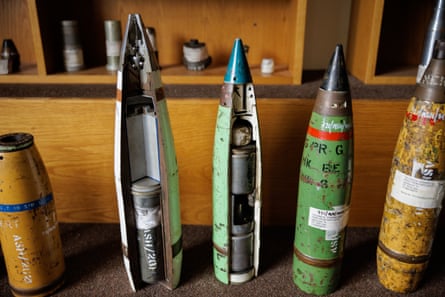
We left the 500kg bomb where it was and walked into the "museum", a grand name for a few long, dusty shelves inside a garage that acts as a visual reference library. "Anything and everything will turn up here," said Walker. He picked up a tapered, hollow metal tube. "This one is actually a kid's baseball bat. But it got called in." They'd hung on to this and other red herrings so that trainees could see, in practice, how easy it is to mistake something for a bomb. The other miscellanea included an internal part from the Citroën 2CV car that looks so much like a bomb that people regularly call 999 after finding it in a scrapyard. Until I looked at the items in the museum, I hadn't fully grasped how little there is to go on: the munitions are not just rusted but distorted, sometimes missing pieces, completely blank. Translating these rusted lumps of metal into something legible requires an expert eye: a cylindrical shape with a curved end means it could be a German SC50, particular fuze pocket positioning can identify a British SAP250.
There is a generational difference between bomb-disposal technicians in the UK. People who qualified before 2012 cut their teeth in Afghanistan, where the Taliban laid an extraordinary number of IEDs. In 2011 alone, US-led forces recorded 16,800 IED incidents, roughly 46 a day. Those who qualified after 2012 tend to have mainly worked on second world war munitions. Hambley's own career has mapped this change. His first job as a bomb-disposal officer was in Helmand in 2012, walking toward a buried device while live rounds tore past his ear. These days, the problems are different: orchestrating large-scale evacuations of civilians, trying to avoid property damage. "You've got a lot more latitude than when you're deployed in Afghanistan," Hambley told me. "In the UK, we own the ground, no one is going to shoot at us, we've got time, so we can afford to be as safe as we possibly can be." Caution, though, is slow – and the moment a bomb is discovered, the clock is ticking to get people back into their homes.
Sitting at her desk overlooking Exmouth Marina, Fiona Bolt, a chartered financial planner in her 60s, could see the bomb on the dredger. At about 3pm on Wednesday 14 January, police knocked on the office door and told Bolt and her four colleagues to pack up and leave. "It was really quite scary," she told me. By 8pm, the safety cordon had expanded from 100 to 400 metres and police started knocking on doors on streets near the marina. Some people went to stay with family members nearby, others in hotels. One of the Bolts' neighbours ended up sleeping in their car.
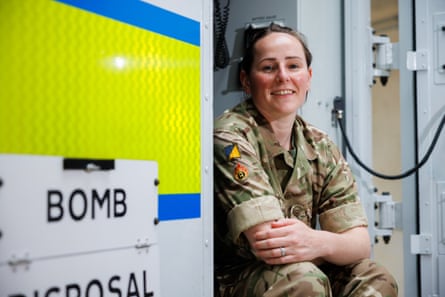
As the night set in, Kidman's team was out on the water, trying to see inside the bomb. The first X-ray images of the fuze were unusable: the steel casing, thickened and blistered by rust, defeated the beam. They spent seven hours cycling through different X-ray equipment, trying to get a clear image. As Kidman worked through the night, he could see lights going on and off at the far end of Exmouth harbour, in flats that would ideally be empty. Police can't force anyone to leave. When someone refuses, police hand them a letter saying they're staying at their own risk, and the regiment has to work around them. In Great Yarmouth three years ago, Hambley worked to render a 250kg bomb safe with a resident "teeth-chatteringly close" – less than 50 metres away.
When Bolt got up the next morning, she noticed her street, close to the marina, was eerily empty. When Bolt left the house she saw how far the exclusion zone had expanded along the seafront: it now encompassed 400 metres, and 2,000 properties. She didn't have an office to go to. "I felt really lost, like a rabbit in headlights," she said. "It was all just so out of my control." The council had hastily assembled makeshift shelters out of a leisure centre and retirement home. When Bolt stopped by the leisure centre that day, she saw that camp beds and bedding had been brought in during the night, and Tesco had donated food. "If we'd been in wartime," she said, "I imagine that's what the community spirit was like."
By about 5pm, it was clear Bolt would not be going home that night. Her house was deep within the cordon. She stuffed essentials into a rucksack and walked across town to her son's house. By 9pm the cordon had crept up to 600 metres, encompassing a further 500 homes, cleared block by block by police officers. This was a big operation, but in Germany, where far more unexploded ordnance lies buried, even larger scale evacuations are common. In September 2017, 60,000 people were cleared from central Frankfurt, including two hospitals, so that a 1.8-tonne British "blockbuster" bomb could be defused. In 2025, the city of Cologne alone carried out 19 evacuations for wartime bombs, affecting almost 70,000 residents.
At their respective sites, Dooley and Kidman were both acutely aware of the disruption around them, which adds an intense time pressure to their work. In Plymouth, all the buildings within a 100-metre radius of the building site had been evacuated on Wednesday, including the school. Dooley's first X-rays, taken with the standard equipment, had come out completely black. At around 4pm on Thursday, high-sensitivity X-ray plates arrived from elsewhere in the country. Finally, a readable answer. The bomb had no mechanical fuze, and no anti-handling device. Dooley breathed a sigh of relief. "People could just calm down a little bit," he said. "It wasn't going to tick if you knocked it."
Soon afterwards, in the late afternoon, the high-sensitivity X-ray machine arrived in Exmouth. It went out on to the dredger. The team started scanning, and kept going for hours. Still nothing. Kidman reported back to the operations team: they couldn't identify the fuze.
The forward base in Exmouth was the lifeboat station, and over the course of Thursday it filled up with marina staff, police, coastguard and emergency planning officers from the council. Briefings and strategy meetings took place every few hours. The position of the bomb severely limited the normal mitigation procedures. The regiment's standard protection for a 250kg bomb is a sand-filled fortification weighing about 350 tonnes. This could not be built on a barge. Abrasive cutting, an advanced technique for cutting out the fuze, was not deemed appropriate. The next option was towing the dredger out to sea and blowing the whole thing up. Griffin, the marina's compliance manager, phoned its insurers to ask whether this would be covered. Most marine policies carry an act-of-war exclusion, which raises a difficult question: after 80 years, is a Luftwaffe bomb still an act of war? "We went round in circles, really," said Griffin.
This is a sensitive subject for 11EOD. In February 2021, a 1,000kg German bomb – one of the heaviest in the Luftwaffe's arsenal – was discovered on a construction site next to Exeter University's halls of residence. The team could not establish if the bomb was booby-trapped so it decided to do a controlled detonation where it was, with 400 tonnes of sand around it to absorb the blast. It was not enough. The explosion, which was heard for miles, left a crater the size of a double-decker bus in the ground and threw debris at least 250 metres, shattering windows of nearby buildings. The university claimed on its all-risks policy; the insurer, Allianz, declined, citing a clause excluding damage "occasioned by war". The high court found in favour of the insurer. The military was not financially liable for this, but the experience of having every step of its process picked over in court made the unit even more cautious. "We are very aware that everything could end up in court and everything could be questioned," said Hambley.
Caution pulled one way and time pressure – the need to get people back into their homes in Exmouth and kids back to school in Plymouth – pulled another. The idea of exploding the entire dredger was ruled out due to the risk of environmental pollution from the 20,000 litres of fuel on board and fragmentation of the vessel itself. That left only one option: get the bomb into the water and tow it away to detonate safely at sea. But this left a question: how to remove it?
By 11pm on Thursday 15 January, there was a plan for the smaller bomb in Plymouth: lift it out, place it in a 4x4 packed with sandbags, drive it 1km to the water's edge, take it out to sea and blow it up there. By 12.30am, police and fire crews were going door-to-door to evacuate everyone who lived within 150 metres of the route. At about 2.30am, Dooley and another bomb operator lifted the 50kg bomb out of the pit with their hands, climbing up on a makeshift staircase they had built out of sandbags. The bomb, slick with mud, was cold and heavy. It was dark, and the steps, wedged deep in a muddy pit, were slippery. They placed the bomb carefully into the back of the waiting vehicle. The convoy slowly moved off, at walking pace. As the vehicles passed by, the police released the cordon, letting people back into their houses while the bomb was still crawling towards the sea.
Once it was at the water's edge, the bomb was carried down on to a boat and lowered over the side, where a buoyancy device was waiting so that it could be dragged along underwater at a safe distance from the boat. Dooley was aboard the navy boat, which lowered the bomb into the water as it got further away from the harbour. He'd had two hours sleep in the preceding 36 hours.
The King's Harbour Master, which controls shipping in Plymouth Sound, had given permission for the bomb to be detonated in a specific patch of sea, and they sailed out four nautical miles towards this spot. At the drop point, Dooley fixed an explosive charge to the bomb and had it lowered down to the seabed. A navy diver followed the rope down in the dark. It was pitch black and the water was thick with silt, rendering a torch useless. Working by touch, the diver undid the bolts, let the air out of the float and brought it to the surface.
When the diver came back up, Dooley took the boat back a hundred metres. From there, the only thing showing the location of the bomb was a small lit float attached with a line, bobbing on the surface of the water. The swell of the waves kept hiding it. Police drones confirmed nobody on shore was in danger. The navy confirmed there was nothing on radar at sea. The charge was initiated. Dooley counted down.
At 5.13am on Friday 16 January, the sea briefly lit in the dark. A plume of white water rose above the surface, then nothing. Eight decades after it was dropped, the bomb had been detonated.
As this unfolded in Plymouth on Thursday night and into Friday morning, Exmouth Marina was empty except for the military bomb-disposal team and the two marina staffers. "It was quite eerie," said Hockings-Thompson, the marina manager. "It was like going back to Covid times." They were all focused on how to get the bomb off the dredger. Someone suggested bringing the dredger in closer, but moving the boat meant moving the bomb, and nobody wanted to risk it.
Griffin went back into the office and called a local crane hire company, who agreed to bring a 55-tonne crane. The next problem was who would drive it. Senior officers including Fisher scrambled to find a military crane operator qualified to drive a 55-tonne crane, available at short notice. They could not. The civilian crane driver who had brought it over offered to do it himself. "I can't own the risk of him driving that crane," said Fisher, who held the military liability. That passed the question to the police, who had to decide whether to authorise a civilian to handle an unexploded bomb – and whose financial responsibility it would be if the crane was destroyed. "If the worst happens," Fisher said, "we've got much bigger problems than losing the crane." Eventually, they let him go ahead. (The crane driver declined to speak to me for this article.)
After midnight, in the early hours of Friday 16 January, bomb-disposal operator Lt Matt Bowden attached straps around the bomb casing and added a buoyancy device. He left the dredger and the crane lifted the bomb. As the 250kg lifted from the deck, the barge rose in the water. They had discussed this in advance: whether the dredger, suddenly lighter, would bob up hard enough to bump into the bomb and trigger something. The dredger heaved. The bomb swung out to the side and missed the steel vessel entirely. It was lowered into the water and attached to a navy boat.
Everything now depended on the tides. There was a fixed window in which it could be towed out and detonated. At about 4.30am, the boat picked its way through moored yachts with the bomb submerged and trailing 100 metres behind. By 6.30am, the bomb was so far out and deep underwater that residents were allowed back to their homes.
Hockings-Thompson and Griffin, who had been mostly awake for the preceding 48 hours, went aboard the dredger to bring it back into the marina. Then they walked up to a coffee shop on the seafront. They were in the queue at 8.13am when the bomb went off, a mile and a half out. "The whole seafront was full of people expecting to see a massive bang and a splash," said Griffin. "All we got was a bit of a plop." The sea had done its job and neutralised the blast.
By 11am, businesses around the marina were open again. Kidman was exhilarated. "No one died, there was no injury, no damage to infrastructure," he said. After working for 36 hours straight, everyone went home to sleep. For Dooley, after his own successful operation in Plymouth, it was only a few hours later, when he was sitting with his family, that the magnitude of what had happened hit him. "You're just doing your job," he said. "Then you sit there and think, what have I done here? A 50kg could kill you as much as a 1,000kg."
In late summer, about six months after the double bomb discovery, I sat in the bar at Vauxhall Barracks with Dooley, Kidman, Fisher, Boyce and others who had worked on the two operations. It was a wood-panelled room with a blue patterned carpet, the wall adorned with regiment photos and a framed Private Eye cover of the Queen meeting Martin McGuinness in a bomb-disposal suit. As I pressed for details, they found their recollections blurring. Was a particular memory from 14 January? Or was it the 250kg Plymouth bomb that was found in April outside an Aldi? The one found in June at a business park in Coventry? "So much has happened since then," said Boyce. In fact, WO Sarah Rowland, who had worked with Dooley on the bomb in Plymouth, was unable to join the meeting as that morning she'd been called out to Staffordshire, where a 500kg bomb had been found in a quarry. (She texted Dooley to say she was collecting them all, "like Pokémon cards".)
They are getting busier. Ten years ago, one or two large airdropped weapons were found each year. This year there have already been six. The latest was on 21 September, when a 115kg American bomb was found in the water off Pendennis headland, at the mouth of Falmouth's harbour. The call went to Dooley, but he was already on another job. Kidman was assigned to it and drove down to Cornwall, where he spent almost all of the next three days awake, problem solving. The job was complicated. Blowing it up where it lay risked rupturing waste tanks 40 metres away and pouring sewage into the Channel. Instead, more than 300 households were evacuated while the navy lifted the bomb and towed it out to deep water. It was too dangerous to send a navy diver down, so the bomb was left on the seabed, far from anyone, while the regiment counted down the hours.
On 27 September, with the clock on the Falmouth bomb still running, another call came in: three white vans near RAF Fairford, a Gloucestershire base used by American bombers. A major counter-terror operation began. Kidman and Rowland drove to the scene. A robot searched the vans. X-rays followed. They helped each other out, catching some sleep in the car when possible. Kidman was still overseeing the bomb in Falmouth. On 28 September, they found that there were no explosives in the white vans. Kidman went home to sleep. At 2.25pm on 29 September, the timer was up on the bomb in Falmouth, so the team went back to detonate it at sea. "And then," Kidman said, "we're ready for the next bomb, I guess."