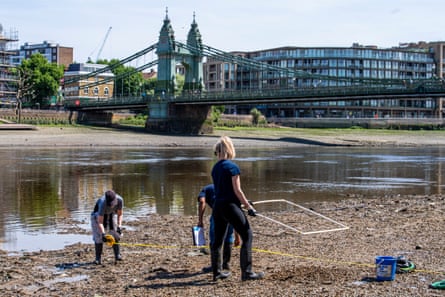
n a pale-blue Sunday morning on the foreshore of the River Thames, 40 people are searching for what others have tried to lose. Dotted across a 250-metre stretch under Hammersmith Bridge, they are combing through layers of silt, seashells and dirty driftwood to find one of the river's most stubborn problems: wet wipes.
"People come and walk here and it looks just like mud, at a distance," says the organiser, Dr Felicity Rhodes. "And then you get closer in and see."
The dig forms part a citizen science project that has tracked sanitary litter on the banks of the Thames for nearly a decade. Set up by the environmental charity Thames21, volunteers are recruited to help map out the amount of wipes that are flushed down the toilet and washed up along the river. Findings are added to a database that quantifies plastic pollution on the banks of the Thames.
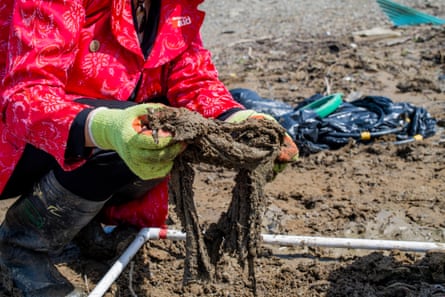
"It's not glamorous," says Rhodes, the programme manager at Thames21. "But through this data generation, we've created this dataset of really robust, accurate data that's given us an understanding of the wet wipes here on the foreshore."
Hydrographic surveyors from the Port of London authority (PLA) are assisting the project, and are riverside before the volunteers arrive, having meticulously marked out channels of the foreshore based on where the last count took place. Volunteers lay quadrats, square frames, on the riverbed and drag metal sticks through the mud. One drag can pull up a clump of flushed wet wipes from what had appeared to be just silt to the naked eye; they are counted, recorded and deposited into a bucket for disposal, along with the plastic, vapes and other rubbish curios that come up.
Jim Powell, an operations manager and hydrographic surveyor at the PLA, explains why Hammersmith is such a hotspot for grime. "You're on the inside of a bend of the river so the water velocities are slower," he says. Material builds up on the inside because the water flows faster on the outside. "As soon as you get bits of wood and tyres, they start to trap sediment and other things start getting caught, like plastic wipes. Then it just snowballs from there."
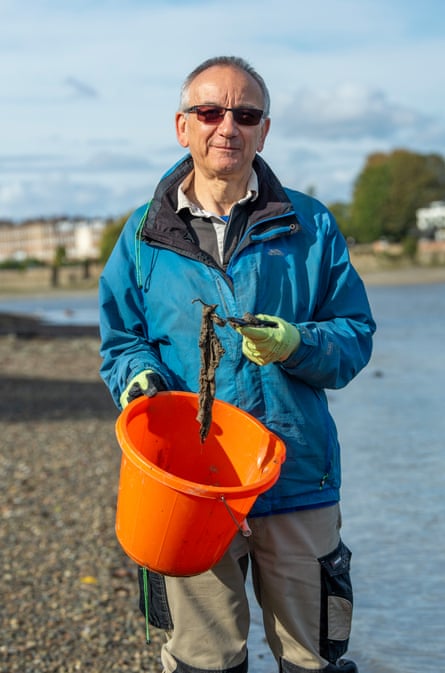
Elio Gregori, 66, has attended about 300 sessions since he retired. "You can look at a place like this and assume that it's mostly nice and clean, but under the surface is a wet wipe," he says, fishing a knot of rotten-brown wipes out of his bucket as an exhibit. "When it's in the environment, you wouldn't really recognise it as a wet wipe. If you look down, it opens your eyes to how much of this stuff is around."
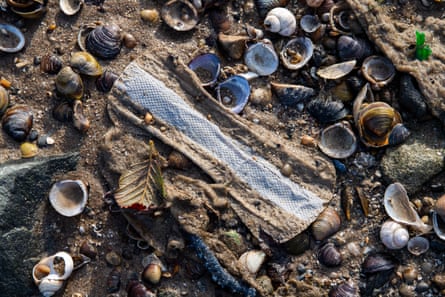
Many wet wipes contain plastic fibres and are designed to stay intact when wet – even some marketed as biodegradable. When London's wipes are flushed down the toilet, they can end up on the riverbanks, mostly through storm water overflow and sewage outfall. Thames Water estimates 3.8bn wipes are flushed into its network each year – enough to build more than 10 wet and stinking Big Bens.
"Plastic here on the foreshore has the potential to make its way into the ocean and into our ocean food system as well," says Rhodes. "We want to remove plastic here so that it doesn't become microplastic in the ocean."
A young refugee from Sudan attended the count with the community centre West London Welcome. "It's really a shame for people to throw bad things through toilets," he said. "This waste is in this nice area … people should have to be more careful in the environment where these things ended up."
Some relief arrived last year when the delayed Thames Tideway Tunnel opened – the £4.6bn project designed to reduce sewage discharges into the river.
Then diggers came to this part of the foreshore a few months later to remove the infamous "Wet Wipe Island", the 180-tonne amalgamation of wipes that had grown so large it had begun to alter the shape of the river. Thames21 estimates the work removed 5m wipes that had congealed into a 250-metre island.
Now, Thames21 is back to assess what the Tideway Tunnel – the "super sewer" – and removing Wet Wipe Island has done. "Will we see fewer wet wipes? Most likely," says Rhodes. "Are they re-accumulating? We might be able to start to see any changes and that's why it's really important to keep monitoring."
Last December, the government announced that selling single-use wet wipes containing plastic will be illegal by May 2027. It was a win for Thames21, who had for years been banging the drum and sharing their data with Fleur Anderson, the MP for Putney, who campaigned on the issue in parliament.
By the end of the weekend's count, Thames21 said volunteers had found 733 wipes in 50 sampling squares, compared with 1,584 found in the same spots in April. It is a substantial drop in the recorded count, although the PLA says it is still early days, and two surveys cannot yet establish precisely how much of it is due to the cleanups, the Tideway tunnel or changing conditions on the river.
But for now, Thames21 volunteers plan to keep counting. "We expect that they'll still wash up on the river for a time," says Rhodes. "What we're doing here is tracking the ongoing change in that."