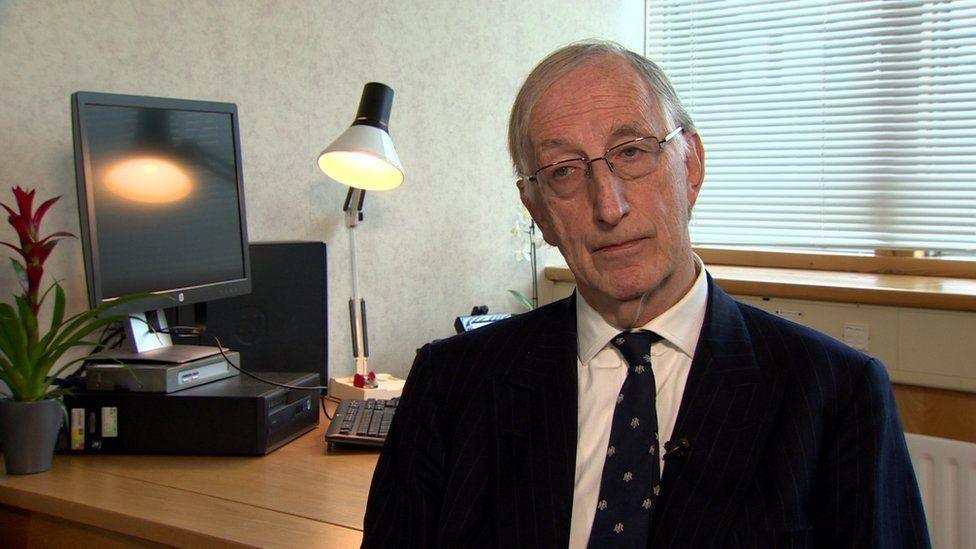
A former senior judge who is carrying out a review of the legal framework on trial of the facts cases in Northern Ireland has said he wants to look into whether victims are "being sidelined".
Sir John Gillen, who led a major review of sexual offence trials in 2019, is expected to deliver an interim report by February 2027.
It comes after Eleanor Donaldson, wife of convicted sex offender Jeffrey Donaldson, faced a trial of the facts after being found unfit for a conventional trial on mental health grounds.
Sir John said he will also explore what happens in a case when a defendant later "becomes fit" after being deemed unfit to stand trial.
The Department of Justice said the review would examine a range of factors, including whether a conventional criminal trial should remain possible if an individual becomes fit to plead.
It will also consider whether safeguarding measures, such as sex offender notification requirements, should apply following findings involving acts which would otherwise constitute serious sexual offences.

In September, Stormont's justice and health ministers announced a joint review would be carried out.
Regarding a defendant being ruled out of a criminal trial because of their mental health, Sir John said "there are avenues that need to be explore more fully".
"There was legislation in 2016 about that not fully implemented, so we do need to look at that. It's going to be one of the matters at the fore in my review," he told BBC Radio Ulster's Good Morning Ulster.
He said a psychiatrist or medical practitioners would decide if somebody becomes fit.
Are victims being 'sidelined'?
Sir John has already started to meet with groups and representatives of victims and survivors and said there are "genuine concerns" about trial of the fact cases that he plans to look at.
"I'm being asked to look at the existing system and to consider whether the balance between victims, defendants and the public is the appropriate one."
One of the questions he wants to answer is: "Are the concerns of victims being appropriately considered?"
He said he wants to look into whether victims are "being sidelined" and if the offence is "being fully tested".
'Are we using the appropriate mechanisms?'
Sir John also plans to review if "the outcome reflects the seriousness of the offence" in a trial of the facts case.
"The law at the moment has involved from 1836... We have to ask ourselves does that law require to be modernised?" he said.
"Are we using the appropriate mechanisms in light of modern medical practice?
"Is the medical practice that we have at the minute a bit too narrow in its focus?"
He said one of the main concerns is whether the public is "properly protected in the wake of the disposals available to judges in these cases".
The final report is due to be published in spring 2027.
What is a trial of the facts?
A trial of the facts is an option that is open to prosecutors if a court determines that a person is unfit to stand trial and criminal proceedings cannot go ahead.
It takes the place of a criminal trial and is used to determine whether an accused committed the acts alleged.
It cannot result in a conviction, but if the court is not satisfied that the accused committed the acts alleged, then he/she will be acquitted.
The procedure is allowed for in legislation by Article 49A of the Mental Health (Northern Ireland) Order 1986.
The mechanism is not used often but one high-profile example was in the trial of former IRA leader Ivor Bell in 2019.