t the top of an extendable ladder on a quiet street of Ilfracombe, in Devon, an older woman dressed smartly in cropped trousers, a red rain jacket and matching red socks is chopping at some wires at the top of a set of traffic lights with a small pair of pliers.
A grey-haired man holding a takeaway coffee supports the ladder, while others, filming their activities, give encouragement from behind the camera. "Yeah, that's how you do it," says one man. "Just cut the wires."
Posted to social media after the incident on 28 August, the footage rapidly attracted attention. To some, it was an act of straightforward vandalism; a woman in her 60s and man in his 70s were later arrested and bailed on suspicion of criminal damage and causing danger to road users.
Others, however, believed the woman should be lauded. "Not all heroes wear capes," reads one Facebook comment on a supporter's page. "Bideford and Barnstaple next, please," reads another.
Most people view traffic lights as helpful landmarks that keep road and pavement users safe. To a group who call themselves "Blade Runners", however, the traffic scanners installed above them increasingly conceal a sinister purpose: to install "phased array electronic assault weapons" on city streets that they claim can carry out mass surveillance and even cause cancer, dementia and sudden death.
Previous activists claiming affiliation to the movement have targeted Ulez cameras in London, resentful at their surveillance and the resulting emission zone charges; there have also been sporadic attacks on 5G mobile network towers, inspired by conspiracy theories that include the suggestion they spread Covid.
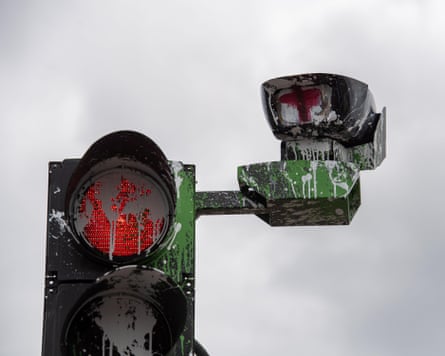
Ilfracombe is not the only town where traffic scanners have been attacked. In May, police in Cambridge appealed for information about a suspect after nearly 200 traffic detector units were damaged. In the same month in Sleaford, Lincolnshire, 10 units were vandalised in a week, with the council describing the conspiracy claims as "ridiculous". In County Durham, a pensioner is facing trial after allegedly damaging units on eight sets of traffic lights.
To Susan Grant-Muller, a professor of technologies and informatics at the University of Leeds's Institute for Transport Studies, hostility to traffic scanners is puzzling because "this technology, in its most basic form, has been around since the late 70s". Activists targeting traffic lights do not generally damage the familiar green, amber and red stop-go systems, but instead target additional sensors installed on top that monitor vehicle volume and, in some cases, pedestrian numbers, to allow lights to be phased to help traffic flow smoothly.
"The cameras aren't recording any personal information at all," says Grant-Muller. "They aren't recording faces or any details about the car. They just detect that there is something there, a car or person, and the length of the queue that people are waiting in."
They are generally only installed at junctions with a history of traffic flow problems, she says – often at the request of concerned local residents – and are welcomed by Living Streets, which promotes pedestrian safety. "Better monitoring technology improves pedestrian safety at traffic lights and crossings, [particularly] when enforcement technology is used as part of a wider approach to road safety," says Tanya Braun, the charity's director of external affairs.
None of this convinces those who see a more nefarious purpose behind them. Conspiracies about these scanners fits into a broader fear of surveillance and limits to individual freedom. This is part of a "super-conspiracy" that believers call "the great reset", says Clare Birchall, a professor of contemporary culture at King's College London, who has written extensively on technology and conspiracist thinking.
"These super-conspiracies draw all sorts of different things together to give some kind of shape to a whole bunch of different anxieties and fears," says Birchall. "We're all worried about technological overreach. Lots of people are worried about datacentres. And I often read conspiracy theories as a vernacular form of critique. It's an everyday version of what we're all trying to grasp.
"I'm not surprised at all that [some] people need to find a narrative to find their way through it, because we're so disenfranchised when it comes to the collection of our data or what happens to that."
Conspiracies often form in response to frightening events, agrees Stephan Lewandowsky, a professor and chair in cognitive psychology at the University of Bristol, "and if you can assign that to a bunch of evil-doers who are responsible, that can provide psychological comfort for certain people, because they'd rather have bad people do bad things, then realise that the world contains effectively random events that you can't control".