"Want to touch it?" Jonny Jennings asked, clutching the World Stone Skimming Championship trophy in his arms as he waited for the ferry. The mind games from the 2025 men's champion had started hours before this year's competition had even begun. The 38-year-old had travelled from Kentucky to Easdale island just off the west coast of Scotland to defend his title. He was not giving it up without a fight.
On Saturday, more than 400 of the world's best stone skimmers descended on the tiny island in the Inner Hebrides, normally home to just 60 residents. From Argentina to India, Hong Kong to Jamaica, more than 30 countries were represented, ferried over in groups of 10 from the mainland.
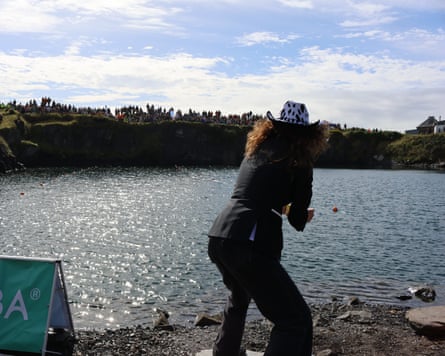
Easdale is home to stone skimming's colosseum: a former slate mine flooded by a ferocious Atlantic storm in 1881, forming a natural amphitheatre for the tournament. Competitors get three throws across the 63-metre (207ft) stretch, which is marked off like a swimming lane. Stones must be made of Easdale slate and can be no wider than 7.6cm (three inches). The ultimate aim is to hit the back wall, the equivalent of a nine-dart finish that sends the crowd into raptures.
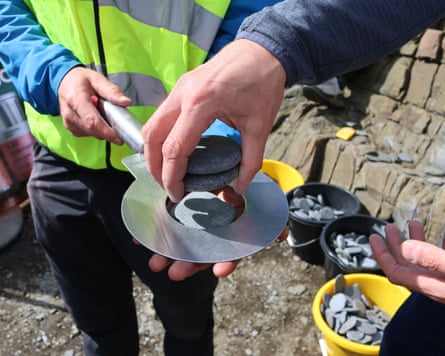
From the "skim of destiny", the stone plinth from which all skimmers have to throw, the back wall of the quarry does not look far away. But looks deceive on Easdale. The wind, the rain and shadows in the water combine to make it one of the toughest places to compete for skimmers in the world. Many elite male skimmers can throw more than double the distance of the quarry in calmer conditions. But at the world championships, they often crumble.
"It's the magic of Easdale," said Lucy Wood, the six-time female champion. "It's different, very different. You have got hundreds of people watching you throw. It's completely insane. Some people say that the island is not the best place to host the competition because of the back wall, and you cannot really throw that far. But most of these skimmers have never even hit it."
On Saturday, a vicious wind played havoc with the competition, blowing stones off course as it swirled around the quarry. To combat conditions, many skimmers changed their style to try to avoid the gusts. Some bent their knees more than usual, others wound up their arms and used brute force for their throw. But nothing seemed to work. Stones whizzed off course in all directions, disappearing into the depths of the quarry far short of their intended target. By the halfway stage, just one competitor had hit the back wall.
Last year, the competitive spirit boiled over. Two competitors were caught cheating after fashioning stones into perfect circles in an attempt to improve their chances of a better throw. The scandal made international headlines and organisers had a geologist on hand this year to check stones if any questions were raised.
"To win at Easdale, you need to have guts," said Dr Kyle Mathews, the competition organiser, known as the "official toss master".
"You need distance, consistency and accuracy. You need to be able to stand up and throw when it counts. We are often put in the same category as cheese chasing down the hill or the conkers championship. But these skimmers have genuine sporting talent. The world record for the javelin is nearly 100 metres. The record for stone skimming is much further than that," he added.
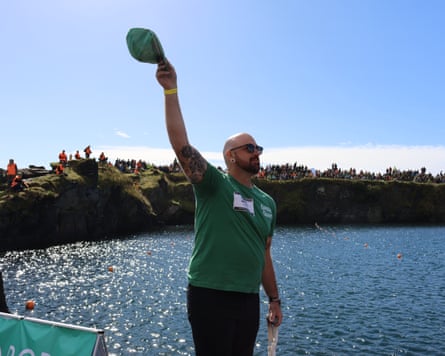
When it was time for Jennings to throw, the packed crowd around the colosseum fell silent with expectation. Dressed in his signature colour, the "Green Giant" finished his pint of beer before taking the plinth, still wearing sunglasses. "Now that's aura," one young spectator whispered.
Jennings had to hit the back wall if he was going to retain the title. His first attempt was superb, delighting the crowd, but the stone disappeared into the water just before it could produce a satisfying "clink" with the back wall. The second skewed left, caught by the wind. He waited for the gust to die down for his final attempt. Bending his knees, the champion unleashed the throw with all his might. But it was short again: 2026 would have a new men's champion.
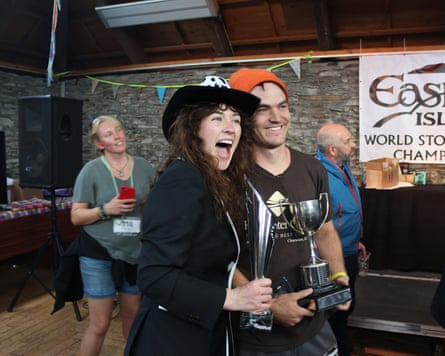
By late afternoon, Liam Knight from North Carolina was still the only competitor to hit the back wall. Nobody could beat him. "I came here two years ago and I got the bug. I had to use a technique that nobody else was using to get it out past the wind. It was brutal. It ruined everyone's day," said the 32-year-old. "It was kind of a trick shot really. But it worked."
At the award ceremony, Jennings had to watch from the crowd as Knight lifted the trophy. He would return to the mainland empty-handed. But he would be back next year to try again.