Nepal's government has appealed for financial help as it faces the daunting task of recovering from the devastating flash floods and braces for the possibility of more flooding.
Entire communities have been swept away, leaving families homeless or sheltering in temporary facilities.
"Multiple bridges have been washed away and major roads disrupted, leaving some of the worst-affected communities extremely difficult to reach," the Red Cross says.
At least 18 schools have been destroyed and another 20 damaged, leaving about 10,000 school-age children affected, according to the UN Children's Fund.
The disaster comes just ahead of the anniversary of last year's September 8-9 mass anti-corruption protests that toppled the government.
Nepal is now led by prime minister Balendra Shah, a 36-year-old rapper turned politician widely known as "Balen". The former Kathmandu mayor swept March elections on a wave of euphoria calling for political change.
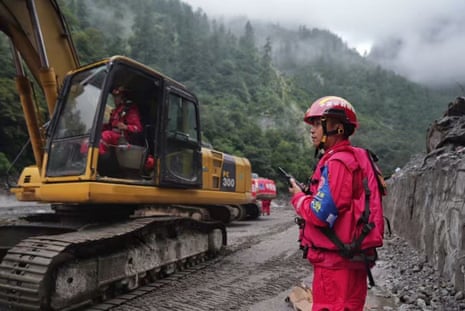
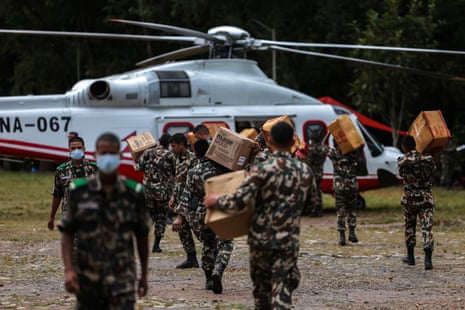
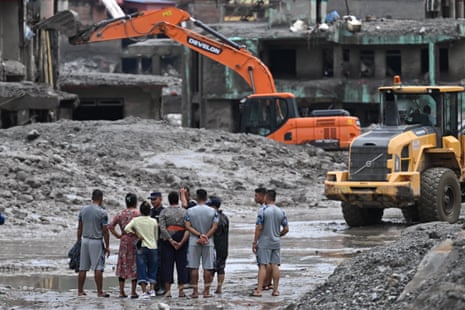
The risk of a lake formed after the glacier collapse bursting near the China-Nepal border where the devastating flood occurred earlier this week has decreased, Chinese authorities said today, as its size appears to have shrunk.
Satellite images from Thursday this morning suggest water in the lake – straddling the China-Nepal border at the confluence of two rivers – has been slowly flowing through, decreasing the reservoir gradually, state broadcaster CCTV reported, citing the Water Resources Ministry.
The ministry said satellite imagery of the surface area of the lake at Purepu Tsangpo river showed it was 99,000 sq metres in size this morning – around the size of 14 football fields combined – having shrunk by 21,000 sq metres compared with images from Thursday.
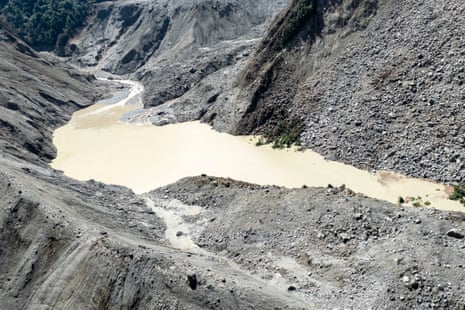
Experts and authorities have warned of the extremely high risk of secondary disasters in the valley, especially from the lake that was formed by glacier debris, potentially endangering rescue operations downstream.
State-owned engineering and rescue enterprise China Anneng, which has been monitoring the lake since Thursday, dispatched a 15-member team on Friday with reconnaissance drones, portable satellite stations and mobile surveillance cameras to gather more data about the lake.
An overflow from the lake on Friday temporarily halted rescue work before further assessment deemed the risks manageable.
Thank you for joining us for our continuing coverage of the aftermath of Wednesday's catastrophic flash floods in the Himalayan mountains near the Nepal-Tibet border.
Poor weather has hampered aerial rescue operations in Nepal as the search for thousands of people missing enters its fourth day.
Nepal's finance minister says his country will need up to $5bn to rebuild after the floods, believed to have been caused by a melting glacier high up in the mountains that set off a deadly cascade of water into the valleys below.
Finance minister Swarnim Wagle told Reuters today those figures are "just an estimate" and that "loss and damage is being assessed".
Here's a summary of what we know so far:
-
. Nepal's disaster agency on Saturday said 2,426 people were missing on its side of the border, while China's Xinhua news agency reports the total number of missing in Tibet is now 554.
-
The death toll in Nepal has now risen to 626, while China's Xinhua news agency earlier today reported seven people confirmed dead in Tibet.
-
More than 3,700 people have been rescued in Nepal so far but at least 93,000 people are estimated to have been affected by the disaster, according to the Red Cross.
-
At least 777 foreigners are missing, with Nepal's disaster agency on Friday reporting 517 foreigners unaccounted for – which could include tourists and foreign workers – and Chinese officials putting the number of foreigners missing at 260.