A projectile hit a passenger terminal at the airport in Riyadh on Sunday, the day after a deadly missile attack on the facility carried out by Yemen's Iran-backed Houthi rebel group killed 13 people.
An unidentified projectile hit terminal 4 at King Khalid international airport, starting a fire and causing injuries, according to Saudi authorities. Air defences also intercepted a cruise missile in the vicinity of the airport. It was the latest of several attacks on the airport in the past week.
The escalating attacks threatened to draw more countries into the Yemen conflict and further widen the regional fallout of the US-Iran war, which has already spread to Lebanon and Iraq.
After Saturday's strike on Riyadh airport, the US president, Donald Trump, said he was weighing whether to join the Saudi military campaign in Yemen, telling reporters: "We're going to look into it."
The Iran-allied Houthis claimed to have launched several attacks on the airport, including the attack on Saturday, which killed 13 people and injured more than 300 the deadliest attack on a Gulf country since the war with Iran started in March and an apparent escalation in the Houthis' war with Saudi Arabia and the Yemeni government that Riyadh sponsors.
In response to the attack, Saudi authorities extended the closure of the airport and said schools would be moved online until Thursday.
The Houthis claimed that Saudi Arabia struck the airport in Yemen's rebel-held capital, Sana'a, on Sunday, without providing more information on damage or casualties.
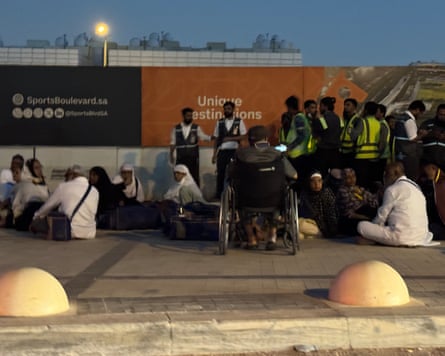
Videos circulated on social media showing travellers walking through debris-strewn ground in the Riyadh airport as sirens blared. Four Saudi citizens, two Bangladeshi nationals, a Palestinian, a US citizen, an Egyptian, a Jordanian, a Syrian and a Sudanese were killed in the missile strike.
On Sunday evening, Saudi authorities also confirmed King Fahd international airport in the eastern city of Dammam had been attacked, with the country's civil aviation authority saying on X: "The assessment of the damage and verification of the safety of airport facilities were still under way, in coordination with the relevant authorities."
On Saturday night, the spokesperson for the Saudi-led coalition in Yemen, Maj Gen Turki al-Maliki, said the coalition would "respond firmly" to the attack, offering few other details.
The Houthis said a Saudi airstrike on Sana'a on Sunday hit a home and killed a child, as well as injuring six others.
The Houthis doubled down on their threats on Sunday, warning airlines, passengers and staff to stay away from Saudi airports. The group said "the worst is yet to come" if Saudi military action in Yemen continued.
"We renew our warning to all airlines, experts, employees, workers and travellers against using Saudi airports and airspace, as they are vulnerable to attack and have become a theatre of operations for our forces," the Houthis said on X.
Trump said he would speak to the Saudi crown prince, Mohammed bin Salman, on Saturday night, after the previous attack on the airport.
The US has already been assisting with intelligence cooperation and targeting, with about 200 US military advisers stationed in Saudi Arabia to help with the campaign. Until now, the US has not directly taken part in fighting against the Houthis.
Direct US involvement could lead the group to resume its targeting of ships passing through the Bab al-Mandab strait, through which about 10% of global maritime goods transit.
It would also further entangle the US in Middle East wars as the American public grows increasingly frustrated with the continuing Iran conflict. Trump faces the prospect of midterm elections in November with an unpopular war and soaring prices at home, threatening his party's performance at the polls.
Saudi Arabia is already carrying out airstrikes against the Houthis in Yemen. The Houthi government's health ministry said coalition airstrikes over the last six weeks had killed 91 Yemenis and wounded 168, 60% of whom it said were women and children.
Saudi-backed government forces in Yemen launched a campaign to push the Houthis back from the areas the group conquered over the last month. Despite claiming initial successes, the government forces have not been able to loosen the Houthis' grip over areas closest to the Bab al-Mandab strait such as Perim Island.
The Indian embassy in Saudi Arabia said one of its citizens died on Sunday after being wounded in the Riyadh airport attack a day earlier.
The Egyptian woman killed in the attack on the airport was a flight attendant identified as Azza Ramzy, 28, who worked for the Saudi airline Flynas, according to Egyptian state-run TV.
The Syrian woman was a widowed mother of four who had been living in Saudi Arabia for five years, a relative told the Associated Press. The Syrian embassy in Riyadh identified her as Buthaina Ahmad Oweida.
Her niece, Nisreen Oweida, said her aunt was 56, from Syria's northern Idlib province, and had left during the country's civil war. She was living in Mecca and had been returning from a visit to her sister in Riyadh when she was killed, the niece said.
The airport attack was met with a wave of international condemnation, including from the UN secretary general, António Guterres, and the president of the European Commission, Ursula von der Leyen.
"Attacks by Iran's proxies are pushing the region into a spiral of violence," von der Leyen wrote on X. "They are destabilising crucial global transport and energy nodes."
The increasing intensity of Houthi attacks against Riyadh and its energy infrastructure has brought more foreign involvement in the Yemen war. Governments are facing pressure over oil prices, already high from the US-Iran war since March.
On Monday, Saudi Arabia, Pakistan and Turkey issued a joint statement saying they would move quickly to implement their mutual defence pact, including by speeding up the deployment of military forces in the kingdom.
The UK said it would assist with defensive military support of Riyadh, providing refuelling for aircraft working to intercept Houthi missiles into Riyadh.
Saudi Arabia has asked for further assistance from France, Egypt, the UK and Pakistan as its stock of interceptor missiles are running low.
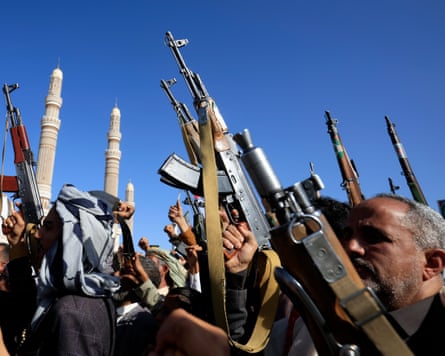
The Houthis launched a military campaign to take Yemen's Red Sea coast in early September after months of escalating tensions with the Yemeni government and its Saudi patron. The campaign interrupted years of relative calm in the country after a 2022 UN-brokered ceasefire froze frontlines between the Houthis and the government.
Despite the Saudi-supported counteroffensive, the group seems to have held on to its recent gains. It is unclear what further Saudi military action would look like against the Houthis, who resisted years of strikes by an international coalition, as well as by the US.
Saudi Arabia led an international coalition that intervened against the Houthis in Yemen in 2015 after the group took over Sana'a and toppled the Yemeni government. Recent Houthi attacks against Saudi energy infrastructure, as well as Houthi military advances, have pulled Saudi Arabia back into the Yemen war.