In his wide-ranging budget speech, Merz talks about Germany "neglecting fundamental issues for far too long" on defence, infrastructure, demographic change, and the economy – and the need to address these issues urgently.
But the starkest part of his speech comes as he talks about the external situation – and particularly the threat from Russia - to explain why some decisions, particularly on defence, are needed.
"Russia knows exactly what it wants and Russia wants more than Ukraine," he warns.
"Anyone who fails to grasp this either does not understand the world as it is, or is pursuing an entirely different agenda – one that stands in opposition to the freedom, openness, and liberal values of our own country."
Merz warns that "Russia is escalating tensions in the Baltic region, in Poland, in the Black Sea, and even in the outer space."
"It is escalating on a massive scale – including here within our own borders, even at the cost of human lives. That is the situation, ladies and gentlemen.
And that is why we, as Europeans, must—and will – set clear boundaries for Russia."
Merz also touches on this week's EU summit, starting tomorrow, and the likely contentious negotiations over the next EU budget.
He pushes back on "impressions" that he thinks Germany spends too much on EU contributions.
But he says he is "pushing for us to limit and focus our spending on what truly strengthens Europe today," specifically on security and competitiveness.
In a pretty passionate defence of European integration, he says only such focused spending will give Europe "an assurance that we will not simply become a plaything in this world, but have a hand in shaping it."
Summing up, he repeats his earlier point that Germany faces major challenges that have been unresolved for too long, and so one budget "is far from solving all of our problems," but says "we have begun to change course" as economic indicators are starting to improve.
And he ends his speech there.
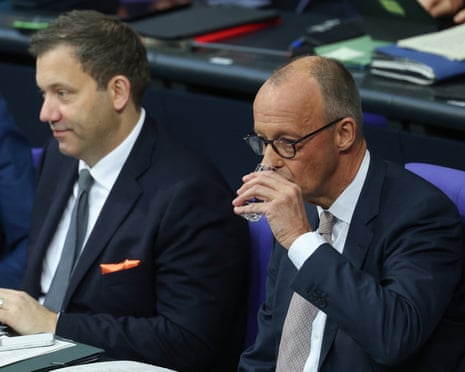
Merz goes back to last week's meeting of the Coalition of the Willing in Berlin, saying the US delegation was "it seemed to me, quite clearly surprised by how united … the Europeans are on this issue."
"It is precisely this determination, ladies and gentlemen, that allows for a cautious optimism regarding the prospect of peace – a genuine peace," he says.
He keeps coming back to his main message: "by supporting Ukraine, we are supporting and protecting ourselves."
"This is true in a sense that may not yet be fully understood by many in our country," he stresses.
In his wide-ranging budget speech, Merz talks about Germany "neglecting fundamental issues for far too long" on defence, infrastructure, demographic change, and the economy – and the need to address these issues urgently.
But the starkest part of his speech comes as he talks about the external situation – and particularly the threat from Russia - to explain why some decisions, particularly on defence, are needed.
"Russia knows exactly what it wants and Russia wants more than Ukraine," he warns.
"Anyone who fails to grasp this either does not understand the world as it is, or is pursuing an entirely different agenda – one that stands in opposition to the freedom, openness, and liberal values of our own country."
Merz warns that "Russia is escalating tensions in the Baltic region, in Poland, in the Black Sea, and even in the outer space."
"It is escalating on a massive scale – including here within our own borders, even at the cost of human lives. That is the situation, ladies and gentlemen.
And that is why we, as Europeans, must—and will – set clear boundaries for Russia."
Germany's chancellor Friedrich Merz is speaking in the Bundestag now – mostly on the 2027 budget, but he's also touching upon broader issues, including on Russia and Ukraine.
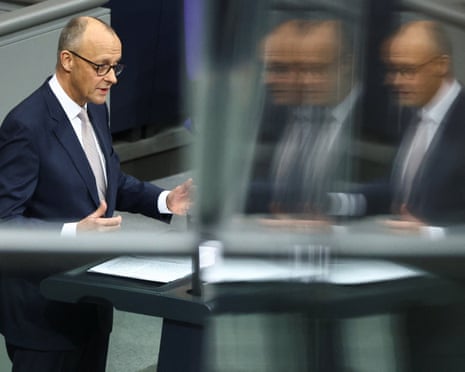
I will bring you key quotes here.
Russian strikes on Ukraine's energy infrastructure overnight caused power outages in five regions, deputy energy minister Artem Nekrasov said this morning.
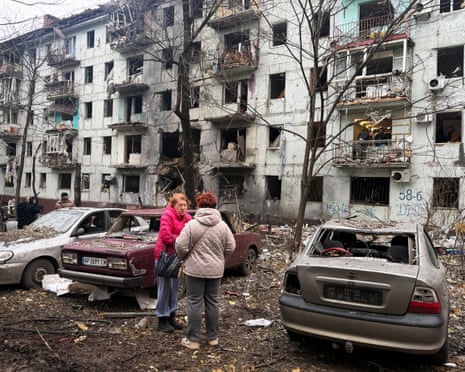
The affected regions are Dnipropetrovsk, Donetsk, Zaporizhzhia, Odesa and Kharkiv. The situation is most difficult in the Zaporizhzhia and Dnipropetrovsk regions, he said, as reported by Reuters.
Separately, at least two people were killed in a strike in Odesa, and injuries were reported in Kyiv after a strike on a multi-storey apartment in the capital.
The latest attacks come just hours before Nato's secretary general Mark Rutte is due to meet with the US president, Donald Trump, in Mar-A-Lago for talks behind the closed doors.
Their meeting comes amid reported delays in air defence missile deliveries to Ukraine, as the country braces for a tough winter under continuing Russian assaults.
I will bring you all the latest here.
It's , it's here, and this is .
Good morning.