Second world war veterans outnumbered former prime ministers for what could be the last time at the national service of remembrance at the Cenotaph in central London.
The number of surviving service personel from that conflict attending the service has dwindled from 20 last year to about a dozen, the oldest of whom was Jeffrey Brereton who served in the RAF. He volunteered for the air force in 1940, at the age of 19, and served as a mechanic on Hurricane aircraft during the Battle of Britain.
The number of former prime ministers has swollen to a record nine, all of whom attended as Andy Burnham took part in the ceremony for the first time. They included John Major, 83, the oldest living former prime minister; Keir Starmer, the most recent ex-premier; and Liz Truss, the shortest-serving.
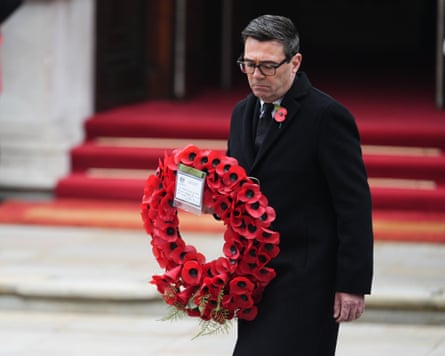
Some of the spouses of former prime ministers joined Burnham's wife, Marie-France van Heel, on a balcony overlooking Whitehall. She was flanked by Victoria Starmer and Hugh O'Leary, Truss's husband; Theresa's May's husband, Philip; Gordon Brown's wife, Sarah, and Rishi Sunak's wife, Akshata Murty.
Reform UK's leader, Nigel Farage, laid a wreath for the first time. Only leaders whose parties hold six seats or more are entitled to take part, and over the last year defections from the Conservatives have taken Reform beyond that threshold to eight MPs.
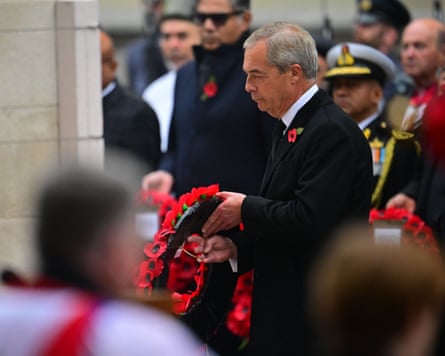
Other politicians who laid wreaths included Kemi Badenoch, Ed Davey, Shabana Mahmood and Lindsay Hoyle.
The Green party leader, Zack Polanski, attended the service, with a white peace poppy pinned to his lapel alongside a traditional red one.
The first wreath was laid by King Charles, who was dressed in a field marshal's uniform. He was joined by his son William wearing the black uniform of a lieutenant colonel of the Household Cavalry.
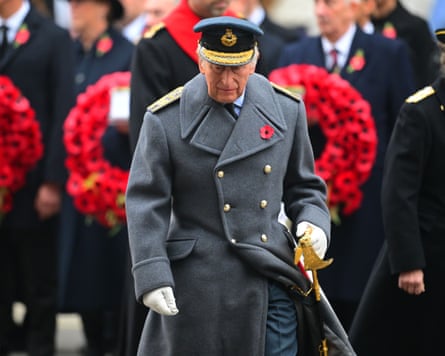
Minutes before the ceremony, one of the soldiers in the parade on Whitehall was taken away on a stretcher after fainting. Charles led the two-minute silence, which was broken only by a crying baby in Whitehall.
A gun was fired to mark the end of the silence before the Last Post was sounded by the buglers of the Royal Marines. After the service about 10,000 veterans took part in a march-past, with more than 300 different armed forces and civilian organisations represented.
Some veterans waved and saluted as they began the march after the wreath-laying ceremony. Some of the older members were in wheelchairs and one group, many of whom were adorned with medals, rode mobility scooters.
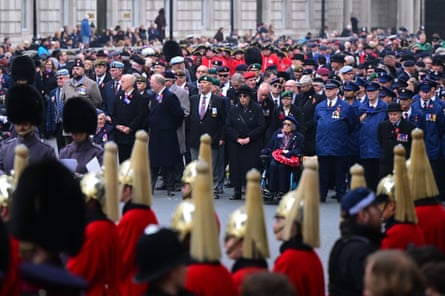
They were applauded by the crowd as they marched swiftly through Whitehall. The youngest taking part was eight-year-old Ronan Doncaster, who walked in honour of his father, a guardsman with the 1st Battalion Coldstream Guards, who died in April 2024.
In Enniskillen in Northern Ireland, the Irish taoiseach, Micheál Martin, and the Northern Ireland secretary, Chris Bryant, attended a memorial service. In 1987, the event was targeted by an IRA bomb that killed 11 people on the day and a 12th victim, who never woke up from a coma, years later.
In Scotland, the first minister, John Swinney, led tributes at a service outside Edinburgh City Chambers. A military parade marched down the Royal Mile from Edinburgh Castle, led by the RAF Central Scotland Pipes and Drums.
A service attended by veterans, faith leaders and representatives of the armed forces was also held in George Square, Glasgow, with a silence at 11am followed by a wreath-laying ceremony.