One way of looking at the extraordinary career of Patrick Stewart, who has died aged 86, is that it went full circle – from the Royal Shakespeare Company in the 1960s and 70s, through global stardom in the twin movie franchises of Star Trek and X-Men, then back to the RSC and the West End stage.
There was plenty more besides, but Stewart's touching performance in 2005 in David Mamet's A Life in the Theatre, at the Apollo in London, expressed the actor's adaptability to a dressing room mood of generational change and evolution in the traditions of live performance.
When he joined the RSC as an associate artist in the 1966-67 seasons, Stewart was already immensely experienced in regional rep. His 1958 stage debut at the Theatre Royal in Lincoln, followed by seasons in Sheffield, Manchester and Liverpool, appearing in Shakespeare, Pinter and Brecht, set him up for a slew of major RSC performances.
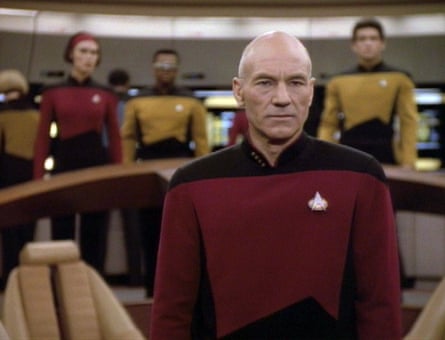
His salient qualities of stillness and physical authority, and a sonorous baritone voice, suited the more relaxed demands of playing the role of Captain Jean-Luc Picard in Star Trek: The Next Generation (1987-94) which rebooted the 1960s TV series Star Trek, in which the crew of the starship USS Enterprise had been captained by William Shatner.
Stewart's Picard – inspired casting – was the show's moral centre and human heart, surrounded by cyborgs and strange creatures. Polls consistently voted him the sexiest man on TV and his cranium – he was bald by the time he was 20 – was hailed as the most famous in the world. American audiences exceeded 30m, and the show scooped 19 Emmys.
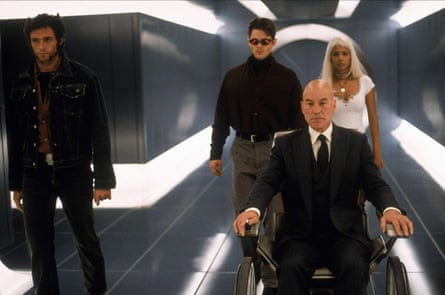
He had graced several notable movies in modest roles, such as King Leodegrance in John Boorman's Excalibur (1981), a troubadour warrior in David Lynch's Dune (1984) and King Richard in Mel Brooks's Robin Hood: Men in Tights (1993). Star Trek went to Hollywood in 1994 and overlapped with Stewart's second big-budget sci-fi franchise, the X-Men series. By 2017, Stewart had appeared in seven outings with the superhero crew, as Charles Xavier, AKA Professor X, their mind-reading mutant founder and mentor.
He managed some theatre between these movies, launching his immensely successful solo performance of Charles Dickens's A Christmas Carol – evoking 40 characters on a bare stage – in New York in 1991 (it came to the Old Vic in 1993 and won him an Olivier award) and playing a well-reviewed 1995 Prospero in The Tempest at the open-air Delacorte theatre in Central Park, New York.
He followed this in 1997 with a curiously earthbound white Othello in Washington. Jude Kelly's "photo-negative" production – an attempt to reverse the racist ambience in the play – featured an otherwise all-black American cast as Iago, Desdemona, Cassio and the Venetian senators.
He was ready to come home, pining for his native Yorkshire and the RSC where he had so assiduously established his career. And 20 years after his global breakthrough, he was not above now caricaturing his eminent new self in two brilliantly funny cameos – as a nudity-obsessed actor-writer in Ricky Gervais's Extras (2005) and as a gay Seattle socialite and opera director in the last season of Frasier (2003).
Stewart was born in the mill town of Mirfield, West Yorkshire, during the second world war, the third son of Alfred Stewart, a postman and labourer who served as a wartime sergeant in the Parachute Regiment, and his wife, Gladys (nee Barrowclough), a weaver and textile worker. It was not a happy home, with Alfred prone to fits of domestic violence.
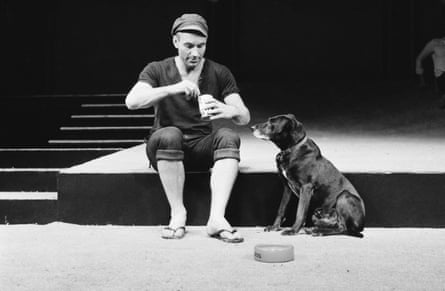
Young Patrick found a more encouraging father figure at Mirfield secondary school, where his English teacher, Cecil Dormand, spotted a potential actor and thrust a copy of Shakespeare into his hand. Patrick left aged 15 to work as a furniture salesman and in local journalism, but spent all his spare time, inspired by Dormand, in amateur dramatics.
On a drama course in nearby Mytholmroyd, he met and became friends with the actor Brian Blessed. They both secured grants to join the Bristol Old Vic school in the late 50s. After several years in rep, Stewart was in Trevor Nunn's sensational 1967 RSC production of The Revenger's Tragedy with Alan Howard, Ian Richardson, Helen Mirren and Ben Kingsley.
Over the next few seasons, in Stratford-upon-Avon and at the Aldwych in London, he was notable in a wide variety of roles: Touchstone in As You Like It, Hector in Troilus and Cressida, the title role of King John, Snout in Peter Brook's legendary A Midsummer Night's Dream, Aufidius to Ian Hogg's 1972 Coriolanus, Cassius to John Wood's Brutus and an award-winning Enobarbus in Antony and Cleopatra (Richard Johnson and Janet Suzman) in the same memorable season.
On television in the 70s he played Sejanus in I, Claudius, and a silent Soviet intelligence officer in Tinker Taylor Soldier Spy (1979) and Smiley's People (1982).
But his best dramatic performances were on the stage, not always in Shakespeare. He was an impassioned Bulgarian communist in Trevor Griffiths's Occupations (1971), a brilliant account of 1920s revolutionary politics; an equally impassioned Astrov, doctor and ecowarrior, to Nicol Williamson's febrile Uncle Vanya in 1974; and a capriciously tyrannical George to Billie Whitelaw's Martha in a 1987 Young Vic revival of Edward Albee's Who's Afraid of Virginia Woolf?, allaying his aggression, at the end, with a moving tenderness.
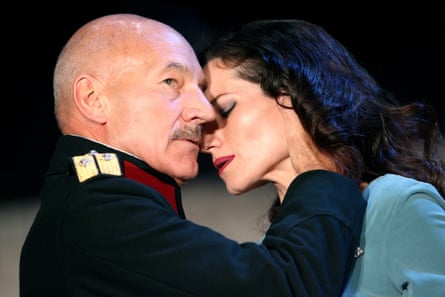
He had been twice married – to Sheila Falconer, a fellow actor, from 1966 (divorced in 1990), and to Wendy Neuss, one of the Star Trek producers, from 2000 (divorced in 2003). He marked his decisive return to British residency by setting up home in Yorkshire with the actor Lisa Dillon, who played Hilda Wangel to his overreaching architect Halvard Solness in The Master Builder, Ibsen's great tragedy of romantic pursuance and catastrophe at the Albery (now the Noël Coward) in 2003. The relationship foundered in 2007. In the same year Stewart returned to Stratford to play the most soldierly of Antonys opposite Harriet Walter's minx-like Cleopatra, as well as a second Prospero and, in 2008, an Olivier award-winning double of Claudius and the Ghost in David Tennant's Hamlet.
Stewart's socialism attracted him to Edward Bond's sour, desiccated portrait of Shakespeare in Bingo, a role he played superbly twice, in 1977 at the RSC and in 2010 in Chichester, transferring to the Young Vic two years later.
By then he had met the singer and songwriter Sunny Ozell (who in 2013 became his third wife) in New York while playing Macbeth at the Brooklyn Academy of Music.
That tremendous Macbeth – directed by Rupert Goold, also responsible for Stewart's Stratford Prospero – opposite Kate Fleetwood's terrifying Lady M, bloodcurdling and tyrannical, had originated at Chichester in 2007, transferring to the West End.
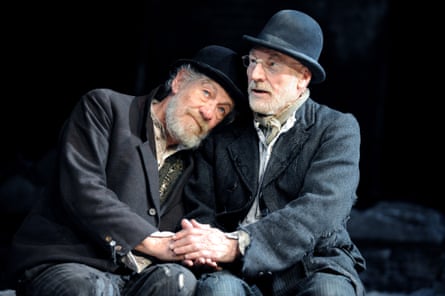
At the same time, Stewart's old RSC friend and now fellow movie star, Ian McKellen, was playing King Lear for Nunn. Two years later, in 2009, they combined as the tramps in Waiting for Godot, a vaudevillian production by Sean Mathias that ended with a soft-shoe shuffle. This affecting onstage reunion played a UK tour, a season at the Haymarket in London and went to Broadway in 2013, paired with Pinter's No Man's Land in which they played the roles originated by John Gielgud and Ralph Richardson. As Michael Billington remarked in London, their radiant, beautiful performances were imbued with the exuberance of memory tainted with the imminence of extinction.
Stewart, a supporter of Huddersfield Town FC, enjoyed politics, grand prix car racing (he appeared on the BBC's Top Gear in 2003), beekeeping and jigsaw puzzles. He was always in demand as a voiceover artist in animated films, computer and video games, and TV adverts.
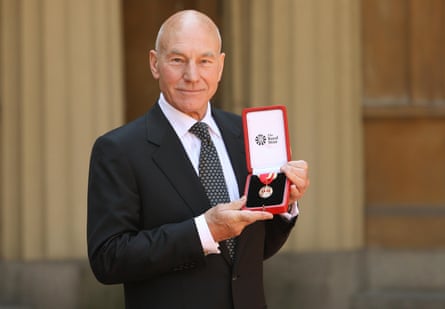
He was made OBE in 2001 and knighted in 2010. He was the Cameron Mackintosh visiting professor of theatre at Oxford University in 2007, an emeritus fellow of St Catherine's College, Oxford, in 2010, and chancellor of the University of Huddersfield (2004-15) where he had the pleasure of presenting his Mirfield schoolteacher Cecil Dormand with an honorary doctorate.