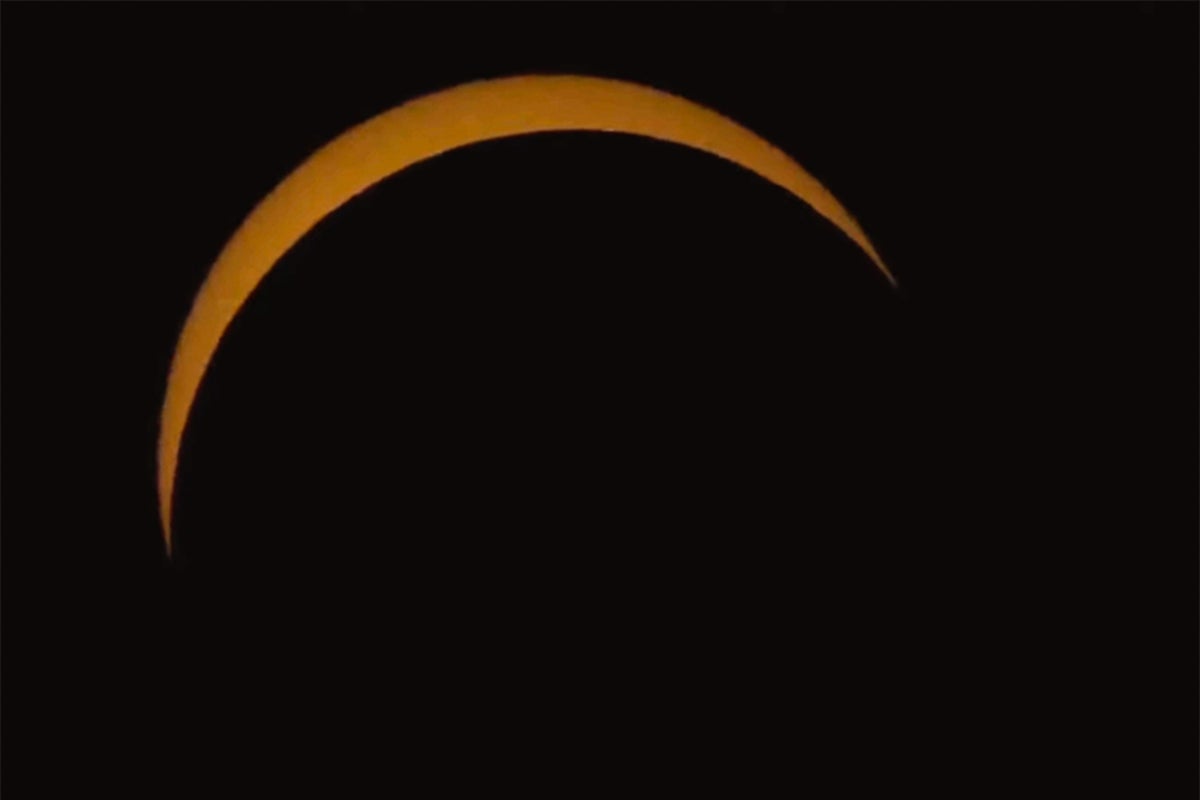
Millions of Britons took a once-in-a-generation opportunity to view the best solar eclipse in decades as the moon obscured more than 90 per cent of the sun.
Crowds of skywatchers descended on viewing spots, including the Royal Observatory in Greenwich, London, and Calton Hill, Edinburgh, to witness the rare phenomenon that will not be seen again until the end of this century.
People uttered gasps of “wow”, “oh my god” and “this is so cool” as they saw the moon blot out much of the sun and the world grew darker.
One couple even scheduled their wedding a year in advance to coincide with the event.
An eclipse happens when the moon passes in front of the sun, obscuring its light and producing a stunning ring of what looks like fire around the lunar surface.
Wednesday evening’s event was the most the sun had been blocked over the UK since the total eclipse in 1999.
People used eclipse glasses, colanders or viewers made from cereal boxes to avoid eye damage from looking directly at the sun.
Shops, national parks and the Royal Greenwich Observatory all sold out of the special glasses.
The Royal Greenwich Observatory sold 15,000 pairs of eclipse glasses a month.
John Lewis said colander sales had risen nearly 40 per cent in a year. Nasa recommended colanders as a way to watch the eclipse by viewing the shadows it casts on the ground.
After the 1999 total solar eclipse, the Royal College of Ophthalmologists reported around 70 cases of people having sight problems after looking at the sun as the moon moved.
Veronica Orozco, who popped a champagne cork as she watched with her neighbours in Greenwich Park, said it was a magical moment. “I am sitting here with my neighbours and we have been telling each other ‘Happy Eclipse Day’,” she said.
Britain’s electricity grid operator cancelled its call to the industry to generate more power during Wednesday evening’s solar eclipse.
The National Energy System Operator (Neso) had feared a massive surge in demand as people across the UK returned indoors, switching on lights and appliances, after being outside to view the eclipse.
The 1999 eclipse caused the largest sudden increase in demand on record.
A Neso spokesman said the notice had been issued “as a precautionary measure to the market due to the solar eclipse”.
Jerry and Jamie Bone had planned their wedding at Alpheton in Suffolk for over a year so they could get married on eclipse day.
The couple provided special glasses and filters for guests to view the event.
People in Cornwall saw the highest proportion of the sun covered.
While the eclipse was only partial in the UK, it was total in other parts of the world, such as Valencia in Spain, which were plunged into darkness.
Dhara Patel, a space expert at the National Space Centre, said it was incredible to witness the event. “What’s really nice is it’s a way for lots of people to come together and connect with nature – looking up at the sky at objects that we typically tend to take for granted,” she said.
“For a lot of people, it can be a little bit of an emotional event. I’ve seen previously people being drawn to tears or just have a really good moment within themselves where they realise they’re seeing or witnessing something… you’ve never seen before in your life.”
The next major eclipse is due in 2081, when 99 per cent of the sun will be obscured by the moon.
In an added bonus for stargazers, the annual Perseid meteor shower reaches its peak on Wednesday night.
The shower is produced as Earth ploughs through a stream of dust left behind by Comet Swift–Tuttle.
Each tiny grain strikes Earth’s atmosphere at about 60km per second, burning up in a brief flash that takes the appearance of a shooting star.