Spain's prime minister Pedro Sánchez said on Friday that he was convinced he would secure a left-wing majority in a snap general election despite adverse public polling, as the political parties prepared to wrap up campaigning ahead of Sunday's vote, Reuters reported.
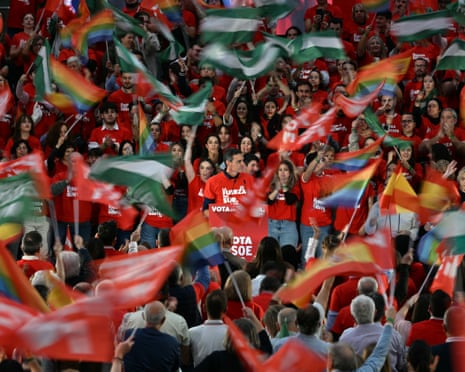
Amid a legal ban on publishing new opinion surveys, the Socialist leader insisted that internal data suggested his party would win the most votes, allowing him to clinch re-election with the support of smaller leftist allies.
"I can't conceive of us losing," Sanchez told radio station SER, adding that left-leaning voters were increasingly mobilising to turn out in droves, a prerequisite for reaching a progressive majority to tackle issues such as the country's deep housing crisis.
"When progressive Spain gets going, it's unstoppable."
However, nearly all the polls released before the ban showed a clear advantage for a potential coalition between the conservative People's Party and far-right Vox, which seek to oust Sanchez after eight years in power.
And, on that note, we will be closing the blog for today – but join us on Sunday night for the Spanish election night!
If you have any tips, comments or suggestions, email me at jakub.krupa@theguardian.com.
I am also on Bluesky at @jakubkrupa.bsky.social and on X at @jakubkrupa.
in Madrid
Spaniards head to the polls on 29 November to vote in the country's sixth general election in 11 years.
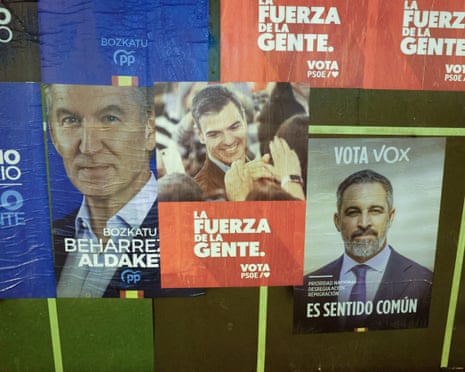
The snap election could end eight years of socialist-led rule and bring a far-right party into government for the first time since Spain's return to democracy after the death of Gen Franco.
Spain's socialist prime minister, called the snap election on 5 October after the conservative People's party (PP), the far-right Vox party and the rightwing, pro-independence Catalan party Junts voted down emergency measures the government had put together to tackle a housing crisis.
The lack of affordable housing has become a key electoral issue, triggering large protests across Spain. The issue was thrown into sharp relief by the case of the late an 87-year-old woman who was evicted from her home in Madrid because she could not afford the 230% rent increase demanded by the investment fund that had bought her apartment. More than 3 million people took part in a recent general strike called in response to soaring housing prices.
Sánchez and his Spanish Socialist Workers' party (PSOE) are hoping their efforts to address the housing crisis – and the fact their plans were torpedoed by the PP, Vox and Junts – will mobilise progressive voters and deliver them another four-year term.
But it is a risky strategy.
All the polls point to the PP finishing first in the election but falling short of an absolute majority. That means it would need to enlist the support of Vox to help it govern. A coalition deal between the PP and Vox would signal the return of the far right to government in Spain for the first time in the country's post-dictatorship democratic history.
Read our full explainer here:
in Madrid
Almost exactly eight years ago, a video clip of a stocky, bearded man riding a horse through western Andalucía went viral in Spain.
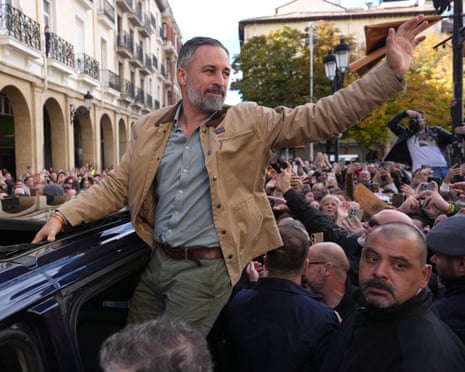
The rider was , the leader of the far-right Vox party, the soundtrack was a bombastic snatch of the Lord of the Rings score, and the caption was an equally unsubtle callback to the 700-year fight to wrest the Iberian peninsula from Islamic rule. "La Reconquista comenzará en tierras andaluzas," it read – the reconquest will begin on Andalucían soil.
Celebrated by some, jeered by others – and inventively lampooned by those with sufficient skill and time on their hands – the video didn't seem quite as amusing three weeks later when Vox broke through into the political mainstream by winning 12 seats in Andalucía's regional parliament.
Until that moment, the prevailing wisdom had been that Spain's experiences of the Franco dictatorship had inoculated the country against the far right, and that Vox was a tiny, fringe outfit whose prospects were terminally limited after it had picked up just 0.2% of the vote in the 2016 general election.
Fast-forward to late 2026 and the horseman seems less comical still. Vox, now the third largest party in Spain, is poised to pick up almost 20% of the vote in the snap general election on 29 November and, very possibly, to form a coalition government with the conservative People's party (PP).
He has become an icon of the European left. A great political survivor, Spain's Pedro Sánchez has been in power for eight years while – across the continent – the right has been on the march.
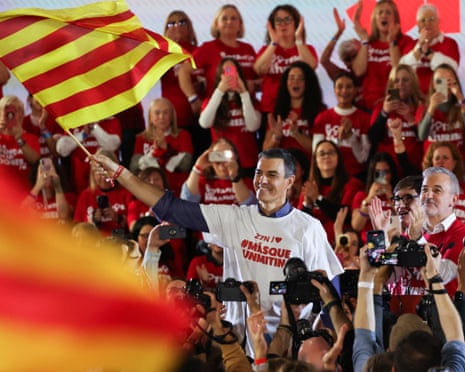
The Socialist party leader has championed immigration, stood up to Donald Trump and been a notable voice for Palestinians in Gaza.
But on Sunday, Sánchez might be replaced by a conservative government in league with the far right.
Where will this leave the left in Spain, asks , and across Europe too?
Back to Spain and our preparation for the big night on Sunday…
In other news, budget carrier Norse Atlantic said on Friday it would file a petition for bankruptcy for its main Norwegian operating unit, becoming the latest airline to succumb to soaring fuel costs wrought by the war in Iran.

"Norse Atlantic has stopped flying. All flights operated by Norse Atlantic Airways AS and Norse Atlantic UK Ltd from 27 November at 14.00 CET are cancelled. This includes return flights. Please do not go to the airport for a cancelled flight," the company said in a statement on its website.
The airline failed to pay its employees' November salaries this week, a pilot union said Thursday, as reported by AFP.
Norse is the second European airline to enter bankruptcy proceedings this year after Latvia's airBaltic, highlighting the toll of the Iran war on carriers that entered the crisis without fuel hedges as jet fuel prices surged, Reuters noted.
The company said it had not been able to secure sufficient funding to meet its short-term liquidity needs, with the board deciding to file a bankruptcy petition on 27 November with the Agder District Court in Norway for its operating subsidiary.
As mass protests over a nationwide housing crisis have forced Sánchez into an early general election, the Guardian travelled to Spain's Andalusian coast to find out what's driving the housing crisis, what solutions are on offer and why rightwing populists are gaining ground.
You can watch our film here:
In Spain, the parties are set to hold their closing rallies this evening, with the Socialists and the Broad Front choosing Madrid for their events.
Meanwhile, the PP and Vox have opted for Seville and Valencia.
Spaniards observe a "day of reflection" on the eve of the vote. Campaigning, rallies and political advertising are banned so voters can weigh their choices before heading to the polls.
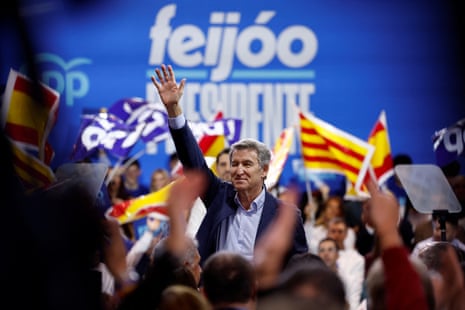
Vox has often been portrayed in international coverage as a party of Franco nostalgists whose ultraconservative Catholicism and civil-war rhetoric towards the separatist Catalan "enemy within" threatened a return to the worst of Spain's recent past.
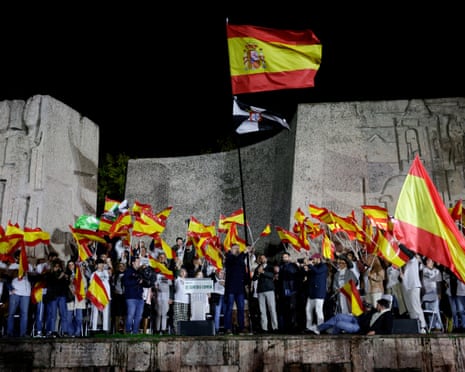
Yet since its disappointing showing at the 2023 general election, Abascal has purged much of the party's original leadership and overseen an ideological renewal.
In looking to update its messaging, Vox has blended elements of Marine Le Pen's welfare chauvinism, such as the concept of "national priority", with ideas coming from the pan-European, white nationalist identitarian movement.
Virtually absent from Spanish political debate a year ago, national priority would give Spaniards preferential access to social housing, public services and welfare benefits, with Vox already securing PP backing for the principle in regional coalition deals.
In September, however, the European Commission warned that even the residence-based criteria used at a regional level could discriminate against citizens of other EU member states. Vox's general election manifesto goes further, pledging to exclude all non-Spanish citizens from the country's minimum-income benefit.
If the polls are right, PP's could become prime minister on a lower vote share than the PP secured in the last election. He would then owe his majority to Vox's surge and support in coalition, and Abascal would have both the leverage and the incentive to show his voters what the party can deliver in office.
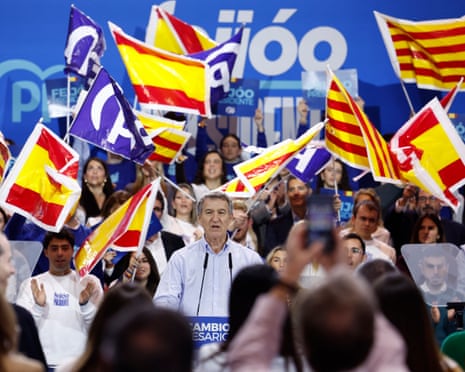
A coalition formed on those terms could also foreshadow a closer alliance between conservatives and the far right at a European level. A Le Pen victory in the French presidential election next spring would put the nationalist right at the head of one of the EU's two most influential states, shifting the political centre of gravity in Brussels and opening the way for a durable governing bloc to the right of the EU's traditional grand coalition.
It was not by chance that Vox opened its election campaign with a rally displaying video messages of support from Le Pen, Meloni and AfD's Alice Weidel. Having drawn on its far-right European allies to reinvent itself, Vox could now in turn strengthen their hand if it is successful in becoming the PP's kingmaker after Sunday's vote.
Sánchez's defeat would also deprive the centre left of its strongest counterweight in the European Council, where he is the only social democrat to represent one of the EU's major powers.
Speaking to the Vox rally, Weidel proclaimed: "All of Europe is waiting for a political change in Madrid." All of Europe may not be waiting for such a change, but it is certainly watching.
Sitting on a park bench, taking in the sunny day, Naima reflected on all that had seemingly changed since she moved to Spain three decades earlier.
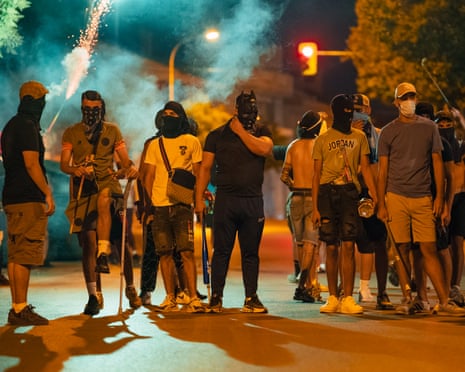
Back then, the Moroccan national had felt warmly welcomed by Spaniards. "I had never, at any point in my life, felt like there was racism," she said.
"But now things are changing. And the blame lies with rightwing politics."
Over the years, she has steadily watched as a growing crop of politicians sought to win votes by demonising migrants, minorities and Muslims. The impact reverberated deeply in places such as whose fertile fields and constant demand for farmhands has long attracted workers from around the world.
"They peddle racism, and lots of people end up suffering," said Naima, 53. "Here everyone knows me, but others speak of being treated differently, looked at in a certain way, or having gestures made at them."
On Sunday, Spain is set to gain a glimpse of how deeply engrained these divisions have become as voters cast their ballots in a snap general election.
Most polls suggest the government of the Socialist leader, will be replaced by a rightwing coalition led by the conservative People's party (PP) and supported by the far-right, anti-immigration Vox party.
If so, it will be the first time that a far-right party has governed Spain since the return to democracy after the death of General Franco.
No new polls are allowed to be published in Spain in the five days before a Spanish election, but one company has found a surprising solución alternativa.
ran from 1984 to 2020, covering the city's cultural and artistic life until Covid and upheavals in the media world made it "untenable", its editor, , wrote in the final edition.
But now it has found unexpected new life as an, erm, back passage for Spanish polls in the blackout period.
The Review site is now owned by a company called which also runs the Spanish newspaper El Periódico.
An article on the Periódico website that links to the poll criticises "outdated legislation" that lets political parties see polls, but not citizens.
"The Adelaide Review's daily poll addresses this issue, giving citizens access to the same information used by politicians," it said.
It's probably a good moment to say that we will be running a special Europe live blog from Madrid on Sunday night to bring you all the latest in the Spanish parliamentary election, including first polls, projections, reactions, and analysis.
Make sure to tune in on Sunday late afternoon and evening.

Spain's prime minister Pedro Sánchez said on Friday that he was convinced he would secure a left-wing majority in a snap general election despite adverse public polling, as the political parties prepared to wrap up campaigning ahead of Sunday's vote, Reuters reported.
Amid a legal ban on publishing new opinion surveys, the Socialist leader insisted that internal data suggested his party would win the most votes, allowing him to clinch re-election with the support of smaller leftist allies.
"I can't conceive of us losing," Sanchez told radio station SER, adding that left-leaning voters were increasingly mobilising to turn out in droves, a prerequisite for reaching a progressive majority to tackle issues such as the country's deep housing crisis.
"When progressive Spain gets going, it's unstoppable."
However, nearly all the polls released before the ban showed a clear advantage for a potential coalition between the conservative People's Party and far-right Vox, which seek to oust Sanchez after eight years in power.
in Madrid
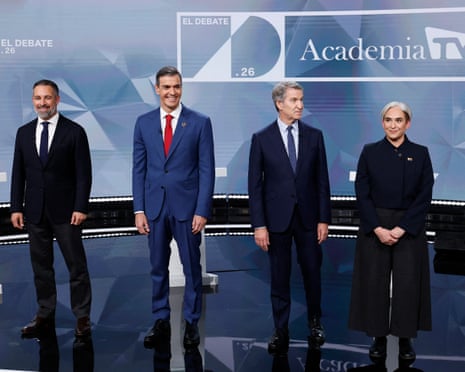
Last night's debate between the leaders of Spain's four biggest political parties was a rambling, ratty and revealing spectacle in which Ada Colau, the leader of the leftwing Broad Front, is generally agreed to have come out on top.
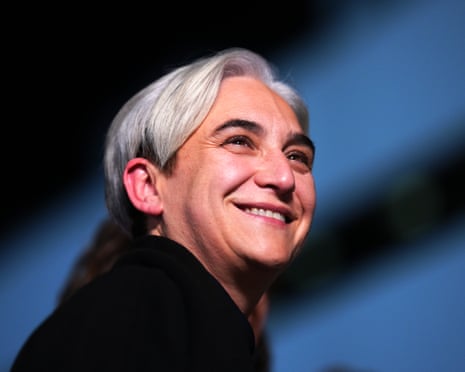
Colau, a former Barcelona mayor, was committed and forensic in her attacks on Vox's leader, over his refusal to condemn gender-based violence.
She and the socialist leader and current prime minister, also joined forces to question the economic wisdom of the far-right party's plans for €112bn of public spending costs, and to defend the benefits of immigration.
– who was far more animated and engaged in this debate than in last week's head-to-head with the leader of Spain's conservative People's party (PP) – was happy to wind up his rival over his lack of English skills.
Before Feijóo could answer a question from Colau about the PP's proposed tax cuts, Sánchez – a fluent English speaker – quipped:
"I'm sorry to say that Mr Feijóo's maths are about as good as his English."
– a problem, he added, "that ruins and kills".
Feijóo also sought to attack Sánchez's government over corruption, the two deadly rail crashes suffered this year, and over the summer's mass border crossing into the North African territory of Ceuta.
He argued that his 30-year political career was unblemished by corruption allegations while suggesting that Sánchez was a "corruption magnet". That led the prime minister to bring up the infamous mid-1990s holiday photos that show Feijóo hanging out on a boat with his friend , who was later convicted of drug trafficking.
But the biggest moment of the night came when Colau asked Feijóo how he could claim to be a good leader when his party had doggedly stood by Carlos Mazón, the PP president of the Valencia region who was eventually forced to resign over his disastrous handling of the floods two years ago that killed more than 230 people.
"Look, good management is taking charge in a national emergency and not running away from Paiporta," Feijóo said in reference to Sánchez's hasty exit from one of the areas that was worst hit by the floods after angry locals pelted him with mud during a visit shortly after the disaster.
But it was what came next that caused a stir. Turning to Colau – who, by the time of the floods in the autumn of 2024, had left the Barcelona mayoralty and no longer held public office – Feijóo said, "Y usted calladita" which translates as, "And there wasn't a peep out of you".
He accompanied those words putting his finger to his lips – a gesture some took to be a sexist shushing of the Broad Front leader.
Although Feijóo seemed to be trying to claim that Colau had remained silent over the floods when they happened, some took his words as an attempt to tell her to be quiet.
Sánchez was quick to pounce. "Why are you saying, 'Not a peep out of you', Mr Feijóo?" the prime minister asked the PP leader. "What kind of sexism is that, Mr Feijóo," Sánchez added.
Feijóo accused Sánchez of trying to twist his words, but the damage was done. Speaking after the debate, the PP leader issued a semi-apology.
"If I've offended anyone, I of course take it back," he said, adding that he hadn't been telling Colau to be quiet. But he couldn't resist arguing that Sánchez leftwing allies had kept quiet "during all the years of corruption".

Colau herself said the PP leader's words undermined his supposed feminist credentials. Speaking after the debate, she said:
"I think it was very clear what [Feijóo] was trying to do when he said 'calladita'. That clearly sexist behaviour was witnessed on TV by all of Spain … As women we will not stop and we will not shut up. No one will make us shut up and we will go and vote."

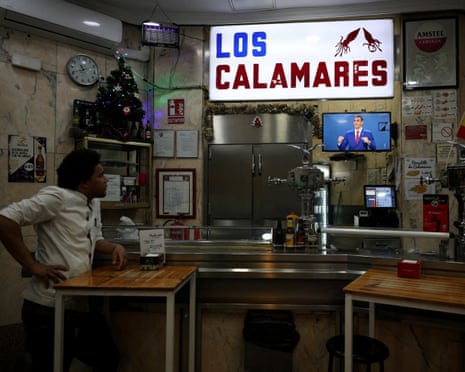
And since Spain's skipped the summit altogether as he's dramatically fighting for his future ahead of this Sunday's parliamentary election…
… let's cross to Madrid for an update on last night's TV debate…
In yesterday's blog, I promised to give you an update this morning on the EU summit, which continued into the small hours.
Well, , as the talks on the bloc's next budget collapsed with no agreement, with a group of countries reportedly refusing to take part in further pointless meetings.
The format set the "Sensible Seven" of frugal countries against "Friends of Cohesion" calling for sustained EU spending. With a bit of theatre, everyone disagreed with everyone, and the talks broke down shortly after midnight.
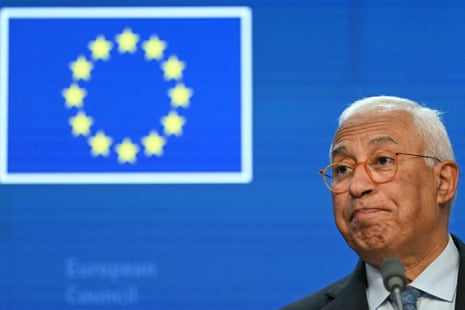
Hungary's PM said the discussions would resume at the next summit in December, but warned "there seems to be little chance of reaching a compromise on the EU's seven-year budget."
But Germany's tried to stay upbeat:
"Views on the EU budget still differ widely. What is needed now is realism and goodwill. I am confident that we can reach an agreement this year – for a strong economy and a secure Europe."
There is a bit of urgency there, as France's wants the discussion on the bloc's new €1.78tn budget for 2028-2034 to be agreed before the end of the year, and well clear of the French parliamentary elections next spring.
We will keep an eye on this for you.
Overnight, Nato fighter jets and an interceptor drone were scrambled overnight in Latvia after a drone briefly entered the country's airspace near its border with Russia, the army said.
Since the start of Russia's invasion of Ukraine in February 2022, several countries bordering the conflict have reported incursions or drone and missile crashes on their territory.
This year, two drones were shot down over Latvia by Nato fighter jets, which protect the skies of Baltic states, Reuters reported.
An army statement said that during the night from Thursday to Friday a drone "briefly flew over Latvian territory" near the border with Russia.
"Fighter jets from Nato's air-policing mission in the Baltic States were scrambled, and an interceptor drone from the national armed forces was deployed," it said, without specifying the origin of the drone.
Ukraine's president Volodymyr Zelenskyy has said that US president Donald Trump comment's hailing Russia's Vladimir Putin as a friend is "the same that somebody'd say about Hitler during the second world war that he's a good friend."
Talking to BBC in Kyiv, Zelenskyy said Trump's comments were "strange," adding:
"He's an aggressor … and a killer. He cannot be a friend. Just cannot be."
In a long interview with the British broadcaster, the Ukrainian president spoke of his frustration with the peace talks, saying Kyiv needed to see "more progress."
In a pointed criticism of the US position, he said:
"We need American position to be American. We don't need signals – I mean from the US – which we can get from Russia."
Urging the US to use its "power and respect" to push Moscow more, he said:
"When you try to be very neutral with the aggressor... it means you support victims and you support also aggressor. It's not right."
His latest comments come as Russian attacks on Ukraine continue, amid growing concern over the upcoming winter as the strikes repeatedly hit Ukrainian energy infrastructure.
I will bring you more on this throughout the day.
I will also update you on last night's EU summit, the final TV debate in Spain ahead of Sunday's elections, and many more.
It's , it's here, and this is .
Good morning.