s a boy in rural São Paulo, Adalberto Luis Val used to stare into the lake where his father took him fishing and wonder how all those creatures swimming below stayed alive. One day, he netted a few, put them in a jar, and brought them home to observe. The next morning, they were all dead. Val was devastated but intrigued.
"I needed to know how fish are able to live," he says.
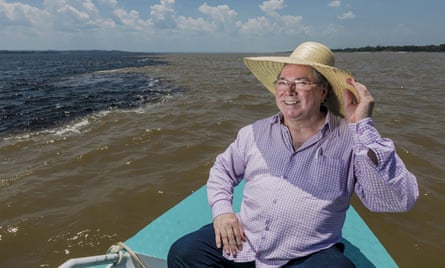
Fast forward to present-day Manaus, a city in Brazil's Amazon rainforest and Val's adoptive home since the early 1980s, which he has helped convert over the past five decades into a frontier for tropical climate science.
An award-winning ecophysiologist, Val, now 70, learned about gills, gases and the biochemical mysteries of how fish survive by pulling oxygen from water – and perish when the climate goes rogue. That is how the tambaqui caught his eye.
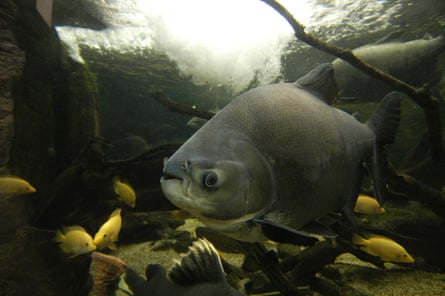
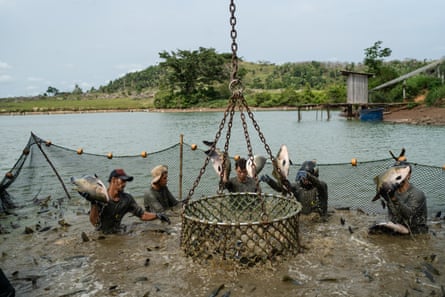
Caged canaries were the classic early-warning system for poisonous gases in the coalmine. In the climate-castigated Amazon rainforest, that's a job for the tambaqui. Coveted by epicureans, this huge freshwater "surface breather" (Colossoma macropomum) rises when increased temperatures drive water-oxygen levels to critical lows and carbon dioxide spikes.
That's an evolutionary trick the tambaqui has mastered over millions of years, thanks to a protruding lower lip designed to hoover up oxygenated surface water. Val's research suggests that tracking the tambaqui may also be one of the best ways to gauge the resilience of the Amazon forest itself.
"For 65m years we've had a reliably stable and predictable climate in the Amazon basin, with water oxygen levels rising in the cooler nights and falling in the warmer days," Val says. "From the Industrial Revolution on, everything started to look different."
A leading investigator at the National Institute for Amazonian Studies (INPA), Val found that tropical fish, far more than their temperate-zone counterparts, are highly sensitive to fluctuations in heat, humidity and chemicals in the water and air.
Add the heavy human footprint on the rainforest, from slash-and-burn farming and wildcat mining to chemical runoff into waterways, and many signature species of river fauna are already living on the brink. After years of documenting the gathering climate upheaval in Amazonia, Val's work is finally drawing global attention.
On 30 July, he travelled to the University of Southampton in the UK to claim the Fisheries Society of the British Isles' prestigious Le Cren Medal for his lifelong contribution to international aquatic science.
This was not just another trophy for the mantelpiece: the stocky scientist – known for his big straw hats and broad smile as well as his 22 books and about 280 scientific articles – had already bagged Brazil's Grand Cross of the National Order of Scientific Merit and the American Fisheries Society Award of Excellence.
This year's Le Cren medal was the first awarded to a scholar in the tropics, a global nod to the vast, understudied world where planetary biodiversity is richest and the battle to contain climate disruption is fiercest.
"A lot of great work has been done on climate change in North America and northern Europe. But no one else was doing this right at the equator, where population is growing," says Chris Wood, a University of British Columbia biologist and longtime collaborator with Val on Amazonian research. "Combine climate change, pollution and deforestation with intense migration to the tropics, and you have the perfect storm."
Climate disruption and consequential extreme weather are often felt, but not always adequately grasped, let alone measured. Val set out to change that. Baseline scientific research told him that rainforest fish flourish within a relatively narrow temperature band, between 27C and 31C (80.6-87.8F). Anything above that could be deadly.
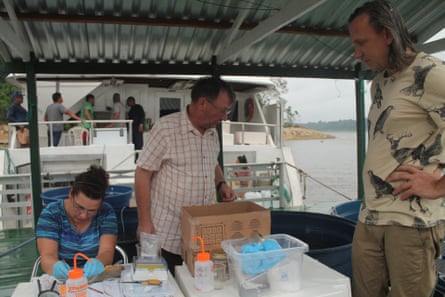
So Val and his team at INPA divided their laboratory into four chambers to monitor the vital signs of tambaqui and other aquatic species as heat and drought intensify.
Three chambers were engineered to simulate escalating climate impacts – mild, medium and extreme – as modelled by the Intergovernmental Panel on Climate Change (IPCC), the global panel of Earth scientists, for the year 2100.
A fourth served as a control chamber, replicating present-day temperatures, carbon dioxide levels, luminosity and humidity in the river basin based on real-time data transmitted from sensors mounted on a tower in the forest.
They found that excessive warming raises water temperatures, depleting water-oxygen levels and damaging the vascular systems, metabolism and physiology of river fish. More than a single rainforest species was at stake.
"Tambaqui transport seeds along the course of rivers," Val says. "So, depleting the tambaqui handicaps the recovery of the forest itself."
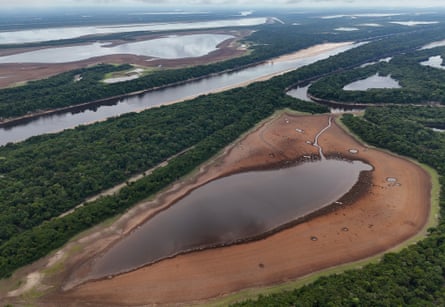
Beyond the lab, his team observed how soaring temperatures prolonged the dry season to devastating effect: back-to-back record droughts in 2023 and 2024 provoked big die-offs of fish and river dolphins across the Amazon basin. Brazil's biodiversity authority, ICMBio, recently added the tambaqui to the list of species at risk of extinction.
Val's work also warns that tropical waterways are acutely susceptible to broader human-driven habitat disturbances. Forest clearing and burning pump toxic soot and ash into the air and watershed. Chemical runoff from mining and plantation agriculture ends up in rivers and aquifers, fouling drinking water, contaminating fish and making humans sick with dangerous trace elements of copper, mercury, microplastics and pesticides.
A hotter, wetter Amazon could also trigger toxic blooms or bring more mosquitoes, and with them vector-borne ailments such as malaria, dengue and chikungunya.
The combined fallout threatens the 40 million people spread across the eight-nation Amazon Basin, where freshwater catches can represent up to 90% of diets. Although fish represent 6.7% of global protein consumption worldwide, 3.1 billion people rely on fish for at least a fifth of their daily protein, especially in the global south, where coastal and riverine populations rely on their catch for up to 70% of their diet.
Val's work is a reminder that what happens in the Amazon matters, and that there is no understanding, never mind containing, the calamitous climate crisis without cutting-edge science in the tropical biomes and the waterways that sustain them.
Troublingly, he also notes that spending on research and technology in the marquee Amazon basin nation is a fraction (3% to 4%) of Brazil's total investment in science. The result is a global blind spot that we ignore at our collective peril.
"Each species in the Amazon holds a wealth of information about the habitat that is extremely relevant to the task of managing aquatic organisms, and conserving the forest as a whole," he says.
"When we destroy something, often we are destroying the unknown – losing perhaps vital knowledge that we still don't have and maybe never will."