o enter Reykjavik's Grafarvogur Lutheran church, worshippers and visitors are invited to make their way down 16 steps painted in the rainbow stripes and the white, pink, blue, brown and black chevrons of the Progress Pride flag. The artwork, which can even be seen on satellite pictures, was originally a project of former head pastor Guðrún Karls Helgudóttir, now the bishop of Iceland, and her colleagues. The point was to show support for the LGBTQ+ community's "need to be visible and accepted", the church's current head pastorArna Sigurðardóttir, told me.
And then some time in between the barely faded midnight sun of 7 July and the early morning light of 8 July, someone painted over all those colours with just three: blue on the outside, and two thin strips of white encasing a thicker strip of red in the centre.
The church's pride flag had been defaced twice before, both times in 2022, once with black scribbling alluding to a verse from the Old Testament.
This time, though, when Sigurðardóttir heard the news that it had been completely painted over with the Icelandic flag, something about it felt different. "More systematic, in a way – much more methodical," she said. "We are experiencing everywhere this pushback against human rights, and they're starting to envelop it in national flags."
A national flag becoming a symbol of contention and exclusion, rather than pride, is a phenomenon I know all too well. As a child, I used to sing the US national anthem to myself, in my head, to time brushing my teeth. By the time I was a teenager, in the rage and haze of the Iraq war and its dissidents, I sat for the compulsory morning pledge of allegiance, and saw the stars and stripes as a symbol of shame. This fraught relationship is why I felt such empathy, tinged with disappointment, when a young Icelander roughly my age told me, after the incident at Grafarvogur church, that for the first time in her life she was starting to feel uneasy with the Icelandic flag.
I had thought, naively perhaps, that a country with such a small population might be spared from the polarisation that is tearing the US apart and increasingly affects my adopted country, France. Instead I found myself face to face with someone who was starting to feel the same sense of rupture with her country's symbols as I had felt with mine.
I didn't want that for her, especially not for someone from a country with very little objectionable in its history. After all, Iceland, which has no army and which prosecuted its bankers for their role in the 2008 financial crisis, never colonised anyone. Even saunas and hot tubs are guilt free; the island is powered and heated almost entirely by carbon-free geothermal energy and even leads the world in capturing CO2, injecting it deep underground and turning it into rock.
Why should Sigurðardóttir, or any other Icelander, suddenly feel shame about her country's flag?
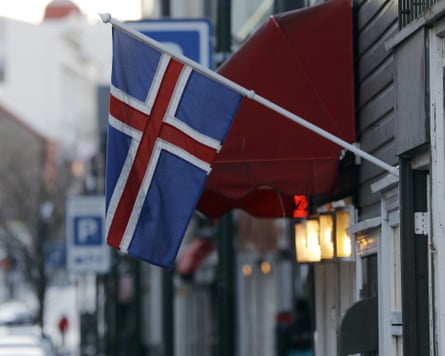
Ása Berglind Hjálmarsdóttir, a representative of the Althing, Iceland's parliament, tells me that until about a year ago she doesn't remember the Icelandic flag ever being used in contentious ways. It remained a unifying symbol for a small country – barely 400,000 people – that only gained its independence from Denmark on 17 June 1944.
A banner of ice and fire: blue for the frigid northern Atlantic waters that surround the island, white for its glaciers, red for the lava that erupts every so often from its roughly 33 active volcano systems. Historically it is never flown between sundown and sunrise, or past midnight during the perpetual daylight of summer months. By tradition it was lowered to half-mast by each local community or town to announce the passing of each individual Icelander.
In spring 2025, Hjálmarsdóttir, a member of the Social Democratic Alliance, encountered an anti-immigration protest outside the Althing, where what she describes as "a small group of extremists" had wrapped themselves in the flag. "I had this bad feeling in my stomach," Hjálmarsdóttir says, "because this had never happened before." Modern far-right politics, it seems, had finally come for Iceland too.
"Our history of having the first openly gay prime minister, renewable energy, women's rights … for me that's what the Icelandic flag symbolises," said Ragna Sigurðardóttir, a 33-year-old member of the Althing (no relation to Arna, the pastor). "We have to have the courage to fly it."
"It's very important that we don't allow the feeling of unease with the flag to grow," Hjálmarsdóttir told me. A year ago, she called for a change in the law to ease Iceland's restrictions on flying the flag, in the hope that more people would display it, and thereby prevent a far-right movement from appropriating it for themselves. The subsequent bill, which was adopted by the parliament and came into effect in May, means that during summer months the flag can legally be flown all day and night. Her colleague Ragna Sigurðardóttir said she had seen an increase in businesses and households doing just that.
It's a response that I find fascinating: faced with an attempt by the far right to monopolise a symbol of national unity, Hjálmarsdóttir decided that the only answer possible was to say that the flag belongs to no one and to everyone.
On 29 August, Icelanders will vote on the first step in a process that could one day see another flag fly alongside theirs: also blue, but with a circle of yellow stars instead of an asymmetric cross of ice and fire. At the moment polling suggests that a thin majority of 53% supports reopening accession talks with the EU (previous negotiations were suspended over fishing rights in 2013), even if there is not yet majority support for becoming a full EU member state.
From the EU's perspective, the benefits to welcoming Iceland as a member are clear: a wealthy, high-functioning Nordic democracy strategically located in the north Atlantic, with vast renewable energy resources and credibility when it comes to both climate and the oceans. French MEP Valérie Hayer recently argued in the Guardian that it would be in the EU's interests to to be flexible and offer a carve-out for Icelandic fishing – a critical component of what would be the EU's second-smallest single economy after Malta.
If I were an Icelander voting, my decision would be dominated by thoughts of what it means to be a small, rule-of-law democracy in the middle of Donald Trump's obsessive threats to annex nearby Greenland and Vladimir Putin's imperialist aggression – one with a collection of like-minded rule-of-law democracies to its south-east.
The head of Iceland's main opposition party, Guðrún Hafsteinsdóttir, told Reuters recently that the country's future security rested on Nato and the US, and that Trump's threats to seize Greenland had not changed her position against EU membership. To an American who has spent the past 10 years observing the deterioration of the US from afar, that sounds irresponsibly optimistic. It's not just about Greenland. The US government has been willing to gratuitously traduce its relationship with Canada, wield tariffs as coercive economic warfare against smaller countries, and pursue financial and political interference in the domestic elections of countries it is nominally allied with.
Is it this context of a split over EU membership that has sparked the rise in flag-related nationalism? The Icelanders I spoke to agree that there is some convergence of beliefs among people who grasp at the flag in a nationalist way (anti-EU, anti-immigration, anti-LGBTQ+). But they are sceptical that the impending referendum is the inciting factor. That seems like a positive thing when it comes to crafting unity over EU talks, and, some day, full membership – but potentially more difficult when it comes to disentangling the flag from reactionary politics.
Arna Sigurðardóttir says that conversations about the EU aren't the most pressing in her congregation, even among those who are uncomfortable with steps painted in pride colours. Lately they've been discussing what's more harmful about the flag: to make people uncomfortable with the pride colours or to harm those who need its symbolic support by removing it? In the end, the church chose to repaint the rainbow colours on its steps.
The pastor told me that a few people whom she suspects had vandalised the steps had actually come out to protest when the church first removed the paint. The church was having a service outside that Sunday in a small park, and she had invited them to attend – and to bring along the Icelandic flags they were carrying. None had accepted the offer, she said. She plans to try again and organise a conversation in the autumn but makes a point of saying that her goal isn't to change their minds. Rather, she told me: "It's about trying to reach the people who are on the fence".