Espresso Embassy, a third-wave coffee shop in Budapest's diplomatic and governmental quarter, is where visiting reporters and academics come to talk politics. On the way in for my morning coffee on 18 March, I passed a poster for Viktor Orbán's Fidesz party that had been vandalised with a marker pen: "the safe choice" had become "the certain way to get fucked". From across the cafe, I spotted the American journalist and historian Anne Applebaum locked in conversation, possibly with a source. I heard someone exclaim: "Just like Mussolini!" It was election season in Hungary.
It was also a couple of days before Cpac Hungary, a satellite event of the US-based conservative conference. As members of the international right arrived in town, the notorious Orbánist thinktank known as the Danube Institute was hosting an event called On Censorship, Tolerance, the Left and God. The official line would be: bad, good, bad, good.
After dark, I walked along the walls of Buda castle and past the Jesuit stairs to the institute. The featured speakers were Dave Rubin, an American podcaster from the so-called "intellectual dark web", and Eva Vlaardingerbroek, a Dutch provocateur who claimed the title "shieldmaiden of the far right" on her X profile. "You don't realise how good you have it" in Hungary, Rubin said. "So many things are wrong across the west." After the panel, an American man introduced himself to me and asked how long I'd been in Budapest. Had I ever considered dual citizenship? If so, he could help. "My friends," he said, "call me the Harriet Tubman of white people."
For the previous few months, I'd been hanging around the Danube Institute and other state-subsidised gathering places, trying to pass as yet another member of the rightwing intelligentsia making his pilgrimage to Budapest. Founded in 2013 with state funds redirected by the Orbán government, the institute had become known as the central hub in the emerging "postliberal" movement, a loose coalition of heterodox conservative thinkers frequently associated with the idiosyncratic American blogger and self-styled Christian dissident Rod Dreher. During Dreher's first fellowship term at the Danube Institute in 2021, he helped arrange Tucker Carlson's weeklong press junket in Hungary, which featured a fawning Fox News interview with Orbán. Since then, liberal publications such as the New York Times, the New Yorker and the Atlantic have dispatched journalists to grill Dreher about the institute and his relationship to Orbán's autocratic regime. This produced a series of breathless reports that showcased the small thinktank as a clearinghouse for dangerous illiberal ideas. As Applebaum wrote in her book Twilight of Democracy: "The Danube Institute exists, in practice, to make the Hungarian government presentable to the outside world."
In Applebaum's view, the Orbán regime had "created a political system in which no opposition party could possibly win", and the foreign intellectuals at the Danube Institute were either cynical propagandists or naive stooges for Orbán's anti-democratic project. But soon, Orbán would be out of power, ousted in a landslide election in April, and in June the new Hungarian parliament would pass a constitutional amendment dismantling the patronage system that funds the Danube Institute, as well as MCC Brussels, a training ground for Fidesz elites.
It was end times for the postliberals in Budapest, even if they didn't know it yet. What will survive the demise of the so-called Budapest scene is a fractured group of rightwing thinkers who, whatever their fate in Hungary, will continue to hold a frightening level of influence over US political culture. If they were ever Orbán's puppets, they aren't any more. But reducing them to the unthinking servants of one particular strongman has made it more difficult to confront the real threat of postliberal ideas – or the crisis to which they are responding.
Officially, I was in Budapest to write a book about the western intellectuals who travelled to Hungary to meet the dissident opposition during the final years of the communist era. My family and I were guests of the Institute for Advanced Study, which had once been called the Collegium Budapest before it was effectively closed by the Orbán government in 2011. Now reopened, it was part of the rump of Central European University that still remained in Hungary. The rest of the institution was forced to move to Vienna during a prolonged campaign against George Soros and Hungary's independent civil society.
At the start of this year, I made it my half-ironic mission to infiltrate the Danube Institute. I really did want to see what was actually going on inside this thinktank that had become known as the headquarters of the international postliberal project. Reaching it was not hard. It is housed in the Lónyay-Hatvany Villa, a refurbished building that had briefly served as an SS casino during the second world war and now housed a high-end restaurant on its main floor. One evening, I climbed a steep staircase dimly lit by iron sconces, the yellow light reflecting off wet stone, until I reached a narrow passage closed in by two high walls. Up ahead, I noticed a doorway marked only by a floor lamp on a small red carpet. I hesitated, then entered.
Straight in front of me was a dining room with a commanding view of the Danube. I snapped a few photos with my phone until I heard someone behind me on the stairs. I hurried into the basement annexe and reached a check-in table. I gave a young assistant my name, and she pointed towards a coat check. It turned out that infiltrating the Danube Institute just required online registration.
In the brightly lit basement, a shelf offered complimentary issues of glossy rightwing journals such as The European Conservative and Hungarian Review. I picked up a copy of the then state-subsidised Hungarian Conservative with a painting by Tivadar Csontváry Kosztka on the cover; its title was Mysterious Island.
The other guests were beginning to arrive, and I was immediately worried I'd been misled by a New Yorker piece on Dreher, in which he told a journalist that "the Danube Institute had a casual dress code" and he "could usually leave the suits at the apartment" even when meeting with ministers from Orbán's Fidesz party. But here was a parade of male intellectual fashion: ribbed turtlenecks; crocheted ties and silk cravats; blazers of tweed, linen and corduroy. I looked down at my rumpled blazer – the only one I own – and felt underdressed.
In the months to come, I would jot down scraps of overheard conversation. Much of it was unsurprising, especially for anyone who had spent time on X: "We're going to interrogate him with truth serum", "No one is linking except Tucker", "Hitler would have gone broke on her OnlyFans", "Do you have a contact for Vance?"
All the knowing gossip and memes were part of a game of one-upmanship among intellectuals who styled themselves as insiders. Still, there was something jarring about seeing this very online culture in the flesh. Most of the names they dropped were exactly the ones you'd expect. What did catch me off guard was how often I also heard them mention the names of the liberal journalists who had alerted me to the existence of the Danube Institute in the first place. If Hungary looms large for people like Applebaum, she, in turn, haunts the postliberal imagination; these guys all clearly read the Atlantic.
"Anne Applebaum, I think she's great," I overheard one of the institute's fellows wisecrack at the bar. "I really respect her." At the very first event I attended, a debate on How Non-Liberal Regimes Rule Through the Good Life, the main speaker referred to Applebaum as "persona non grata" at the Danube Institute. The postliberal economist Philip Pilkington responded: "I do find the descent into Applebaumism hilarious."
Pilkington was referring to Applebaum's stubborn tendency to divide the world between liberal democracies and illiberal autocracies, between virtuous and corrupt elites. This "moral purity test" was not only hypocritical, he pointed out, it was intellectually unserious. According to Pilkington, it prevented liberal elites from accurately seeing themselves. The "crude" Applebaum analysis, he said, doesn't "have a good explanation of why liberalism is falling apart".
Part of the appeal of postliberalism is that it does provide an account of why it feels as though everything is falling apart: a liberal world order could never have turned out otherwise. At least this is Pilkington's view, as expressed in his 2025 book, The Collapse of Global Liberalism. Born in Ireland, Pilkington is a millennial former leftist who took a job in finance and then moved to Hungary, where until June he was employed at the Danube Institute and the Hungarian Institute of International Affairs, then another Fidesz-aligned thinktank. For him, "liberalism is, in the final analysis, a dark and uncivilised philosophy of life that will destroy any civilisation it touches".
Equally comfortable making sweeping claims about "Marxian historical materialism" and offering hot takes about yoga pants as a symptom of civilisational decline, Pilkington argues that the drive to demolish all hierarchies is "self-undermining" and "self-destructive": "The reality is that equality does not exist in most spheres." Liberal capitalism, according to this line of thought, only ever appeared stable because it was built on a foundation of pre-liberal hierarchical structures, such as the church, family and classical legal traditions. Now it has become a victim of its own self-undermining success. As Pilkington puts it, "liberal capitalism" became "far too aggressive in its promotion of work and consumption and is undermining the building blocks on which the stability of society rests", namely "the family and the ability to reproduce the species".
The postliberal movement's foundational text is 2018's Why Liberalism Failed by the philosopher Patrick Deneen, another visitor to the Danube Institute. The title of Deneen's book captures the shared premise of all postliberal thought: that the historical period in which western societies were governed by a "regime of liberalism", as he put it elsewhere, has already reached a calamitous end. Whether that period began in 1989 with the fall of communist regimes in central and eastern Europe or 500 years ago with the Protestant reformation remains a matter of some obfuscation.
For postliberals, the collapse of liberalism was an inevitable outgrowth of its first principles: its anti-hierarchical commitment to formal equality, its faith in human progress and, above all, its emphasis on individual autonomy. In practice, Deneen argues, these values actually produced extreme economic inequality, spiritual debasement and a profound sense of unfreedom. "Liberalism has failed," he writes, "not because it fell short, but because it was true to itself."

At least initially, the postliberals seemed more solicitous of the populist masses than of the Republican old guard: they supported Donald Trump, who was then styling himself as a champion for a new working-class coalition against the elite establishment. Deneen and other postliberals claimed their goal was to transcend the toxic left-right divide in US politics by positioning themselves as both allies of social democracy and enemies of corporate progressivism. Indeed, they insisted the only way to defeat the disastrous post-cold war alliance between neoliberal economics and neoconservative foreign policy was through a novel fusion of social-conservative values and left economic ideas.
After postliberalism relocated to Hungary it became more true to itself. The year after its publication, Why Liberalism Failed was translated into Hungarian, and Deneen met Orbán in Budapest. In the years after 2018, the Danube Institute and other regime-supported institutions hosted nearly every major American postliberal intellectual in Budapest. Many are now familiar figures on the so-called New Right. To use a basketball analogy, if Deneen was the philosopher-coach and Dreher was the veteran point guard on this postliberal squad, the rest of the starting five might include the Catholic integralist Adrian Vermeule; the national conservative Yoram Hazony; the censorious culture warrior Christopher Rufo; and the shapeshifting opinion columnist, UnHerd editor and Compact magazine cofounder Sohrab Ahmari, with the political theorist Gladden Pappin coming in off the bench.
Back in the US, Pappin had been a junior academic before he began writing blog posts for the Journal of American Greatness under the pen name Manlius Capitolinus. By now, all of Pappin's posts as Manlius Capitolinus have been taken down, but he subsequently published a series of revealing essays under his own name in another journal. In Toward a Party of the State, from 2019, Pappin argued that the "liberal conservatism" of the old Republican establishment had failed precisely because it became a handmaid to the "governing ideology of neoliberalism", a form of statecraft without a moral vision of the good life.
Drawing on left thinkers such as Nancy Fraser, Pappin suggested that neoliberalism maintained its fragile legitimacy by "redefining itself as progressive", creating an unholy alliance between pro-corporate and socially liberal constituencies. To overcome the "neoliberal ideological hegemony", according to this theory, we need a national unity government with a strong, activist party-state led by intellectuals, among them, presumably, Pappin himself.
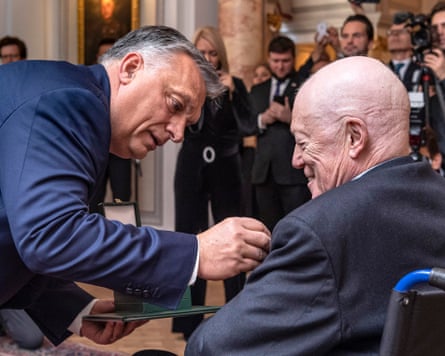
At the time, postliberals could still squint and see Trump as a vessel for this project. After Trump's defeat in 2020, Pappin visited Budapest for the first time, and before long, he had relocated to Hungary. In 2023, he was appointed president of the Hungarian Institute of International Affairs, a highly unusual position for a foreign national. Pappin now had the opportunity to learn from the Fidesz party-state and start putting his ideas into practice.
To postliberals, Orbán's governing programme looked like a dream come true. As Rufo, coming off his stint at the Danube Institute, put it in 2023: "Hungary's leaders are serious people combating the same forces confronted by conservatives in the west: the fraying of national culture, entrenched leftwing institutions and the rejection of sexual difference." But, compared with the contemporary Republican party, Orbán seemed exhilaratingly willing to use the power of the state to pursue a conservative vision of the good life.
Orbán was the great defender of the postliberal trinity: "strong families, strong borders, strong industry," as Pappin said in an interview with the Atlantic. "Orbánomics" consisted of a series of interventions to build up Hungary's car manufacturing capacity, ensure access to less expensive Russian energy and increase work requirements for welfare recipients, raising taxes on banks and even nationalising some.
Defying the EU, the Orbán regime also pursued a so-called "zero migration" policy. But the postliberals were perhaps most enamoured of Orbán's efforts to encourage traditional family formation and raise the birthrate. Since 2022, Hungary has spent about 5% of its GDP every year on a suite of welfare initiatives offering generous maternity leave, childcare support and tax breaks for mothers.
As Rufo explained, these seemingly "progressive" policies were meant to serve "conservative ends": first, "to incentivise traditional marriage and family formation"; second, to help ward off "foreign ideologies, such as critical race theory and gender ideology"; and, third, because "raising the native Hungarian birthrate obviates the need for foreign immigration". Hungary's student debt policy also allowed new mothers to suspend, reduce or ultimately erase their debt entirely, depending on how many children they had given birth to. In 2023, Pappin pointed to Hungary's student debt programme as a model for the kinds of policies the Republican party should pursue.
During the Biden years, the postliberals yearned for the kind of power and stability in the US that Orbán enjoyed in Hungary. In Deneen's 2023 book Regime Change: Toward a Postliberal Future, the philosopher was no longer just diagnosing the problem with liberalism; he was suggesting a radical solution. Deneen now called for a revolutionary turn to "aristopopulism", in which a cadre of elites would act as "class traitors" to help socially conservative workers depose the liberal-meritocratic ruling class in the US, and take control of a newly integrated state and civil society. "What is needed, in short," he wrote, "is … the peaceful but vigorous overthrow of a corrupt and corrupting liberal ruling class and the creation of a postliberal order in which existing political forms can remain in place, as long as a fundamentally different ethos informs those institutions and the personnel who populate key offices and positions." As an example of what he had in mind, Deneen pointed to Hungary.
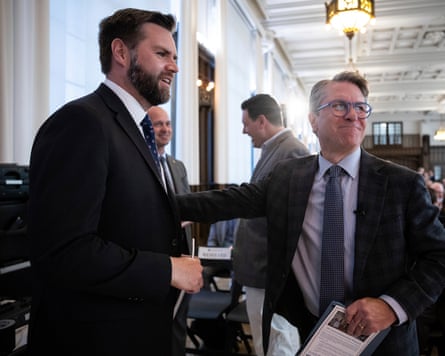
By the time I arrived in Budapest in late 2025, Trump was back in power, with the postliberal darling JD Vance as his vice-president. The new administration was armed with a blueprint for Deneen-style regime change. In 2023, the Heritage Foundation, a conservative US thinktank, had released a report titled Project 2025, "75% of which is being implemented", as Heritage's's Paul McCarthy, who'd been involved in drafting the chapter on US foreign aid, claimed at a Danube Institute event this February. (The Danube Institute and Heritage had established a formal collaboration in March 2023, a month before the Project 2025 report was released.)
For Applebaum and other post-cold war liberal intellectuals such as the historian Timothy Snyder, the direction of the US right was yet more evidence that "America's future is Hungary". According to Snyder, Trump and Vance are "Orbán's pupils", and many of their policy decisions "arise in whole or in part from Hungarian sources".
But in Hungary, a funny thing was happening: Orbán's own government was no longer popular. Péter Magyar, a former Fidesz insider who had broken with the party, was leading Orbán by double digits in independent polls. One of two things was about to happen: either Fidesz would be out of power for the first time in 16 years, or Orbán would prove himself a genuine dictator. The Applebaum theory of Orbán's regime was about to be put to the test, and so was postliberalism.
On the national holiday of 15 March, I joined masses of supporters of Magyar's new Tisza party as they filled the streets all the way up to Heroes' Square, where Orbán had made his first major political speech in June 1989. Later that year, Orbán raced back to Budapest from his Soros-funded scholarship at Oxford to participate in the unfolding regime change as a representative of Fidesz, founded as the Federation of Young Democrats. Now, my Hungarian friends were joking that Orbán resembled one of the corpulent bureaucrats he had once sought to replace.
In the Hungary of 2026, postliberalism was not working out as planned. Inflation and house prices had risen faster than anywhere else in the EU. Orbánomics was crashing out. Industrial development hadn't resulted in the promised economic growth, and Fidesz had been rocked by a massive pollution scandal at an electric vehicle battery plant. Though migration was effectively halted, Chinese guest workers streamed in to work in the newly created car industry jobs. After creeping up marginally, the fertility rate seemed to be flattening.
Corruption throughout Orbán's patronage system was so rampant that Hungary was being widely labeled a mafia state. Fidesz had rewritten the constitution, installed party loyalists in key judicial roles, gerrymandered electoral districts, changed election laws to inflate their parliamentary majority, put much of the higher education sector under the control of boards stacked with party members and overseen the sale of media companies to regime-friendly oligarchs. Already, the regime had granted that women with at least four children did not have to pay income taxes for the rest of their lives. In the run-up to the election, they reduced the number of children required to three, and then two. But that wasn't going to be enough to win an election, let alone replace the global neoliberal economic order.
Both Trump and Vance had been rumoured guests at Cpac Hungary, but neither showed up in the end. The event chair still claimed that the "biggest stars of the sovereigntist right" were all on the way to Budapest. Javier Milei, the president of Argentina, was a last-minute addition. They also advertised an appearance by the Czech prime pinister, populist billionaire Andrej Babiš, but he pulled out at the last minute. Maybe they had all been scared off by Orbán's tanking poll numbers.
Lingering outside the gate on the day of the event itself, I saw Pappin walking toward the VIP entrance. I ducked behind a Cpac banner reading "FEL GYŐZELEMRE!" ("ON TO VICTORY!").
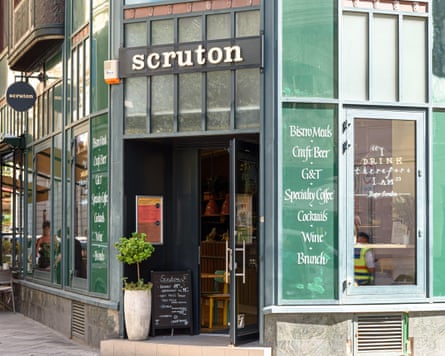
I wondered how he was taking the polls. A little over a week earlier, I had run into Pappin after an event at which he had joked that the liberal Canadian prime minister, Mark Carney, sounded a lot like a "dangerous postliberal" when he prominently declared that the crisis in the rules-based international order was "a rupture, not a transition". I was grabbing a coffee at a Scruton cafe – part of a chain named after the conservative English philosopher and Orbán ally Roger Scruton. Exposed lightbulbs hung from the ceiling in front of a stencilled cartoon of a hip, young Scruton in a double-breasted suit, with a speech bubble: "The greatest treasure of Hungarians is their national identity." When I spotted Pappin at the next table, I decided to introduce myself, playing up the extent to which Scruton himself figures into my research. We talked about life in Budapest, the city he had referred to elsewhere as "Scrutopia", and he scoffed at the impression of the Danube milieu put forward by the western press. "You know, all these people show up in Budapest looking for some kind of conservative intellectual utopia," he said. Though the scene had been influential, he added, "There are only like five of us."
Five intellectuals in close proximity to power can do a lot of damage. Take it from Deneen in Regime Change: "Even if relatively small, an elite cadre skilled at directing and elevating popular resentments, combined with the political power of the many, can bolster populist political prospects as a working governmental and institutional force." But this wasn't what was happening in Hungary, at least not any more. The political power of the many was no longer cooperating. Though Vance had finally flown in for support, the polls still weren't moving in Orbán's direction.
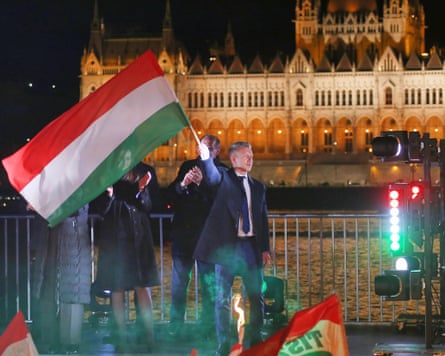
On 11 April, the night before the election, I heard Orbán's voice echoing from the castle during a final torch-lit rally. The next day, the city was all nerves. The final turnout, nearly 80%, would set a national record. After polls closed, I gathered with friends to stream the independent Partizán media feed on YouTube. The first results, released just after 8pm, put Fidesz slightly ahead. Then, at 9.16pm, a new banner crossed the bottom of the screen: Orbán had called Magyar to concede. The convoluted Hungarian election machine had backfired, and Tisza had defeated Fidesz in a landslide. "Looks like the last bastion is gone," Eva Vlaardingerbroek posted on X.
My friends and I rushed to Batthyány Square, where Magyar was set to give his victory speech. The crowd throbbed with expectation; drones circled above us. Techno music drifted across the Danube from a dance party next to the floodlit parliament. We eavesdropped on two childhood friends who hadn't seen each other in years as they embraced and looked deeply into one another's eyes in wonder. Their meet-cute was interrupted by someone vomiting on the cobblestone at their feet.
It slowly dawned on me that what we were witnessing was not a change of government but a regime change. Throughout the campaign, Magyar had used the Hungarian term , literally "system change", once reserved for talking about the democratic transition from communism in 1989, and now, somehow, Tisza had made it happen.
If Pilkington is right that post-cold war liberals don't have a good understanding of why their world is falling apart, neither did the postliberals after Magyar's win. For them, the fact that Orbán had conceded gracefully was proof that he had always been committed to democracy – and that liberal critics such as Applebaum and Snyder had misunderstood him all along. On election night, Rod Dreher responded to news that Orbán had conceded with a sarcastic post on X: "But … but … but, I was told by so many experts and journalists in the west that this would never happen, that Orbán is a fascist dictator who would never surrender power!"
It's true that Applebaum's work often relied on a reductive binary between democracy and autocracy that, in this case, had obscured the fact that democratic change was still very much possible in Hungary. But the postliberals were trapped in their own binaries, too: because Orbán wasn't a dictator, their logic went, Hungary must have ultimately been a democracy. This allowed them to dismiss all the ways Fidesz had held on to power by changing election laws, packing the judiciary, attacking civil society and higher education, and consolidating control over the media.
There was one thing that Applebaum and the postliberals could agree on after the election: the demise of the so-called Hungarian model. Applebaum's post-election column marked the passing of one of her own stock narratives. Orbán's Hungary would no longer serve, she wrote, "as a model for Americans or Europeans who want to capture their own states, or take apart their own checks and balances, or impose their own illiberal ideologies on people who don't accept them". In his own postmortem, Dreher reached a similar conclusion: "As a model for Maga and other nationalist conservatives in the west, Hungary is over." But it would be a mistake to think that Orbán's defeat, or the potential closure of state-supported institutions such as the Danube Institute, means the end of postliberalism.
"We are all postliberals now," Pilkington argued on Postliberal Order, the Substack newsletter he shares with Deneen, Pappin and CC Pecknold, a historian of theology. As he pointed out, Magyar shared many of Orbán's views on core issues. "From the standpoint of domestic politics, Magyar effectively ran on Fidesz's own platform," Pilkington argued in a different post-election column, "promising to keep migration low, maintain Hungarian cultural nationalism, and keep the generous family support system that Fidesz built in place." But Pilkington wasn't just making a narrow political point. Postliberalism as an intellectual project was not tied to the fate of any particular political party. "No doubt, Fidesz has been an incubator of alternative thinking in transatlantic conservatism, but these ideas are in the ether and are unlikely to go away any time soon."
In the narrow, descriptive sense, it's true that there is no going back to the liberalism of the brief, post-cold war interregnum, circa 1989-2015. Still, postliberals are terrible at predicting what comes next. On X, Pilkington posts regular prophecies of western civilisational catastrophe with the swagger of a former finance guy. "There is an old phrase in investment," he writes in The Collapse of Global Liberalism, "it is better to be wrong for the right reasons than right for the wrong reasons."
But if Pilkington is right about our new postliberal era, it is for the wrong reasons. Clearly, the world of post-cold war liberalism is over. But the idea that all the challenges brought on by its collapse can be answered by the postliberal programme is a farce. As Hungary has shown, postliberal policies don't produce a life good enough to win over voters. In the end, Hungary was a false model for our authoritarian future. Now the model we have to worry about is US-made.
In all my time in Hungary, there was one person I had never seen at the Danube Institute or at any of the other events I attended: Rod Dreher, an alleged mainstay of the Budapest scene. After a few failed attempts, we finally met on a spring afternoon in early May, the day before Magyar was sworn in as prime minister. Over rosé spritzes and nicotine pouches, I made my confession to Dreher: I told him I had been attending events at the Danube Institute, about all the wild conversations I had overheard, and about how I was just trying to understand what attracted American intellectuals to the dissident right. We both agreed that Hungary was a strange place to look for lessons about the US. But here we both were.
"I was never part of any scene here, although I kind of thought I would be," he told me. Like Pappin, he noted that only a handful of conservative anglophone intellectuals lived in Budapest; most of their companions were only there temporarily, to check out what it was like when their side was in power. But the Scruton cafes were "phoney", more Ikea than English country house. The Danube Institute, though it was never the Orbánist propaganda factory it was rumoured to be, was overseen by overcautious Hungarian managers, he said, who had held it back from becoming a truly stimulating intellectual environment. "There was a scene," he admitted, "but it was very superficial."
And now the Budapest scene, however superficial, was coming to an end. Over the next few months, the new Tisza-led parliament would pass a series of laws and constitutional amendments aimed at dismantling the Fidesz party's system of funding thinktanks and other intellectual institutions. At the end of July, Pappin would resign from the Hungarian Institute of International Affairs, and the MCC foundation would be formally dissolved. Already, Magyar had promised not only to end government funding of the organisation that runs Cpac Hungary, but to investigate the former funding through the newly created National Asset Recovery and Protection Office. As Dreher would later put it: "The unsettling atmosphere of vengeance that has overtaken Hungary since Péter Magyar became prime minister [sic] likely means the end of the Danube Institute." (The Danube Institute did not respond to requests for comment.)
I asked Dreher what he would do next. He told me he had briefly considered moving to Vienna, but then he had had a change of heart. It was time to give up the good life in central Europe and return to the American south. My own temporary resident permit was about to expire. As the sun set behind Károlyi-kert, one of the oldest gardens in Budapest, Dreher and I downed our last rosé spritzes. Postliberalism was finally coming home, and so were we.