As a child, Analía Azic used to pretend she was secretly a princess, the heiress to a magical distant kingdom. In real life, she was the daughter of a greengrocer named Juan Antonio Azic and a demure housewife named Esther Abrego. The family lived in the province of Buenos Aires, which, as anyone from the area will tell you with a dash of pride, is not the city of Buenos Aires but its rougher neighbour. Analía was not royalty, but she had an iron will and audacity out of proportion to her small stature.
Analía cared little for grades at the Ladies Institute of the Sacred Heart, where she rolled with the , girls who hiked their school skirts up so high they served as little more than belts, and dreamed of the weekend when they could finally trade in their school uniforms for designer jeans and tight tank tops and sashay into Electric Circus, the one local club that allowed in minors. There, Analía would climb atop the speakers and dance, then leap back down to toy with the boys from the Argentine air force's technical trade school.
It was the 1990s and she and her friends were middle-class kids from families with ties to the armed forces. Their understanding of recent events was that the nation had emerged, in the previous decade, from a "dirty war" between two opposing forces of equal strength. On the one side, a national army fighting for the preservation of Christian values and the fatherland; on the other, unscrupulous Marxist guerrillas advocating their overthrow. Both sides had committed crimes, that was true – but it was war, and thankfully the army had won and reinstated order. Analía absorbed this narrative both at school and at home, where her father, Juan Antonio, railed against what he called the "atheist, unpatriotic left".
From the age of nine, Analía had taken to reading the newspaper after her father had finished with it, and at night would sidle up beside him to watch his political programmes on TV. This bonded her to her father, as surely as it unsettled her mother. Esther believed that politics, like climbing trees, was not becoming of the female sex. Analía – who, by her own admission, possessed a "rebellious, contentious nature" – ignored her. But it was precisely this defiant streak that soon led her to question her parents' politics. When Analía turned 15, she got her hands on Che Guevara's complete works. She started to become curious about leftwing ideas.
This was a period of relative calm and prosperity in Argentina, following decades marred by chaos and military dictatorships. Carlos Menem, the nation's president for most of the 1990s, was a flashy, spray-tanned bon vivant with a penchant for posing by his Ferrari for magazine spreads. Though a Peronist – a member of the dominant leftist party in Argentina, named after its founder, Juan Domingo Perón – he ushered in a Washington-approved, free-market liberalisation programme that included privatising more than 400 state-run companies and effectively dismantling the welfare state. In the short term, his programme seemed to offer relief, especially to middle-class Argentines, who splurged on imported goods and holidays in Miami. But in the long term, it devastated many domestic industries and helped set the country careening toward a debt crisis.
Analía had seen spiralling poverty first-hand through volunteer work with church groups. After she read Guevara, these impressions took on a new political dimension in her mind. He embodied the Latin American guerrillas of the 1960s and 70s she had been taught to revile. But now she wondered: if they'd been fighting to ease inequality in one of the most unequal regions in the world, hadn't they been right?
After finishing the book, Analía promptly bought a beret; from then on she took it off only to sleep and shower. She tacked a poster of Guevara's face to her bedroom door. Her father did not tear it down, as she expected, but, with patient resignation, asked her to put it on the inside of the door.
"As I continued to oppose the rightwing discourse of my family, an ideological rift opened up between us that grew even wider," she later reflected. At the time, she saw it as "simply the result of the fact that he was old and I was young". Later, she would come to see it very differently.
f Analía's politics began as teenage rebellion, by the time she went to university they solidified into conviction. She agreed to study law at the University of Buenos Aires after Juan Antonio shot down her first choice, sociology. (The department was a "nest of leftists", he told her.) But it was at university that she joined the political organisation that would define her life.
Venceremos (We will overcome) was the student arm of a self-styled nationalist and revolutionary movement called Patria Libre, which opposed the government's free-market reforms. As the century ended and Argentina slid deeper into an economic crisis, the government implemented harsh austerity measures. Analía, who was still living at home, threw herself into increasingly rowdy protests with Venceremos, while telling her parents that she was going to the movies or volunteering with church groups.
The lies weighed on her. One night in 1999, while watching the evening news with her parents, Analía saw one of her fellow activists on screen, hurling a rock through a shop window. "I'm involved with that group," she blurted out. "That's where I spend my days. Not in church." Esther froze. Juan Antonio just stared at her, with what Analía would later think looked more like fear than anger. "My relationship with my parents, and [Juan Antonio] especially, deteriorated from the moment I stopped lying," she later wrote.
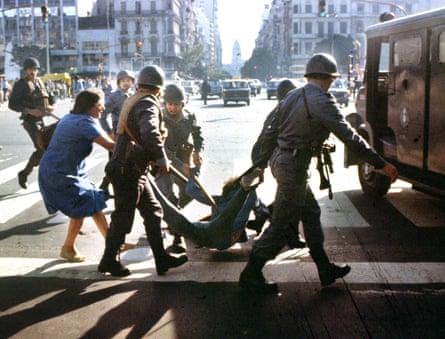
On 1 December 2001, the government imposed a freeze on bank accounts, blocking Argentines' access to their savings. People started rioting. Analía dodged blows from the police as she fled the centre of the capital after a protest, her high heels clacking against the pavement (she'd planned on going dancing afterwards). The riots raged on for weeks, peaking on 19 and 20 December, when police opened fire on protesters, killing 39.
The months immediately after the December 2001 financial collapse were some of the darkest in recent Argentine history. Unemployment soared, and half the population fell below the poverty line. Analía helped set up soup kitchens and communal vegetable gardens to feed the homeless and unemployed, and offered literacy classes and legal advice. She lived in an abandoned bank that had been converted into a cultural centre, with no hot water. Concerned about her health, her parents insisted she come home at least once a week for a home-cooked meal.
It was at one of these weekly dinners, one Thursday night in July 2003, that Analía's life was upended.
fter the fall of Argentina's last military dictatorship in 1983, the country initially seemed to offer the world a rare model of effective transitional justice. In 1985, nine junta commanders were tried in what became the first major war crimes trial since Nuremberg. The prosecution drew heavily from Nunca Más (Never again), a 1984 report compiled by Argentina's National Commission on the Disappearance of Persons, which documented 8,960 cases of forced disappearance, as well as other atrocities. The court convicted five of the nine defendants for "implementing a criminal plan" that included torturing and murdering Argentines. But just two years later, as a new wave of trials targeting middle-ranking officers approached, a faction of the military launched a mutiny, demanding an end to prosecutions for crimes committed during the dictatorship.
To quell the unrest, President Raúl Alfonsín passed two laws. The first, known as the Full Stop law, set a deadline of 60 days for any new prosecutions for political violence. The second, the Due Obedience law, granted immunity to lower-ranking officers on the grounds that they were following orders when they committed crimes. Many Argentines simply called them the "impunity laws". They meant that a decade after the dictatorship had ended, you could find yourself standing in line at the grocery store behind the very man who had tortured you.
Following the 2001 financial crisis, many leftwing organisations demanded the repeal of the impunity laws, and for official recognition of 30,000 as the number of disappeared – far above the 8,960 cases documented in the 1984 Nunca Más report, which counted only those confirmed missing at the time. In the absence of legal mechanisms by which to hold people suspected of war crimes accountable, protesters would stand in front of their homes or workplaces and call them out for their alleged crimes, in a kind of public shaming. Analía was one of the participants in these protests, which were known as .
About 10pm on 24 July 2003, Analía was at her parents' house for one of their weekly dinners when her father emerged from his bedroom impeccably dressed. He asked Analía to stay at home that evening and then left, "without any explanation, although he kissed … us goodbye", Analía recalled, adding that it was "a surprising display of affection".
A few hours later, the phone rang. Analía picked up. It was her father, sounding odd. He dictated a number for Analía to take down and instructed her to call it in an hour. When she did so, a male voice answered. "Analía, is that you?" the man said. "Your father's in the hospital. He just shot himself."
At the hospital, Analía found her father "unconscious and without a face". The bullet hadn't damaged his brain but it had completely disfigured him. Reeling, she stepped out of his room and walked down to the waiting area. That's when she saw a list of names in bright red letters scrolling across a TV screen. They belonged to about 40 members of the Argentine military who had served under the junta and who were facing extradition to Spain to stand trial for dictatorship-era crimes. Juan Antonio Azic, her father, was on the list. (The trials were due to take place in Spain thanks to the efforts of the crusading judge Baltasar Garzón acting under the doctrine of universal jurisdiction, which allowed courts of one country to prosecute grave human rights crimes committed outside that country.)
Analía had known her father had been in the military, but she'd always assumed he'd simply done his service as required by law. Now she learned he had belonged to a taskforce that kidnapped, tortured and disappeared people in the Esma, a navy mechanics' school that had been converted into one of the largest and deadliest clandestine detention centres right in the heart of Buenos Aires. An estimated 5,000 people were held there throughout the dictatorship. The man who raised her, she discovered, had wielded an electric cattle prod against prisoners to get them to speak. "My father had suddenly ceased to be an innocent fruit-and-vegetable merchant and had become one of the people whose imprisonment I had been demanding for years," she said.
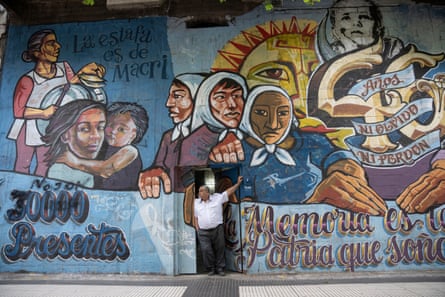
She contacted the Grandmothers of the Plaza de Mayo, a celebrated human rights group fighting dictatorship-era impunity, with whom Analía had campaigned. She asked to speak to their head, Estela de Carlotto, an elegant matriarch with a halo of white hair. "I told her that I needed to apologise, because I had found out my father was a torturer, but that I also needed to hear that I still had the right to be politically active, that my genetic heredity did not automatically make me ineligible to keep fighting for the causes I believed in." Estela arranged for them to meet. It was only later that Analía, who had been sobbing on the call, would think Estela had sounded strangely serene.
A few days later, Analía walked into a bar to meet Estela and several other members of human rights organisations. They informed her they had reason to believe she was not Juan Antonio and Esther's natural daughter, and suggested she have a DNA test. Rather than being the child of a war criminal, they had strong evidence that Analía might be the daughter of a couple of leftist dissidents disappeared by the junta.
cross Latin America, just as elsewhere, the 1960s was a decade of revolution. In Argentina, a string of coups and one general's prohibition of Peronism – more than a political party, the working man's creed – contributed to the rapid radicalisation of Argentine youth. Some turned to armed struggle.
The two most prominent guerrilla organisations were the People's Revolutionary Army, a Marxist-Leninist outfit, and the Peronist Montoneros. These groups raided police stations and army barracks for weapons, robbed banks to fund their operations, and kidnapped military officers and business executives, sometimes for ransom, sometimes to execute them.
On 24 March 1976, a military junta seized power in a coup and began dismantling any leftist opposition. By then, the Montoneros were weak, but they were labelled terrorists and targeted by the new regime, along with students, labour and trade unionists, intellectuals and anyone suspected of leftwing opposition.
The guerrillas went underground. Among them were a couple in the Montoneros, María Hilda Pérez, known as Cori, and José María Donda, known as El Cabo, or Captain. Cori was passionate and impulsive. When her father told her to remove a cache of weapons she'd stashed in his house, she shoved them into an enormous duffel bag and hauled it down the street yelling, "Cowards!" back at her gawking sisters. José was quiet and commanding. He quickly ascended to a key position within the Montoneros.
Cori and José's love for Peronism, which they saw as a liberating force in Argentina, was matched only by their love for each other, and they married in a small ceremony in 1973 when she was 22 and he 19. Their witness was José's older brother, Adolfo Donda, a career navy officer 10 years his senior whom José had idolised as a kid, even as their divergent politics opened a rift between them.
It was Adolfo who, as a senior intelligence officer inside the junta, laid a trap for Cori and had her arrested in March 1977, when she was five months pregnant. When José learned of it, he told a neighbour he believed Adolfo had set her up to get to him. José himself was captured that May. Years later, a man who'd survived imprisonment in the Esma and crossed paths with Adolfo there testified to overhearing him say: "This is a war. And in a war you can't show mercy to your enemy. I didn't show mercy to my own brother, who was a Montonero. And I didn't show mercy to my sister-in-law."
To avoid the bad press that had haunted Franco's Spain and Pinochet's Chile with their firing squads – loud and flashy affairs that received international condemnation – the junta turned to another mode of extermination, the "death flight". This consisted of injecting prisoners with a sleep-inducing narcotic, tying rocks to their feet, loading them into a small plane, and tossing them out, midair, into the River Plate or the Atlantic.
In April 1977, a group of 14 women gathered on the Plaza de Mayo before the Casa Rosada, the squat, rose-coloured presidential palace, demanding information on their missing children. Within weeks, the ranks of what became known as the Mothers of the Plaza de Mayo had swelled to more than 100. Six months later, a few, soon to be called the Grandmothers of the Plaza de Mayo, asked another question. Where were the children of their missing pregnant daughters? Rumours churned that pregnant women who had been captured were kept alive long enough to deliver their children, only to have them taken away and handed off for adoption, often to regime sympathisers.
After she was arrested in March 1977, Cori was held prisoner in the Esma. She gave birth on a wooden table in a small room in the attic sometime between July and September 1977. The baby was her second child; the first, a two-year-old girl, was in her grandmother's care at the time. Cori was told to write a letter to her family asking them to take care of this new baby, too. Suspecting neither the letter nor the child would ever actually reach them, she hatched a plan with her cellmate, a 19-year-old woman named Lidia Vieyra who'd been pulled in to act as midwife, despite having never done so before. With a needle and bits of blue surgical thread left over from the birth, they sewed tiny blue loops around the baby's earlobes. Cori hoped that one day, if she were freed, somebody would remember the baby with little blue hoops in her ears, and the sign would help her trace the child.
Fifteen days after giving birth, the baby was taken from her, and according to testimony from survivors of the Esma, Cori was "transferred". "Transfer" was the euphemism the military used to refer to the death flight. Her brother-in-law, Adolfo, was part of the detention centre's leadership that decided on each week's "transfers". The circumstances around José's disappearance are unclear.
Lidia Vieyra, Cori's former cellmate, survived. After she got out in July 1978, she sought out the Grandmothers of the Plaza de Mayo to tell them about Cori's missing baby. Over the next few decades, a series of tips slowly brought them closer to finding the child's new identity and whereabouts. One came from someone who questioned whether their previously childless neighbours, Juan Antonio Azic and Esther Abrego, were really the parents of the baby who had suddenly appeared in their home. And another came from the wife of a junior coast guard officer who said that in 1977, shortly after she'd given birth to a son of her own, a commanding officer from the Esma handed her a baby girl, less than a month old, asking her to nurse her. When she took the baby, she noticed something unusual. Bits of blue thread sewn through her ears, like tiny blue hoops.
Vieyra had one final piece of information. Before she died, Cori had given the baby a name. She'd called her Victoria.
n estimated 500 babies were stolen during the dictatorship and, as part of a systematic plan, handed to military families or junta sympathisers who passed them off as their own. Couples who wanted a child joined waiting lists at military hospitals. Now Analía Azic had reason to believe that she was one of the stolen children.
On top of her grief and confusion, she was saddled with an enormous responsibility. Taking the DNA test and confirming Juan Antonio Azic and Esther Abrego were not her biological parents might mean putting them behind bars. She was convinced that Juan Antonio, who had been working at the Esma when Cori gave birth in custody, had kept his wife in the dark about their new baby's origins, and that Esther, an obedient and timid wife, had simply never asked. Harder still was reconciling her feelings for Juan Antonio himself. She described him as a stern but loving father, and "the most important man in my life".
It wasn't until nearly a year later, on 24 March 2004, that Analía finally decided to take the test. She got her results in October. There was a 99.99% chance she was related to Cori and José María Donda. By this point, she can't have been surprised. She had been shown a passport-sized photo of Cori. With the hooded eyes that conveyed both defiance and teenage ennui, jet-black hair falling at her temple, full lips and a strong chin – Cori was her spitting image.
Analía changed her name to Victoria Donda, the name her mother gave her at birth, and her father's surname. This was shortly after the election of a Peronist candidate named Néstor Kirchner, whose presidency inaugurated a new era of accountability for dictatorship-era crimes. He struck down the Full Stop and Due Obedience laws, putting an end to protection for those guilty of human rights abuses, and annulled a decree prohibiting the extradition of Argentines accused of torture and murder during the dictatorship.
In this new climate, Victoria became well known in Argentina as a child found by the Grandmothers of the Plaza de Mayo. She wasn't comfortable with the attention at first, though she later came to see it in a more positive light. "It's a good thing for society to know what happened," she said. "Argentina was a country where the dictatorship was not talked about."
The one person who knew the most about her origins – her biological uncle, Adolfo Donda, the naval officer who had been in the leadership group that ordered her mother Cori's "transfer" – had still not spoken.
Adolfo Donda had been first arrested in 1987 but was released after just four months. It was around the time the impunity laws were passed. For more than a decade, he faced no further legal consequences. That changed in 2003, when the impunity laws were repealed and he was arrested again. In 2011 and 2017, he would finally be convicted and sentenced to life in prison for a battery of crimes including kidnapping, torture and murder. But not Victoria's abduction.
Victoria's new identity deepened her commitment to leftist politics. "I'd always been a woman of the left, but to find out that this was in line with my parents, that it was the first thing I'd shared with them, that gave me another impetus."
In 2007, members of Kirchner's coalition encouraged Victoria to run for a congressional seat representing Buenos Aires Province. She was unsure whether she was ready to trade activism for a role in formal politics. But after some persuasion, she agreed. At 30, she became the youngest person ever elected to Argentina's Congress, and the first stolen child of the dictatorship. She committed herself fully to the defence of human rights. "I owe this to my parents," she later wrote, "who gave their lives to build a more just world for their daughters."
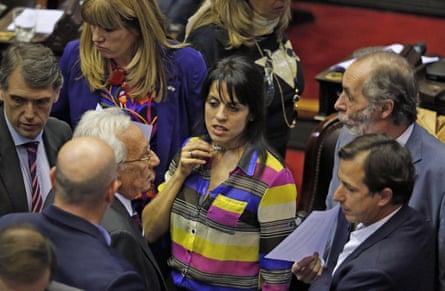
n 18 October 2014, Victoria gave birth to a baby girl of her own. She named her daughter Trilce, after a book of poems by César Vallejo, a portmanteau of and , sad and sweet. Two weeks later, she was in bed recovering from her C-section when she learned that there was to be a vote in the congressional committee on which she served on an abortion bill – an early step before a bill made it to Congress' floor. She grabbed a bandage, wound it tight around her abdomen, swaddled Trilce, and lurched over to Congress. "I didn't want my daughter to go through what I had," Victoria said.
Many years earlier, when Victoria was 19, she had used her savings to get a clandestine abortion in a "more or less acceptable place". Later, when she'd accompanied other women forced to have abortions under worse circumstances, she'd realised she'd been lucky.
Abortion was a criminal act in Argentina, strictly prohibited by the nation's 1921 penal code unless the pregnancy presented a threat to the woman's life or health, or in cases of rape. Fearing legal repercussions, doctors were often unwilling to proceed even in permitted cases.
When the 2014 abortion bill did not go forward, owing to a technicality, Victoria realised the campaign needed a new approach. Between the end of the dictatorship in 1983 and 2016, at least 3,040 women died of complications from abortion in Argentina. The true number was likely much higher since hospitals often logged the cause of death after abortions went wrong as "sepsis". Hundreds of thousands of clandestine abortions were carried out each year, of which more than 50,000 ended up in public hospitals after developing complications. It was an unspoken healthcare crisis. Yet even progressive parties did not want to touch it. Just as silence had smothered the dictatorship's crimes for two decades of democracy, it hung over this issue too. Victoria wanted abortion dragged out into the open.
In 2016, while traveling through Tucumán, one of Argentina's poorest provinces, Victoria learned of a young woman serving an eight-year sentence for homicide after having had what appeared to be a miscarriage. Belén, the pseudonym by which the woman came to be known, had checked into a hospital in 2014 for severe stomach pain. Unaware she was pregnant, she was arrested on the spot after staff claimed to have found a foetus in a toilet she had used. Police handcuffed her to her hospital bed, then transferred her to a prison.
Victoria knew that a poor woman from a poor province imprisoned over a suspected abortion wouldn't make national headlines – unless there was outrage outside the country. She arranged a visit from the United Nations special rapporteur on torture, who, after hearing Belén's story, publicly condemned Argentina in the nation's Congress in May 2016. The next day, his words, and the case, dominated national news.
After more than two years in prison, Belén was released in August 2016 and acquitted in March 2017. The case helped "show what the consequences of abortion were", Victoria said. "And the consequences were that if you were poor, you ended up dead or in prison. The rich could always pay for them. But not the poor."
Over the next few years, Argentina's increasingly powerful feminist movement trained its attention on reproductive rights. In early 2018, President Mauricio Macri allowed a congressional debate on abortion for the first time in the nation's history. On 6 March 2018, Victoria was one of four deputies who sponsored a bill proposing to legalise abortion up to 14 weeks.
As lawmakers and civilians made their cases for or against the bill over the next few months (in a rare set of proceedings, civilians were invited to speak before Congress), opponents repurposed the language of a crime Argentines were now all too familiar with, claiming that abortion was "the real forced disappearance of people". In this way, many of the same people who denied that 30,000 people had been disappeared under the dictatorship now accused progressives – feminists in particular – of being the real killers in Argentina.
At the urging of a friend, Victoria read Margaret Atwood's The Handmaid's Tale during those heady weeks of debate. Atwood has said she took inspiration from Argentina for the idea of giving babies from the lower classes to the ruling class. "It was hard," Victoria recalled of reading the book. "I thought a lot about my mum. Locked up. With no possibility to choose," she said.
On 13 June 2018, Congress's Chamber of Deputies voted on the bill. Victoria leaned into a microphone planted on her desk. "How can Argentines look at the world, this developed world we strive to resemble, when we have an authoritarian gene in us that makes us lock up women to have children? What kind of perverse project led us to have women kidnapped and disappeared and forced to give birth, as if their uteruses were spoils of war, and the results of those uteruses, those babies, were also spoils of war?" Her voice boomed as lawmakers around her rose to their feet, their applause echoing through the chamber.
After a million women gathered to demonstrate, the bill passed the Chamber of Deputies with the smallest of margins. Two months later, it was struck down by the Senate. But on 30 December 2020, Argentina's Congress approved a law allowing abortion up to 14 weeks. A few months later, an eccentric economist named Javier Milei launched a political campaign that combined dictatorship denialism and promises to repeal the abortion law. He was elected Argentina's president in November 2023.
met Victoria Donda in 2024 in a cafe in Boedo, a bohemian neighbourhood of Buenos Aires. Outside, a torrential downpour pelted the streets. The previous week, Victoria had sat in a small courtroom, chapel-like in its intimacy, as a judge handed her uncle, Adolfo Donda, a 15-year sentence for his role in her abduction and for concealing her identity. After having refused to see her years earlier in prison, because he said she was not a "recognised" family member, during the trial Adolfo had scolded her for going against her own "blood". "Family is sacred, Victoria," he had said. In their ruling, the judges described what happened to Cori during labour as "dehumanised childbirth". It was the first time a ruling in one of Argentina's stolen-baby cases used those words.
Victoria did not forgive Adolfo. But she did forgive Juan Antonio Azic, the man she had once called her father and now referred to as "my appropriator". After emerging from a coma after his suicide attempt in 2003, he had encouraged Victoria to take the DNA test that confirmed her identity as a daughter of the disappeared – which, in 2015, helped secure his own conviction for her kidnapping. Far from the glare of any camera, Victoria, over the years, regularly visited him in prison, bringing him small honey-glazed croissants called . He is now serving the remainder of his sentence under house arrest and Victoria continues to visit him. "I still love him," she said quietly, gazing out the window as thick raindrops hit the pane.
Later she pulled out her phone and scrolled through pictures of Trilce flashing bucktoothed grins at abortion protests. "We fought so hard for that law, and my daughter was right there with us," she said, smiling at her child. With her dark, disheveled locks, hooded eyes and broad grin, Trilce looked unmistakably like Victoria. She also looked a lot like Cori.
Adapted from Sex and Dissent: Stories of Feminist Resistance in Argentina, Chile, Mexico, and Spain, published by Penguin