nthony Bourdain was typically forthright when it came to his expectations for the toilet facilities in a food business. "I won't eat in a restaurant with filthy bathrooms," wrote the late chef and author, in his seminal, turn-of-the-millennium memoir Kitchen Confidential. "This isn't a hard call. They let you the bathrooms. If the restaurant can't be bothered to replace the puck in the urinal or keep the toilets and floors clean, then just imagine what their refrigeration and work spaces look like." Setting aside the fact that, in later life, Bourdain softened his stance ("Some of the best food experiences I've ever had [have been in] places where they really don't give a shit [about bathroom cleanliness]," were his words in a 2018 interview) his initial take tells us plenty about what the average customer historically demanded of restaurant restrooms. They needed to be clean. They needed to be functional. They needed, at a push, half-decent hand soap and the faint, reassuring waft of pine-scented floor cleaner.
Today, things could hardly be more different. Where once restaurant toilets tended to be a boring, unglamorous afterthought, in recent years, they have emerged as arguably the most unexpectedly attention-grabbing room in the building: atmospherically distinct sites of creativity and muscle-flexing design, where lavish amenities, bespoke lighting, custom soundscapes, selfie mirrors and all manner of other eye-catching flourishes abound, and are documented by social media channels, such as @LoosOfLondon (TikTok followers: 78k).
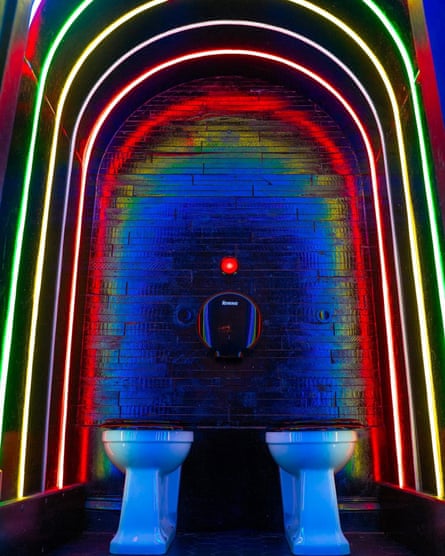
Nip off to spend a penny at Michelin-starred Timberyard in Edinburgh and you'll be plunged into an atmospherically shadowy space, soundtracked by the discordant pops and burbles of grapes fermenting. Do the same at Oxford's south-Indian spot Dosa Darlings or Soho's neo-trattoria Osteria Vibrato and you'll hear, respectively, Stephen Fry's booming narration of the Harry Potter audiobooks and the swelling sound of opera. The practice of rigging lavatories with a disco soundtrack and flashing lights activated by a button – as seen at Barbara's Bier Haus in Birmingham, plus outposts of Bavarian cabaret bar Albert's Schloss – is so commonplace that it has almost become a cliche. From palatial TikTok-bait boudoirs (see the sprawling, uplit powder rooms in Mayfair's Bacchanalia) and horror-themed mini cinemas (MeatLiquor spin-off BloodSports in London's Covent Garden) to the unexplained shrine to former basketball player Dennis Rodman (there is genuinely one of these in London haute rotisserie joint Story Cellar), the world of modern restaurant bathrooms is in the grip of an unlikely, ever-intensifying arms race waged with luxury mouthwash dispensers, avant garde music, and soft-lit mirrors that are so flattering they might as well be enchanted. So how did we get here? And how far is too far, when it comes to turning these functional ablution chambers into noisy Instagram backdrops or giant art installations?
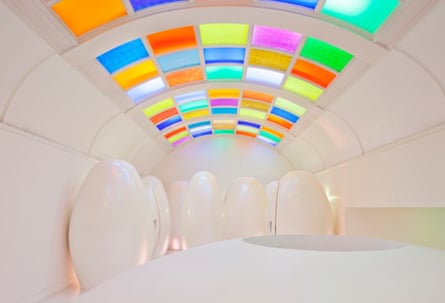
Naturally, social media has had a huge impact, pioneering toilet interiors – particularly the futuristic egg-pods at Mayfair brasserie-cum-gallery Sketch – showing other operators how to turn a utilitarian amenity into a canny, digital age attraction. Yet, beyond all the hastily installed flower walls and neon signs, there is another significant factor. Namely, a post-Covid, industry-wide shift towards dining spaces that are more immersive, memorable and unapologetically atmosphere-forward.
"We've become fascinated with the tiny details that add up to make a difference in a restaurant," says Jo Radford, head sommelier and co-founder at Timberyard, and creator of its viniculture-themed bathrooms. "The amount of time that a guest is in the building with food in front of them is quite a small portion of their overall time with us, so we were looking at all those other touch points and how we could elevate things." The result was the unexpected onslaught of scent, purposefully impeded sight ("environmental health told us that the lights might be so low that it wasn't safe," adds Radford with a sheepish chuckle) and sound that acts as both talking point and nudging link to the earthy seriousness of Timberyard's wine programme. But the use of a wash of loud, discordant noises also serves another function. "It definitely helps in terms of audio privacy, " he notes, highlighting the fact that a lot of these loud, characterful soundtrack choices often act as a kind of sonic veil against some of the grimmer realities of shared lavatories.
More generally, the seclusion and privacy afforded by toilet facilities – plus the access flex of a selfie from within a hot new opening – is something that restaurant interior designers and operators are identifying, leaning into and playing with. "The bathroom is a little space where you can take time to look after yourself and maybe muck around and have an Instagram moment," says hospitality designer Russell Sage, a more than 20-year veteran of the industry with clients including Gordon Ramsay and Angela Hartnett. "It's increasingly become about giving people their own time, getting the lighting right, and making sure they feel a million quid by the time they step back into the restaurant."
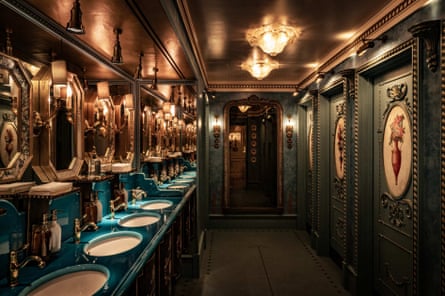
Nowhere is this more true than at Lilibet's, a maximalist seafood restaurant in Mayfair that Sage worked on ahead of its opening late last year. Beyond the fact that its gilded, azure-hued restrooms are inspired by the young Queen Elizabeth II's love of decorative china (a whole new kind of "royal flush"), they also feature mirrors that are lengthening and slimming. "There have definitely been enquiries from people about whether they can buy one from us," says Sage. "We just thought, people want to look fabulous, so let's make a mirror that guarantees you look even more fabulous."
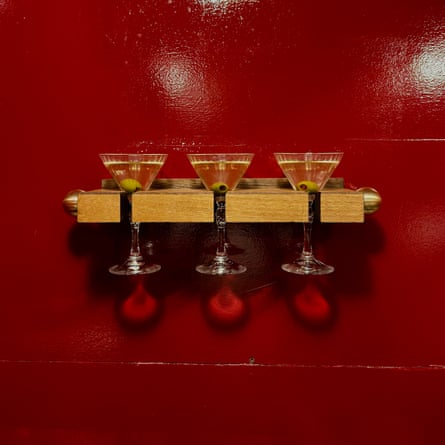
Expensively wrought trick mirrors, opulent miniature spas and panoramic "loos with a view" like the ones atop 20 Stories in Manchester, many of the restrooms in this new wave default to the luxurious, but it's notable that even smaller, scrappier businesses are getting in on the act. Cal McRae, owner of Zillennial-coded Dalston bar Ellie's, had already been experimenting with time-sensitive crimson lighting and video installation, when he noticed an issue with one of the bar's signature, budget-friendly cocktails. "We had these beautiful martini glasses that cost £7, the martinis themselves were £8, and by the end of the weekend the majority of these expensive glasses would be smashed all over the toilet floor," he explains. "I was adamant that [we not use cheaper glasses] and that it was worth the cost, but by the end it was like, this is so stupid." The solution was to build a custom martini-holder rack into the area above the sink; a feature that not only helped preserve Ellie's glassware but became a much-photographed encapsulation of its dishevelled cool, written up in international publications like the hugely influential New York culture Substack Feed Me. "I was absolutely buzzing off the back of that," says McRae. "And it was nice to find this practical solution to a problem, that was interesting from a design point of view and became a bit of a talking point."
That Ellie's viral martini-holders were needed in the first place reminds us of one of the abiding realities of toilets in restaurants and bars: they are often magnets for illicit behaviour, drunken damage, petty theft and other miscellaneous forms of unobserved wildness. "We've had someone rip off all the framing around the sink. And in the first week I heard about two people having sex in there which, honestly, is a massive achievement for a bar owner," says McRae, laughing. Perhaps unsurprisingly, this tendency towards chaos and the basic importance of lavatories have caused some problems for this new generation of immersive facilities. Late last year, the Manchester branch of bougie steakhouse chain The Cut and Craft implemented a five minute time-limit on their Instagrammable toilets; this spring, veteran restaurateur Jeremy King revealed he'd had to ban filming and hire extra security at his Bayswater grand cafe, The Park, because of the number of influencers arriving with suitcases, tripods and sound systems for prolonged video shoots in the handsome, honey-toned restrooms. Even something as pointedly mischievous as the screamingly camp disco loos in branches of Albert's Schloss – with two adjacent toilets in the ladies with a big "push for disco" button beside them – has needed occasional policing. "Now and again, we'll get four girls going in there with a bottle of prosecco and there'll be a big queue after 20 minutes," says James Plant, head of openings and innovations at Albert's Schloss. "So we make sure we have toilet attendants, to give them a gentle knock and a nudge."
Yes, these "influencer bans" often become a handy bit of additional publicity for the restaurant, but does the need for them also show us that the trend for ostentatious loos and logo-embossed selfie mirrors in restaurants and bars may already be circling the drain? McRae, founder of a bar so cool it was the venue for Charli xcx's wedding party, certainly thinks so. "I hate the idea of putting a bar or restaurant name on a mirror," he says. "I understand that a lot of people that come in might put [a photo] on Instagram, and that can help build a following. But it just feels so forced."
Conversely, Sage believes that the kind of amplified, TikTok-ready bathroom aesthetic he employed in Lilibet's will only become more commonplace. "It's the world that we're in now," he says. "Going to a restaurant is not a cheap business, so we owe it to people to give them a good experience, turn up the volume and really put on a show. Ten or 15 years ago it was all about exposed brick and how dreary we could make everything look. I loved it at the time, but we're now in an era where people are in search of a little bit of glamour, fun and enjoyment."
The truth probably lies somewhere in the middle. Even if there is an active retreat from disco lights, selfie mirrors and some of the more gimmicky plays for virality that have dominated the world of restaurant bathrooms in recent years, we've passed a point of no return when it comes to bathroom design. Plush or pointedly stripped back; flatteringly illuminated or cast in a sexy, candlelit gloom; fitted with a Bond villain-worthy tank of live piranhas (as at Nikkei-themed Mayfair spot Pirana), or ornamented with nothing more than stacked pyramids of loo paper. Even a quieter aesthetic choice is still an aesthetic choice. And in an economically pressured era when hospitality businesses have to use every marketing tool at their disposal, a bathroom that has to be experienced to be believed is both added value and a kind of irresistible, dangled lure.
"We want to give people a stolen moment," says Radford. "There's nothing like seeing one of our guests returning from the bathroom, turning to the rest of the table and saying: 'You need to go downstairs and experience that.'" Expect to see more and more restaurateurs continuing to turn their own facilities into the kind of miniature worlds that spark this level of unexpected ardour and intrigue. And if your dining companion suddenly disappears mid-meal for a prolonged toilet break – well, it's no longer guaranteed that it's a bad sign.