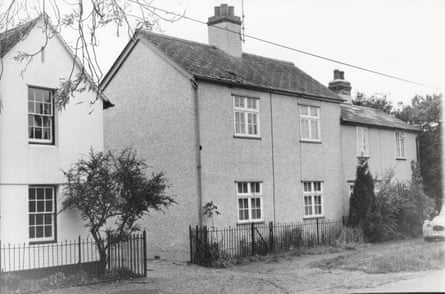
people were found dead at in Essex, England: 28known to her family as Daniel and Nicholas61June and Nevill Bamber. All five had been shot with a rifle. Caffell's 24-year-old brother, Jeremy Bamber, who was also adopted, had called to alert Essex police to a disturbance inside the farmhouse – he said his father had called to tell him – and had been outside with the police for hours before the bodies were discovered. Caffell, who had recently been hospitalised with schizoaffective disorder and is said to have feared her children were going to be taken into foster care, was found with the rifle lying on her chest, pointing towards her neck. There were two gunshot wounds to her neck and chin by her side.
The case was initially thought to be open and shut, a tragic murder-suicide committed by Caffell. But a month later after relatives went to the police to voice their suspicions about him; his former girlfriend Julie Mugford then told police he had made a confession to her. The relatives went on to inherit from Nevill and June Bamber's considerable estate after Bamber's convictions. It was later discovered that Mugford had agreed to sell the story of their relationship to the News of the World for £25,000 if Bamber was convicted. Essex police and crown prosecutors had also agreed to drop charges against her for prosecuting her could jeopardise her availability or credibility as a key witness" against Bamber.
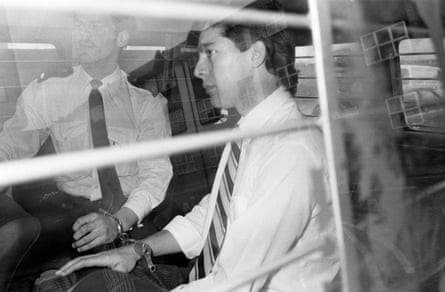
Bamber was found guilty of the murders and has now been in prison for 41 yearsbut questions have always been asked about the safety of his conviction. These have grown recently. The proper body to examine these is the Criminal Cases Review Commission (CCRC), but it has already taken the CCRC years to consider less than half the evidence that Bamber has submitted to them. In , it concluded that thedid not meet the high evidentiary threshold needed to refer the case back to the appeal.
In the third piece in our series considering discrete pieces of evidence, we analyse discrepancies in timelines recorded by Essex police that could prove Bamber's innocence.
"Imagine how stupid I'd have to be to put myself in the frame for murdering my family by telling the police I'd received a phone call when I hadn't," Jeremy Bamber says. "Like most people, I assumed the police would have been able to trace the call. If it turned out Dad hadn't called me, I'd have basically been handing myself in."
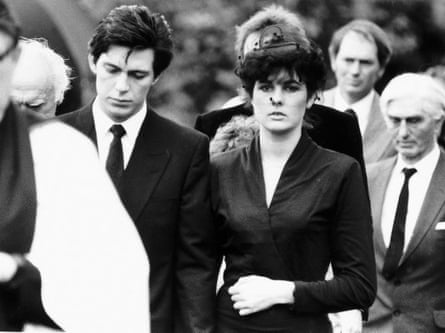
Bamber is writing to me from Wakefield prison. For the past 41 years, he has been locked up for the murder of five members of his family, while always protesting his innocence.
In his letter, he is referring to a phone call he made to Essex police from his cottage in the middle of the night on 7 August 1985. Bamber, now 65, told the police his father, Nevill, had just called him to say Bamber's sister, Sheila Caffell, had "gone crazy" at the family home, White House Farm, and got hold of one of Nevill's guns. Bamber said the line had then gone dead. His call to Essex police has never been disputed. What has been disputed is his claim that Nevill called him.
At Bamber's trial, the prosecution claimed he had made up the call to provide himself with a false alibi. They argued that he had killed the five members of his family at White House Farm between 12am and 3am, before cycling back to his cottage and calling the police himself.
This is a story about telephone calls, technology and timings. It is also a story about a single disputed digit in police logs, which could prove Bamber's innocence. A digit that, at the time of the trial in 1986, neither the jury nor Bamber's defence team could possibly have understood was so significant. It was only 25 years later, when 347,000 documents relating to the case were released, that its importance became clear.
The digit relates to the time Bamber called the police. At trial, there was confusion about whether it was 3.26am or 3.36am. The presiding judge, Sir Maurice Drake, told the jury to accept a timing of 3.26am. But a series of police logs and statements that were not disclosed at trial suggest Bamber made the call at 3.36am.
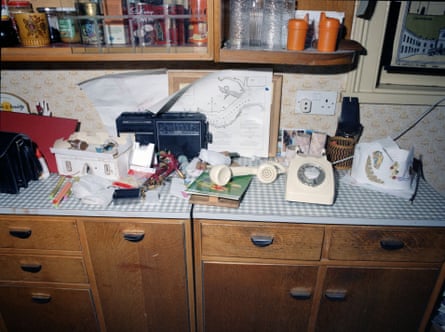
It appeared to be an obscure time-keeping argument in court, of little real significance. But it seems there is evidence that the jury was misled and that the differing times in fact refer to two different calls – the first made by Nevill and the second by Jeremy Bamber. And if Nevill did call the police to report his daughter had gone "berserk" with a gun, his son should not be in prison.
The trial
Chelmsford crown court, October 1986. PC Michael James West, who took Bamber's call at Chelmsford police station in the early hours of 7 August 1985, takes the stand to give evidence for the prosecution. He explains that he works in the control room, a radio and telephone hub for the Chelmsford division, where the unit's calls are received and officers are allocated their tasks. PC West says he filled out an event log, called a C1, as the conversation took place with Bamber, and that the practice is to log the time at the beginning of the conversation. Surprisingly, that C1 call log is not available to the jury. West tells Anthony Arlidge, the QC for the prosecution, that he recorded the time of 3.36am using the digital clock on the wall in the control room.
Arlidge doesn't mention the time again. It is only when Geoffrey Rivlin, counsel for the defence, cross-examines West that he is challenged about the purported inconsistencies in his record-keeping.
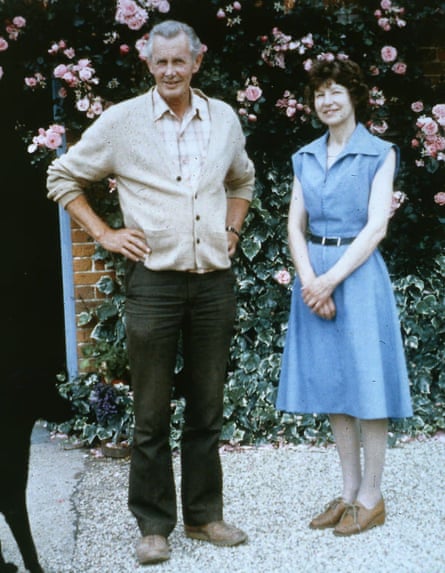
In his first statement, made two days after the murder, West said he received the call from Jeremy Bamber at 3.26am. In a more detailed statement a month later, the time had changed to 3.36am. Rivlin suggested in court that West had got the time wrong when he changed it and that the call was made, as he had said in his first statement, at 3.26am.
Rivlin: I would like to ask you about times first, if I may. The time you have recorded was 03.36.
West: That is correct.
Rivlin: Is it right that you may have misread the clock and the time may have been 03.26?
West: I was informed I actually spoke to the room at a time prior to the one that I have recorded so I can only assume that I have wrote – I actually recorded the wrong time, as it were.
But then West, it seems, becomes defensive. He is reluctant to say he made a mistake or that the clock was inaccurate.
Rivlin: The situation is, you looked at the clock and recorded 03.36. You were told subsequently that was almost certainly wrong and you said you may have misread the clock.
West: Well, there is a dispute over the times. I don't know whose time is right and whose time is wrong.
Rivlin: Let me ask you this question. As regards the clock in the station, is that accurate?
West:. Yes, it is.
Rivlin: Are you sure about that?
West: It has on occasion been inaccurate, but on very few occasions.
Rivlin: Would you agree with this, that the room wall clock rarely shows an accurate time?
West: I would have to disagree with that.
Rivlin: You disagree?
West: Yes.
Rivlin: At all events, perhaps we need take it no further than this, that you did subsequently agree you may have misread the clock?
West: It is possible, although certainly there is a variance in times, yes.
This exchange must have been baffling for the jury. West appeared unwilling to concede that he got the time wrong. Rivlin seemed to suggest the difference between 3.26am and 3.36am was highly significant, but never explained why. He was determined that 3.26am should be recognised as the correct time, but the jury was given no explanation for his insistence.
The reason Rivlin was adamant that the call was made at 3.26am is simply because he thought it looked better for the man he was defending. Bamber had said he received the call from his father at about 3.15am, then rang his girlfriend, Julie Mugford, before calling the police. What kind of man waits 20 minutes and speaks to his girlfriend before contacting the police in such an emergency? Ten minutes, Rivlin thought, would seem more acceptable to a jury.
But Bamber says that is looking at it with the benefit of hindsight: "The last thing I thought when Dad called me was that this was going to end up with my whole family killed." There had been previous incidents with Caffell, who had a diagnosis of schizoaffective disorder and had been hospitalised after a psychotic episode five months before the murders. But none had ended in disaster.
The evening before the killings, Bamber had been at White House Farm and had taken out his father's .22 rifle, to try to shoot rabbits. When he returned to the farmhouse, he had removed the magazine and the bullet in the breech of the rifle and left those items, and the gun itself, on a bench in the annexe of his parents' kitchen.
He didn't fear for the worst when he got the phone call from Nevill, he tells me, because he knew the gun was unloaded. "I assumed my dad, who was 6ft 4in and a strong man, would take the gun off Sheila and that she would calm down."
As for waiting 20 minutes before calling the police, Bamber has always claimed his father was cut off in the middle of their conversation and that he tried a number of times to call him back, but kept getting the engaged tone. He says he then called Mugford at 3.30am and asked her what she thought he should do. Mugford – who told police a month after the murders, just after Bamber ended their relationship, that he had confessed the killings to her – advised him to "go back to bed".
He ignored her and at 3.36am, he says, he called the police. "If I'd made up the call from Dad, why on earth would I have said I took 20 minutes to call the police? I would have said I called the police immediately." Bamber is telling me this in letters sent a few months ago, before the prison banned him from discussing his case with journalists.
But the 3.26am timing of the call appeared to be supported by a rolling log made by a civilian phone operator, Malcolm Bonnett. He was situated at Essex police HQ, a building roughly a mile away from Chelmsford police station, where West was stationed.
Bonnett's job was to log radio messages and send help from the police and other emergency services. Emergency 999 calls came in to Bonnett, but he also took phone calls from local police stations and officers such as West.
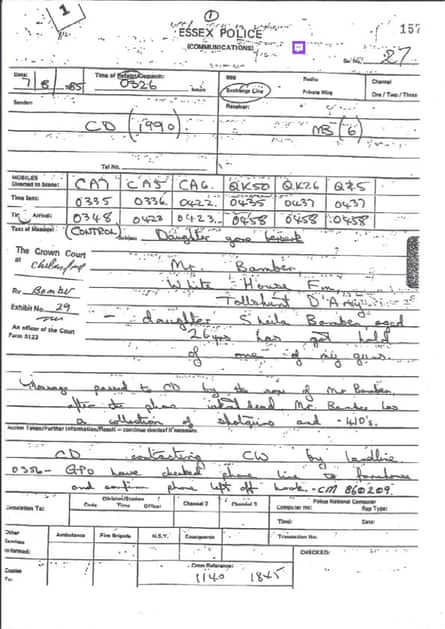
The Bonnett log shown to the jury at the trial – exhibit 29. It was presented to the court as his record of a call West made to him about the phone call he had received from a Mr Bamber. The jury was told that the Mr Bamber in question was Jeremy. Bonnett's rolling log starts with an entry at 3.26am. The subject line for this call is "Daughter gone berserk". This is the only document the jury were shown in regard to the time of the call. It was never explained why West's C1 log of the phone call was not included in the bundle given to the jury. They had no idea why West had logged the time as 3.36am or why the confusion in court when it was suggested he had got it wrong.
Something didn't add up. At the trial, it was unclear whether West or Bonnett actually sent out the police cars. Both appear to claim to have done so. West said he radioed the officers asking them to attend the scene, but Bonnett also said that after receiving the call from West about the incident he sent the first police car, CA7, to White House Farm at 03.35am, followed by another car, CA5, at 03.36am. These timings only made sense if West had taken the call from Bamber at 3.26am.
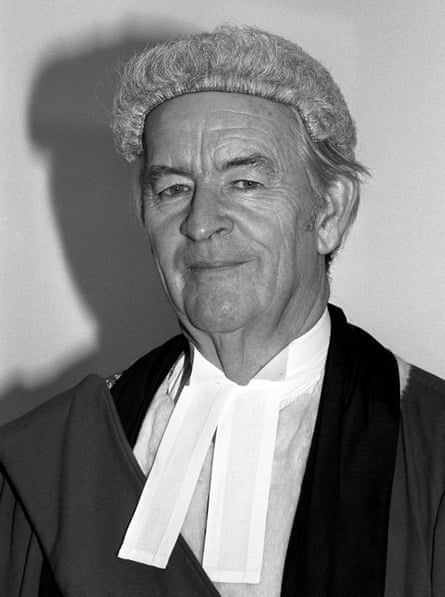
After West and Bonnett's evidence, the time of Bamber's call played no part in the trial until the summing up, in which Drake stated that the clocks in the information room were later checked and found to be correct. He advised the jury to accept the true time of Bamber's call as 3.26am. "You would, in effect, be giving the defence case the benefit of a doubt, and I will suggest that you may – although it is always a matter for you – work on the timing of 03.26 as the time when the phone call was made to Chelmsford police station, and accept that Police Constable West quite simply made a mistake when reading the clock, or writing down 03.36."
In fact, though, insisting that the call was made at 3.26am gave Bamber anything but the benefit of the doubt. Instead, it put him in the time frame for the murder, because the chronology now made sense: Bamber called West at 3.26am, and West called local officers, who set off for White House Farm at 3.35am.
After a month-long trial, the jury came back with a 10-2 majority on 28 October 1986. Bamber was convicted of one of the most notorious crimes in British history and sentenced to life with a recommended minimum of 25 years. This was later extended to a whole-life tariff by the then home secretary Douglas Hurd in 1988, although Bamber was not made aware of this until 1994.
Fast-forward 25 years. It's 2011 and Bamber now spends most of his life in prison searching for exculpatory evidence. There is also a campaign team working on his behalf to try to get his conviction overturned. He belatedly receives 347,000 pages of documents, initially withheld by Essex police, after public interest immunity laws are amended in favour of greater disclosure.
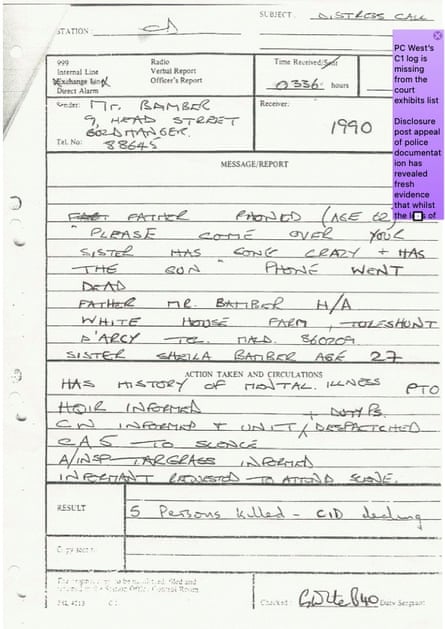
This is when Bamber's team becomes convinced it has found the smoking gun. Amid the myriad documents is the C1 form that West filled in as he was speaking to Bamber on 7 August 1985. Astonishingly, this log wasn't even included in the exhibit list, which includes every document that can potentially be shown to the jury. The time recorded on it is 3.36am, as he stated at trial. At the top, it clearly states who has made the call and from what address – Mr Bamber, 9 Head Street, Goldhanger. The subject is "Distress call".
When West's C1 log is compared with Bonnett's log, important differences, apart from the times of the call, become obvious. In West's C1 log of Bamber's call, it says: "Father phoned (aged 62). Please come over your sister has gone crazy and has the gun. Phone went dead. Sister Sheila Bamber age 27 has history of mental illness." This is clearly Bamber relating the call from his father – hence the reference to father and sister.
By contrast, the opening of Bonnett's rolling log, which begins at 3.26am, is told from a wholly different perspective. For a start, it refers to Caffell as "daughter" rather than "sister". The subject of the log is "Daughter gone berserk" and it says "Daughter Sheila Bamber aged 26 yrs has got hold of one of my guns". The guns at White House Farm belonged to Nevill. In West's C1 log it refers to gun. Both logs get Caffell's age wrong. Bonnett's says she is 26, West's 27. In fact, she had celebrated her 28th birthday a couple of weeks earlier. In West's log, Bamber has mistakenly added an extra year to his father's age. In Bonnett's log, no age is given.
Then there is the different way in which the caller's name and address is logged. The convention in police logs is to start with the informant's name and address, because it immediately establishes who is providing the information, and it means they are traceable if contact is lost. Bonnett's log of West's call refers to "Mr Bamber, White House Farm, Tollshunt D'Arcy". West's log refers to "Mr Bamber, 9 Head Street, Goldhanger". Next to the address for White House Farm is the phone number. Bonnett's rolling log doesn't have a number for the farm till 03.56am, when the police confirm that the phone is off the hook.
In addition, Bonnett's 3.26am log makes no mention of Caffell's history of mental health problems, a crucial fact that any officers dispatched to the scene should have been informed of. The differences in perspective and facts between Bonnett's log and West's log would surely been spelled out by Rivlin for the defence if both had been available.
There is a line space in Bonnett's log after the initial paragraph, and then it states: "Message passed on to CD [Control Chelmsford, the code used to refer to the central radio control room where West was stationed] by the son of Mr Bamber after the phone went dead". The line space suggests it could be a new entry.
When Bamber's team came across West's C1 form, they were convinced that this explained the confusion between 3.26am and 3.36am and why the first police car had been dispatched before Bamber's call: there had been two distinct calls. They believed that the first section of Bonnett's log referred to a call from Bamber's father, Nevill, and that this was the information the police appeared to have responded to. This would finally explain how a car had been sent to White House Farm before West said he took Bamber's call. And, crucially, it would prove Bamber's innocence.
"At the trial, I had no idea why they were making such a fuss about whether I'd made my call at 03.26am or 03.36am," Bamber writes. "It was only when we finally saw the log from West 25 years after I was first jailed that it became obvious there must have been two calls. The language is different, the perspective's different, the information provided is different. It can only be two different people reporting the same incident as they see it."
In 2016, a documents expert, Dr Chris Davies, studied the new evidence and concluded that the most likely reason for the inconsistencies was that there were two phone calls. "I consider that this would be my preferred explanation for them," he said. If Nevill called the police at 3.26am to say his daughter had "gone berserk" and had the gun, it puts Bamber in the clear.
If there was an earlier call from Nevill Bamber, there are various theories about who may have taken it, including Malcolm Bonnett (who died in 2023) and officers who were in the control room with PC West (there were at least two others).
Bamber's team felt that the 3.26am and 3.36am logs finally enabled them to make sense of a mystery from the original investigation: why had the police devoted so much energy to trying to prove that Bamber could have cycled from White House Farm back home to Goldhanger in 10 minutes, before finally concluding that it was impossible? This early police theory appears to have allowed for two calls – one from White House Farm at 3.26am and the other from Goldhanger at 3.36am, both made by Bamber.
Fifteen years on from the disclosure of West's C1 log, Bamber's team are still scouring the 347,000 documents that were released to them. In 2020, they came across "pocket book no.49", belonging to DC Stephen Myall, one of the three officers originally radioed, alongside PS Bews and PC Saxby, asking them to attend the incident at 3.30am, six minutes before West stated on his C1 log that he received the call from Bamber. At the time, they were on an undercover foot patrol of an industrial estate after a spate of burglaries.
In his pocketbook, Myall wrote that he, Bews and Saxby immediately returned to Witham police station when, at "03.37am approx", they received a phone call from West about the incident at White House Farm. "The Officer (PC West) at CD Control was on the phone and told us that he was relating information to us and still had the informant (Jeremy Bamber) on the other telephone." Myall wrote that Bamber had told West that his father had said "words to the effect of 'Come quick, your sister's gone berserk. She's got a gun'. The telephone had then gone dead."
Bamber's team believes it is now clear that Bews, Saxby and Myall were contacted by radio at 03.30am, as a result of a call from Nevill at 03.26am. The police officers were not at Witham police station at that point, but immediately returned from the nearby industrial estate to collect the police car, which they hadn't taken with them on the undercover job. West then contacted Witham police station, by telephone, at 3.37am, having spoken to Bamber for a minute, from 03.36am.
The CCRC, the body that investigates alleged miscarriages of justice, has examined Bamber's convictions three times. In 2002, it sent the case back to the court of appeal, but the judges concluded: "The more we examined the detail of the case, the more likely we thought it to be that the jury were right."
In 2011, the CCRC refused to refer the case, stating that the evidence did not raise a real possibility that the court would find Bamber's convictions unsafe. In 2021, his legal team made a new submission, consisting of 10 points. The CCRC has been widely criticised in recent years for its tardiness and its poor referral rate. In 2024/25, only 2% of cases – 31 out of 1,541 applications – were referred back to the court of appeal. (This rate has improved considerably since Dame Vera Baird became interim chair in June 2025.) By July 2025, the CCRC had examined four of the 10 points in Bamber's submission and declared that, on the basis of these four points, it would not be referring the case back, although it would continue to explore the remaining six points.
One of the four points that was dismissed was the discrepancy between 3.26am and 3.36am being recorded as the time of Bamber's call to the police. The CCRC remains adamant that the different timings are a result of police error and that there was only one call, from Bamber, at 3.26am. This is despite the C1 log from West stating it was at 3.36am and despite Myall's record stating that West had Bamber on the phone at 3.37am.
The CCRC also claims that the issue of the call timings "had been dealt with at trial". This is plain wrong. At trial, and at his 2002 appeal, Bamber's team had no idea that there were two logs suggesting two calls to police about the same incident.
Since the 2021 submission to the CCRC, more valuable evidence has been uncovered. After the trial, Drake ordered the Dickinson review, an internal inquiry by Essex police into what the Times called the "blunders, omissions and ineptitude" of the force's early investigation into the murders. The review would examine, for example, why the crime scene was grossly contaminated; the destruction and mismanagement of vital evidence; and the timeline and call-log inconsistencies.
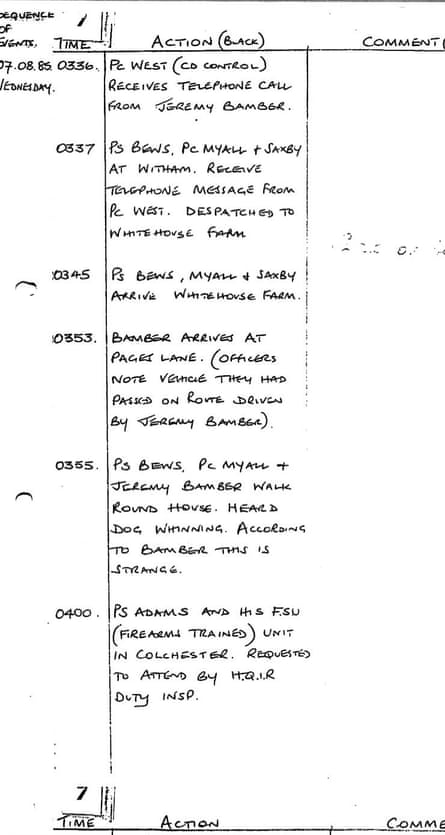
The findings of the inquiry have never been made fully public. However, some documents from the review were released to Bamber's lawyers in 2011 after a legal challenge. His defence team only recently discovered that the Dickinson review supports the 3.36am timing of Bamber's call in its timeline of events on the day. It states that Bamber called West at 3.36am and, at 3.37am, "PS Bews, PC Myall & Saxby [were] at Witham. Receive telephone message from PC West. Despatched to White House Farm." All these references are consistent with the first call to the police having been made by Nevill at 3.26am, officers being asked to attend White House Farm, then West taking a second call from Bamber at 3.36am.
Today, West works for the Masons. I contact him to suggest that his original log, which stated that Bamber called the police at 3.36am, was in fact accurate and consistent with the statements provided by other officers. He tells me he cannot recall the details, 41 years on, without seeing the specific documents and suggests that we meet face to face.
After this conversation, West does not respond to my calls. I text him with an explanation of why I believe his initial record of 3.36am was correct and suggest that a separate call may have been made at 3.26am. But he is having none of it: "Simon, I have nothing to add to anything that has been said and absolutely no comment on any of your rather ridiculous postulations. Jeremy Bamber was found guilty and remains a convicted felon. No one seems to ask: 'What if that was the correct decision?'"
Meanwhile, Bamber's team continue to try to piece together the missing pieces of the jigsaw. A few months ago, they re-examined PC West's trial transcript and came across an astonishing exchange between him and defence council Geoffrey Rivlin.
Rivlin: You made it clear to him [Bamber] that police officers would be sent to the house.
West: Police officers had already been sent when I spoke to him, yes.
Here, PC West states that police officers had already been sent when he was speaking to Bamber. But if the police only received one call alerting them to the incident and the time of it was 3.26am, as the CCRC and Essex Police now insist, that would mean the first car had left before then. Yet the earliest mention of a radio call to officers is 03.30am and officers leaving is 03.35am. On the other hand if we stick with the 03.36am timing on West's log, it only makes sense if there had been an earlier call because of the radio call to local officers at 03.30am and the leaving time of 03.35am.
This was the closest the jury ever came to hearing that the police appeared to have received two different calls about the incident. Unfortunately, neither the defence nor the jury picked up on West's answer that officers had already been sent to White House Farm when he spoke to Jeremy Bamber.
When asked to comment about the failure to disclose evidence and inconsistencies in officers' logs, a spokesperson for Essex Police said: "In August 1985, the lives of five people, including two children, were needlessly, tragically and callously cut short when they were murdered in their own home by Jeremy Bamber. In the years that followed, this case has been the subject of several appeals and reviews by the court of appeal and the Criminal Cases Review Commission – all of these processes have never found anything other than Bamber is the person responsible for killing his adoptive parents Nevill and June, sister Sheila Caffell and her two sons Nicholas and Daniel."
A CCRC spokesperson said: "Mr Bamber has made three applications to the CCRC. The first application led to a referral to the Court of Appeal in 2001. His conviction was subsequently upheld. The second application to the CCRC in 2004 did not result in a referral. A third application received in 2021 is currently under review. A provisional decision on part of this latest application was issued to his legal representatives, and they responded to us in January this year. Work now continues to consider additional matters which were raised in Mr Bamber's application. It would be inappropriate for us to discuss the case or make any further comment while the application is being reviewed."
Those convinced of Bamber's guilt maintain that Nevill Bamber's calls to his son and the police never happened. Which takes us back to the first statements Bamber made when he was arrested. At the end of an aggressive 11-hour interrogation by Essex Police on 10 September 1985, Bamber is getting frustrated with all the questioning about the phone call he claims to have received from his father. He suggests there is one easy way of settling the issue. Get hold of British Telecom's records. Bamber is apparently convinced this will provide him with an alibi and prove that he is telling the truth. If his father never called him, this is a kamikaze defence. All Essex Police need do is check BT's records, and if there isn't a call from White House Farm, he has implicated himself.
Bamber: Telecom must be able to tell you the times of phone calls on my parents' phone.
Officer: What d'you mean by that?
Bamber: It would be proof that I received a phone call from my father.
Officer: If I tell you that Telecom can't give such details then your theory can't be checked.
Bamber: I thought Telecom could.
But it couldn't. Or at least that's what he was told. Despite an extensive advertising campaign in Essex stating that phone records were being digitised at the time, Essex Police said that calls in the area could not yet be itemised and bills still relied on an anonymised meter system. Years later, documents emerged showing that Telecom did indeed have itemised bills of earlier calls made from Bamber's home phone number, though these were long-distance calls.
One aspect of the Bamber case that must have shocked the judge was how much evidence was destroyed on the day of the murders. At the time, the police believed it to be an open-and-shut murder-suicide. But that can never excuse the destruction of bloodied mattresses and bed linen.
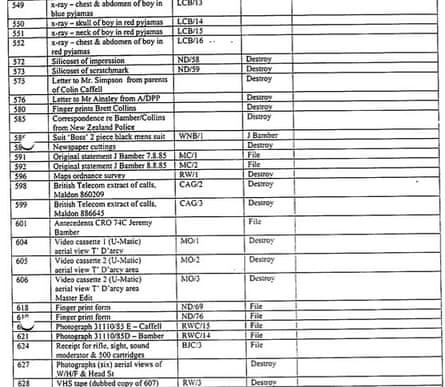
However, in 1996, 11 years after the murders, an even more shocking obliteration of evidence took place. Although it was known that Bamber was preparing an appeal for the Home Office (which was subsequently inherited by the newly formed CCRC, in 1997), Essex police unilaterally destroyed vital evidence. Among the list of exhibits that were destroyed are bullets, blood samples and swabs, all of which may have provided exculpatory evidence for Bamber as DNA testing became ever more sophisticated. It was particularly alarming that Essex Police destroyed Sheila Caffell's heavily bloodstained night dress, which may have shown her to have been in contact with the other victims, who were also very bloodied.
As so often in Bamber's case, the document listing the evidentiary material and whether it was to be filed or destroyed is incomplete. Here it starts at number 167 and finishes at 661. At numbers 598 and 599, it says "British Telecom extract of calls", citing the telephone numbers for Bamber's home and White House Farm. By the side of both entries, it says "Destroy".