For a couple of journalists who spend such an inordinate amount of time sloshing around the putrid inner recesses of Donald Trump's mind, they come across as remarkably chipper.
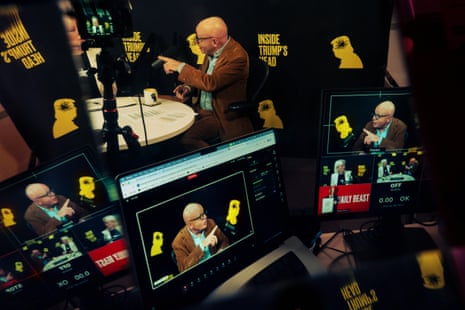
Michael Wolff, chronicler of the 45th and 47th president, and Joanna Coles, chief creative and content officer of the Daily Beast, are just about to record the 168th episode of their runaway podcast, Inside Trump's Head. Now in its 15th month, the thrice-weekly show is attracting an expanding audience as it digs down into Trump's unique blend of megalomania, narcissism and insatiable lust for fame.
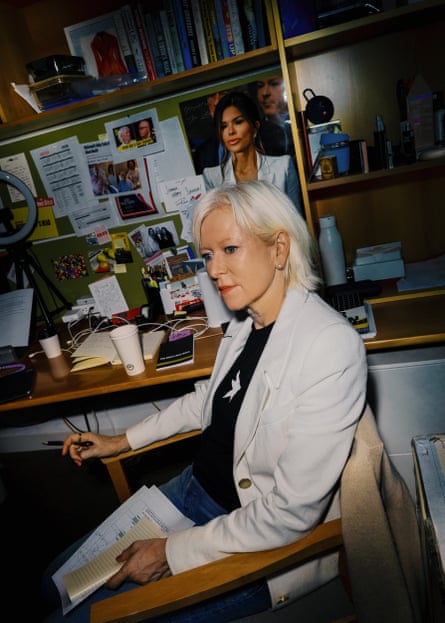
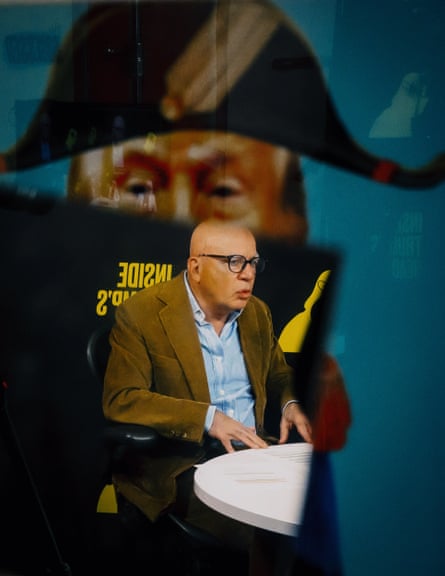
We are sitting in Coles's office on the fifth floor of the IAC building, the shiplike Frank Gehry structure in Manhattan where the Daily Beast is headquartered. Coles, dressed sharply as you would expect from a former mentor on Project Runway in snakeskin shoes, jeans and white jacket, is having her trademark shock of white hair groomed for camera.
Wolff, who has styled himself more in the mould of a country gentleman in sumptuous brown corduroy suit (of which more later), seizes on the hair arranging to unleash his own trademark: the Wolff monologue.
"I don't have any hair," he laments. "I used to. You should see the author photo of my first book – I looked like a 70s porn star, heavy moustache and heavy hair. All gone now …"
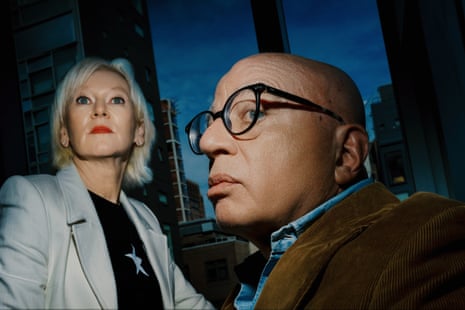
The pair are fond of ending each other's sentences. And they bicker a lot, like those long-married couples in When Harry Met Sally. "Do be quiet!" Coles snaps at him in a mock schoolma'am's voice. "She really was a kind of pest," he snipes back, recalling the early days of their friendship.
Underneath the crotchety patina, though, it's clear they adore each other.
In the fickle world of Trump-focused media, the Daily Beast's podcast seems to be enjoying an enduring appeal. Since its launch in August 2025, its audience in audio form has tripled to 1.5m downloads a month, while it now exceeds 5m monthly full-episode views on YouTube. The lion's share of its supporters are in the US, but it also has a healthy following in Canada, the UK and Australia.
Part cod psychology, part celebrity gossip, part Shakespearean tragedy, the podcast leads us to places that more traditional Trump reporting rarely goes. The title is indicative. As Coles puts it, "we go deep into the dark matter inside Trump's head".
The 168th episode, whose recording I attend, takes in Trump's belligerent UN general assembly speech happening that day and his later fawning reception of China's President Xi Jinping. But it is fair to say that fans of the podcast don't come to it for geopolitical analysis.
An average episode will delve into such matters as: the defenestration of senior women in his administration, including the short-lived press secretary Katie Zacharia and ambassador to Greece, Kimberly Guilfoyle; Trump's weight (they call him the "all-you-can-eat president"); Melania's mysterious disappearing act (Wolff and the first lady have form, having locked horns in a long-running legal dispute); and the outsized role of executive assistant Natalie Harp, whom Wolff flagged as an issue well before the White House correspondents' pack.
They have also tackled the portentous question: does the president wear diapers? "There was no odor that surrounded him," Wolff revealed in one show, drawing on his olfactory reporting skills from when he trailed after Trump during the 2024 presidential campaign.
There is no mincing of words in the pod, no on-the-one-hand-this-on-the-other-hand-that. Coles brings the sharpness of her Fleet Street training to bear in analysing Trump, as well as her skills as a forensic interviewer well-versed in the seamier side of celebrity lifestyles. Wolff can inject the observations of a book and magazine writer and the knowledge he gained from the extraordinary access given to him at the start of the era, when he was invited to spend weeks inside the first Trump White House.
His language on the podcast is spicy. Wolff has variously described Trump on air as "that fat fucker" and a "fucking asshole", while Coles likes to highlight what she is convinced is the president's declining mental faculties.
Trump's top team returns fire with equal gusto. Steven Cheung, the White House communications director, has on umpteen occasions slammed Wolff as "a lying sack of shit" and a "fraud", while Coles is a "retard" and a "blithering idiot".
Faced with such blowback, the duo are unapologetic about their choice of subjects or words, dismissing Cheung's attacks as "performative". "We talk how people talk, about their friends, about their bosses," Coles says. "We are not trying to put a glass wall between us and politicians, we're trying to understand them as people."
Trump has often claimed that he has made a fortune for the "fake news" media, and such bragging would appear fair comment when it comes to Inside Trump's Head. Coles estimates that a third of the Daily Beast's content and traffic is entirely dependent on him.
As for Wolff, Trump has been a veritable cash cow. According to Forbes, Wolff made $13m just in the first year of Fire and Fury. Will he say exactly how much he has profited from all four books?
He hesitates, then says, "No."
Coles, true to form, finishes his sentence. "Well, you have made a lot of money," she says. "There's your 18th-century mansion in Amagansett."

"It's 19th-century," he retorts. "And it's a farmhouse."
"What about your hand-sewn Savile Row suit, it's Anderson & Sheppard isn't it?" she presses, referring to that sumptuous brown corduroy affair he is sporting.
Wolff silently concurs. A bespoke Anderson & Sheppard suit, as worn by King Charles and Daniel Craig, can easily set you back $9,000.
The podcast's unashamed technique of examining Trump in the round, with all his personal flaws and foibles, is not without its critics. The New York Times columnist Frank Bruni last month wrote an opinion piece that berated media outlets that focus on Trump's appearance rather than on the damage he is doing to the world. Though he didn't mention the podcast, Bruni did mention "cankles", a Daily Beast favourite.
When I raise the Bruni argument – that what matters is Trump's anti-democratic actions not his inner psychology – it sparks off another Wolff monologue.
"Trump is the most unique politician anyone has come across," he says. "He's so unique no political reporter can cover him. That's our conceit: to probe what the traditional media is not covering. They cover Trump as they would an ordinary politician, and his politics as an ordinary function of cause and effect. But Trump is completely outside of the familiar ecosystem of the presidency."
He's only half done. "You can analyse Trump's policies all you like, but what he is doing has nothing to do with policy. It has everything to do with himself, with his self-aggrandizement. To understand him, you have to look at his character, how this guy thinks, what are his fundamental motivations."
The seeds of Inside Trump's Head can be traced back to the start of Wolff's decade-long engagement with its subject. The two men had some contact in the early 2000s when Wolff was writing a media column for New York magazine, but it was not until May 2016 that he and Trump went head-to-head.
In the course of an interview during Trump's first White House bid, Wolff asked him why he was running for president. Trump replied: "To be the most famous man in the world."
Wolff recalls: "I thought at that moment, my God! This is going to be a trip."
Ever since that exchange Wolff has been on an epic voyage of discovery to get to the bottom of Trump's bottomless desire for fame. "It's not just a character flaw that he craves all this attention. It has become Trump's strategy. 'How do I stay the most famous person in the world?' That is literally the question he asks himself when he wakes up every day."
Trump's attention-seeking is one of the central themes of the four books that Wolff has written about him – starting with the bestseller Fire and Fury that took readers into the chaos of Trump 1.0, and most recently last year's All or Nothing that marked his return to office. It is also what inspired Coles to create Inside Trump's Head as part of her plan to reinvigorate the Daily Beast after Barry Diller, the billionaire chairof IAC, invited her and Ben Sherwood to take over its helm in 2024.
Coles and Wolff have been friends for 25 years, after she left her West Yorkshire roots and relocated as a Guardian reporter from London to New York. It was Wolff who gave her a leg up into American media, helping her leave the Times of London to which she had defected and secure an editing job at New York magazine.
(This seems a reasonable moment to make a full personal disclosure. I have been friends with Coles since we worked together in the Guardian newsroom in London in the 1990s. I have also known Wolff since I myself moved to New York for the Guardian in 2006, and I have on occasion written about him. The last time I did so I reported on the Trump-related interviews he conducted with Jeffrey Epstein, during which Wolff gave the convicted sex offender PR advice on how to handle the scandal spiraling around him. Wolff emailed me having read the piece. "Jesus, Ed, you're a nitwit," he said.)
The Coles-Wolff friendship hasn't always been easy. They've had intermittent feuds along the way, in which they have avoided speaking to each other for a couple of years, though neither can remember why. "I feud with a lot of people," Wolff concedes.
I wonder what price the two of them are paying for what they are doing. There are many journalists who have covered Trump for the past 10 years, myself included, who know only too well the toll it takes on one's mental health, repeatedly grappling with his lies and darkness. But few have devoted themselves to the task as round-the-clock as they have. In one podcast, Wolff admits: "There are very few conversations I ever have that are not about Donald Trump."
What's the collateral damage of all that wallowing in Trump gunk?
"Good question," Wolff says. "I would fall back on that, as a writer, to get this story, to get this character, is once in a lifetime. You have the opportunity to have a voice in history. You don't walk away from this so readily."
"I'm British, so I don't even think about my mental health," Coles quips in that schoolma'am's voice. She carries on: "We are at a pivotal moment for the global world order. Growing up in Europe, in the shadow of the second world war, you had tremendous confidence in America as an ally. All that is changing because of one man. I would feel depressed if I weren't trying to understand this as much as I can."
With the midterm elections fast approaching, the tone and focus of the podcast is inevitably shifting towards Lame Duck Trump. Aren't they worried that we are nearing the end of this extraordinary epoch, of the "government of one" as they like to frame it, and the journalistic riches it brings?
Coles puts on a brave face. "We are interested in people and power. Whatever comes next will be interesting, because Trump has blown off the doors and allowed us to see inside the mechanics of power, and you can't put the doors back on."
The last question I direct to Wolff. Having sacrificed (at great personal gain) 10 years of his life to Trump, can he see the US, the world, ever recovering from this trauma? Will we ever be post-Trump?
"We're going to get to the other side of this, yes," he says, beginning his final monologue. "I absolutely believe that the unique Donald Trump will not come again. When he leaves, everyone is going to sigh with relief, even the Republicans."
He's not done yet.
"It's a fascinating thing. Nobody, except his fanbase, likes this guy. I mean, Trump is a fat fuck, even to those closest to him."