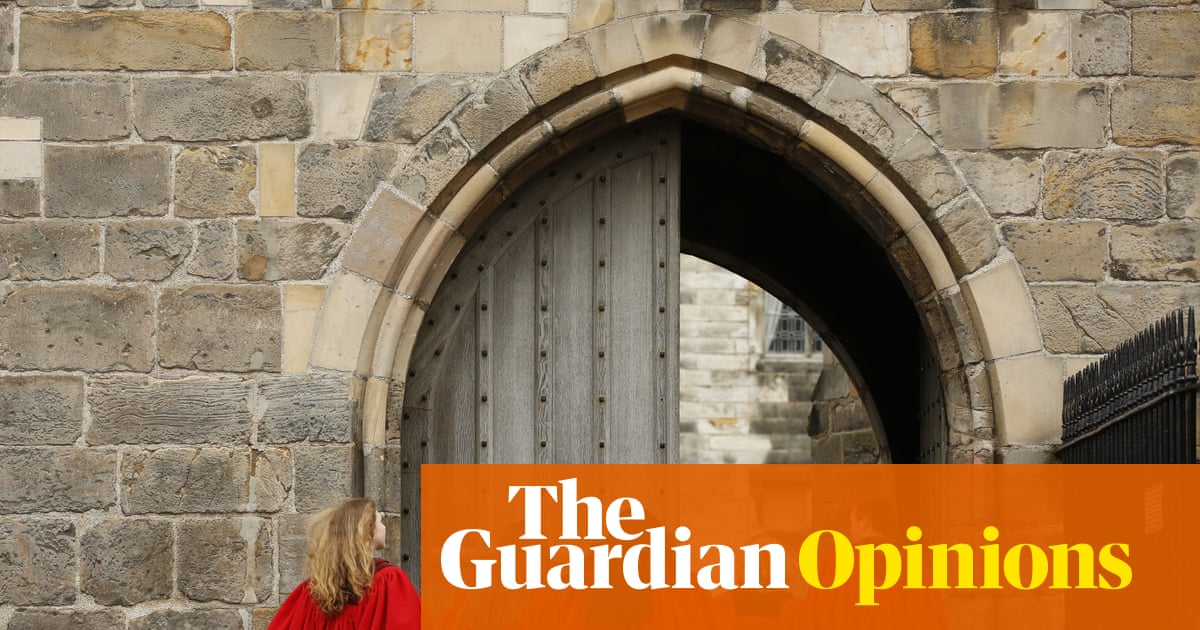
"So, where did you go to school?" On the face of it, it doesn't seem like a loaded question. I was mostly bemused when I first started university 20 years ago and found myself being asked it repeatedly by other students. Why were they so interested? Surely no one would have heard of the north Wales comprehensive I had attended? When they countered my baffled reaction with "Charterhouse" or "Marlborough", how was I supposed to respond? When one student said, of another, "He went to Winchester, you know", I stared blankly at him, not understanding why he was telling me about someone else's day trip to a city in Hampshire ("Oh, did he have a nice time?"). It was strange, new territory.
Asking someone where they went to school is often not an innocent question. It is a way of "placing" you on a social scale. As thousands of freshers settle in to their first terms at university, a significant proportion will be battling with this dawning awareness that Britain runs on a network of private schools whose alumni often seem to know, or know of, one another. State-school students might have been dimly aware of it before, but nothing puts it into sharper focus than freshers' week. It's clear that little has changed since my own student days. I was saddened to read recent reports of classism at St Andrews, which led to a student's announcement that she would not return this academic year: "Working-class students have been made to feel ashamed of their home life at university," she said. The pervasiveness of private school culture, as I suppose you could call it, remains nationwide and deeply embedded.
It's a shock, as a young person, to go from being the majority – state-educated – to suddenly feeling like the minority, and in some stark cases being made to feel "less than" as a result. It's why I admire Sophie Pender's 93% Club so much. Pender set up the initiative while she was at Bristol University, where she was mocked for her working-class background, to bring renewed focus to the fact that the vast majority of people educated in the UK – 93% in fact – attended state school, and to offer them a professional career mentoring and networking alternative to the "old boys" that is a de facto benefit of private school attendance.
Pender's new campaign, Made in State School, aims to shift attitudes by issuing red plaques to celebrate some of the nation's finest state school alumni – from David Attenborough and Jacqueline Wilson to Jessica Ennis-Hill and Marcus Rashford. She even presented a plaque to Andy Burnham at the Labour party conference last week. She is right when she says that state schools have a PR problem. They are often framed, in rightwing media especially, as dystopian, rough, a hardship that has to be overcome, as opposed to what they actually are: symbols of British excellence, innovation and creativity.
So often the media conversation takes the default assumption that private schools are inherently better than state schools, and that it is always in a child's best interests to attend one. When you hold opinions like mine – that in rejecting the local state school, you are choosing a form of segregation – they can sometimes feel uncomfortable to express. My industries, media and publishing, are dominated by people who went to private school (half of newspaper columnists are privately educated). Education is a sensitive topic, and this can sometimes have a silencing effect.
So allow me to lay my cards on the table. Sending your child to private school encourages them to believe that they are better than other children. We have seen where this leads, in the behaviour of some of our leading politicians. The cultures of abuse that have been able to thrive at boarding schools that prioritised reputation and prestige over safety have left many victims in their wake.
We should be lauding the benefits of state schools. Being more socially mixed, they teach children openness and confidence. Being able to interact with people from a huge range of backgrounds is a vital life skill. State school kids are often hilarious – there is a unique sense of humour that comes from inclusion; from having seen it all. In the case of mixed-gender schools, they give you a far more developmentally appropriate understanding of the opposite sex. Perhaps due to a combination of socially repressed poshness or a lack of exposure to girls, the ex-public schoolboys at my university often seemed genuinely terrified of the working-class young women they were now expected to study alongside.
I wouldn't go as far to say that it's impossible to be cool and to have gone to private school, but let's be honest, it's harder. University was the first place I went where privilege was a status symbol, and it was discombobulating to be treated with derision by someone who wouldn't have lasted two minutes in the roasting competition that was your morning registration. Well, you might say, "cool" shouldn't matter – but as the Made in State School plaques demonstrate, cool people often go on to do radical, groundbreaking, culture-defining things.
I won't rehash some of the toxic attitudes I experienced that first term, mostly from public schoolboys, but the scales fell from my eyes. Someone with less confidence and weaker politics might have put on a voice and tried to fit in. Which is why I want to say to any university fresher who feels that way now to hold their head high. These people's parents chose to purchase educational advantage for their offspring – which was their prerogative – but that doesn't make them better than you. You've still ended up in the same place, without the astronomical costs of private school tuition fees and largely off your own back! Being made in state school is something to be proud of. Become comfortable owning it, and using it to lift others up. We're the 93%, after all.